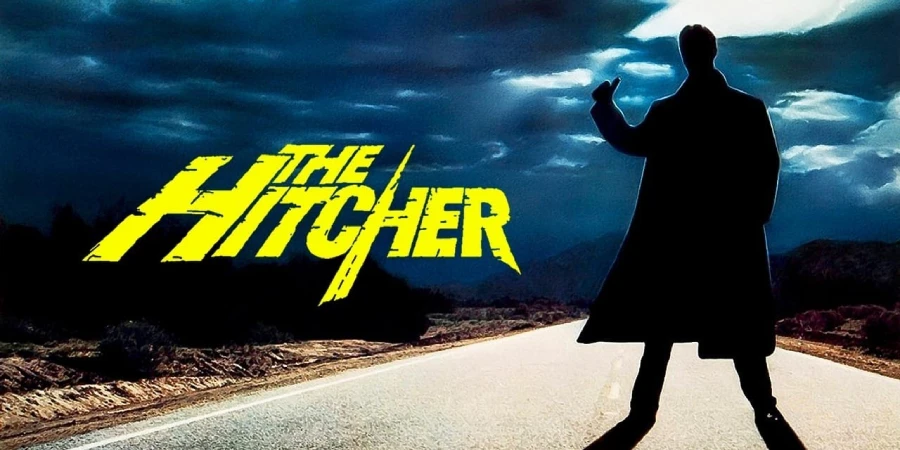

Rutger Hauer’s cold, almost playful grin is enough to keep you awake at night. The Hitcher drops a young man into an inescapable nightmare somewhere on the open American highway, where the threat is not just physical but deeply psychological. Director Robert Harmon crafted something lean and relentless, a film that refuses to let its audience breathe. It remains one of the most unsettling road movies ever committed to celluloid.
Detailed Summary
Jim Halsey Picks Up a Stranger
College student Jim Halsey is driving a car cross-country through Texas on a dark, rainy night. He makes the fateful decision to pick up a hitchhiker standing alone on the road. That hitchhiker is John Ryder, played with terrifying calm by Rutger Hauer.
Almost immediately, something feels deeply wrong. Ryder is polite but unsettling, watching Jim with an eerie, almost clinical curiosity. He soon tells Jim, quietly and without theatrics, that he killed the previous driver of the car Jim spotted broken down on the road.
The First Escape
Ryder produces a knife and presses it against Jim’s face. Jim manages to kick Ryder out of the moving car, sending the hitchhiker tumbling onto the highway. However, this escape only marks the beginning of Jim’s ordeal, not the end.
Jim pulls into a gas station, shaken and desperate. He spots Ryder has somehow already arrived, sitting inside a family’s car. Jim watches in horror as Ryder drives off with the unsuspecting family.
The Family on the Road
Jim chases the family’s car across the desert. He finds it crashed and abandoned. Inside, he discovers the family has been brutally murdered, confirming exactly what Ryder promised he would do.
Jim, consequently, becomes the prime suspect in the killings. Local law enforcement begins pursuing him as the body count climbs. Ryder operates invisibly, always one step ahead, always framing Jim.
Nash Enters the Story
Jim encounters Nash, a young waitress played by Jennifer Jason Leigh, at a roadside diner. She is skeptical of him at first, but she eventually believes his story. Nash becomes Jim’s only real human connection in the film.
Their bond develops quickly out of shared desperation rather than romance. Meanwhile, Ryder continues his campaign, killing police officers and planting evidence to destroy Jim’s credibility. Every ally Jim tries to find ends up dead or disbelieving.
Jim Gets Arrested
Police finally catch Jim and take him into custody. Captain Esteridge, played by Jeffrey DeMunn, interrogates him. Jim insists Ryder is responsible for everything, but without proof, his story sounds like the raving of a guilty man.
Ryder attacks the police station, killing officers and freeing Jim in the chaos. This is a crucial turning point: Ryder does not want Jim dead. He wants Jim to keep running, to keep suffering.
The Truck Pursuit
One of the film’s most visceral sequences involves Jim and Ryder exchanging fire during a pursuit involving a massive semi-truck. Harmon stages these chase sequences with remarkable tension, using the flat Texas landscape to emphasize how exposed and vulnerable Jim is.
Ryder demonstrates again and again that he is untouchable. He survives situations that should kill him, which gives him an almost supernatural quality. In contrast, every ordinary person Jim interacts with pays a fatal price.
Nash Is Captured
Ryder captures Nash and uses her as leverage against Jim. Police catch both Jim and Nash, arresting them at gunpoint. Ryder, however, manages to capture Nash from police custody in a sequence that makes the authorities look completely powerless.
Ryder ties Nash between a truck and a trailer. He hands Jim a gun, essentially daring Jim to shoot him before Ryder releases the truck’s brake. Jim hesitates, unable to act in time.
Nash Dies
Ryder releases the brake. Nash is brutally killed as the truck and trailer pull apart. This scene remains one of cinema’s most shocking off-screen deaths, its horror amplified precisely because Harmon does not show the act itself directly.
Jim collapses emotionally. Nash’s death strips away his last reason to hold back. From this moment forward, Jim’s goal shifts from survival to confrontation.
Movie Ending
Jim finally takes direct action against Ryder, pursuing him instead of running. Police surround Ryder, but Jim wants to be the one to end it. He grabs a shotgun and faces Ryder directly on the open road.
Ryder, notably, seems almost satisfied at this moment. Throughout the film, audiences have wondered what Ryder actually wants, and the ending clarifies it with chilling logic. He wanted Jim to stop being a passive victim and become a killer, to cross a line he could never uncross.
Jim shoots Ryder dead with the shotgun. Ryder dies standing, and Jim watches him fall. There is no celebration, no relief, and no catharsis in the traditional sense.
Jim stands alone in the empty landscape, the gun in his hands, having become exactly what Ryder seemed to want him to become. The film ends on Jim’s hollow, exhausted face. Harmon refuses to offer any emotional resolution, which is precisely what makes the ending so deeply disturbing.
Many viewers ask whether Ryder was real or a psychological manifestation. The film presents him as entirely real, a physical person who commits physical acts witnessed by others. However, his near-supernatural ability to appear everywhere, his lack of any discernible motive, and his strange fixation on Jim all give the film a nightmarish, almost allegorical texture.
Are There Post-Credits Scenes?
The Hitcher contains no post-credits scenes whatsoever. Once Ryder falls and the film cuts to black, it is over. You can leave your seat immediately, though you may find yourself staring at the screen for a moment regardless, processing what you just watched.
Type of Movie
The Hitcher is a psychological thriller with strong elements of survival horror. It operates primarily as a road movie stripped of any romance or adventure, replaced entirely with dread. The tone is relentless, bleak, and deeply atmospheric.
Some critics have also read the film through a slasher lens, though Ryder behaves less like a traditional slasher villain and more like an unstoppable force of chaos. In addition, the film carries existential undertones that elevate it beyond simple genre entertainment.
Cast
- Rutger Hauer – John Ryder
- C. Thomas Howell – Jim Halsey
- Jennifer Jason Leigh – Nash
- Jeffrey DeMunn – Captain Esteridge
Film Music and Composer
Mark Isham composed the score for The Hitcher. His work here is sparse, atmospheric, and deeply unsettling, leaning on synthesizer textures that feel cold and desolate. Isham understood that the vast, empty landscape needed music that mirrored its silence rather than fighting it.
The score never overplays the horror. Instead, Isham lets tension build through minimalism, which suits the film’s restrained directorial approach perfectly. His background in jazz and ambient music clearly shaped his choices here.
Filming Locations
Production filmed primarily in New Mexico rather than Texas, though the story is set in Texas. New Mexico offered the crew wide, flat desert highways, sparse vegetation, and dramatic skies that perfectly served the story’s sense of isolation.
The landscape itself functions almost as a character. Harmon used the enormous empty spaces to visually reinforce how completely alone and exposed Jim is at every moment. There is nowhere to hide on those roads, and the locations make that brutally clear.
Awards and Nominations
The Hitcher did not receive major awards recognition upon its release. It found its audience gradually through home video and cable television rather than theatrical acclaim.
Behind the Scenes Insights
- Rutger Hauer reportedly found ways to keep his performance unpredictable on set, occasionally improvising small details to keep C. Thomas Howell genuinely unsettled during filming.
- Director Robert Harmon was making his feature film debut with this project, having previously worked in commercials and music videos.
- Jennifer Jason Leigh has spoken about the emotional weight of filming Nash’s death sequence, describing it as one of the more psychologically demanding scenes of her early career.
- Producer David Bombyk and writer Eric Red developed the screenplay with a conscious intention to subvert the typical hitchhiker horror premise by making the hitchhiker the aggressor from the very first scene.
- Harmon deliberately avoided giving Ryder a backstory, feeling that any explanation would diminish the character’s power.
Inspirations and References
Screenwriter Eric Red has cited the Doors song “Riders on the Storm” as a key inspiration for the film. The lyric about a killer on the road, hitchhiking and destroying lives, directly seeded the concept. Red built an entire cinematic nightmare from that single image.
The film also draws from a broader American tradition of highway paranoia. Works like Duel (1971), Steven Spielberg’s television film about a driver stalked by a truck, share obvious thematic DNA with The Hitcher.
Furthermore, the existential quality of Ryder as a figure who seems to exist only to force Jim into transformation echoes certain literary traditions around the doppelganger and the dark mirror. Red likely drew on this archetypal framework, even if not consciously.
Alternate Endings and Deleted Scenes
No widely documented alternate endings or significant deleted scenes from The Hitcher have entered the public record. The film as released appears to reflect Harmon’s intended vision closely. No major cut sequences have surfaced through home video releases or special editions.
Book Adaptations and Differences
The Hitcher is not based on a book. Eric Red wrote the screenplay as an original work. A novelization may have followed the film’s release, as was common practice in that era, but the screenplay itself was the source material.
Memorable Scenes and Quotes
Key Scenes
- Ryder calmly telling Jim he killed the previous driver, delivered almost as casual conversation, establishing the film’s tone of quiet menace immediately.
- Jim watching Ryder get into the family’s car at the gas station, helpless to stop what he knows is about to happen.
- Ryder attacking the police station, demonstrating that no institution or authority figure can contain or stop him.
- Nash tied between the truck and trailer, with Jim holding the gun and Ryder staring at him, the film’s most emotionally devastating sequence.
- Jim shooting Ryder on the open road, the hollow, joyless finality of the film’s climax.
Iconic Quotes
- “My name is John Ryder. What’s yours?” (delivered with a calm that makes it feel like a threat)
- “You’re a smart kid. That’s what I like about you.” (Ryder to Jim, one of several moments where his strange admiration for Jim surfaces)
- “I want you to stop me.” (Ryder’s clearest statement of his actual intention toward Jim)
Easter Eggs and Hidden Details
- Ryder’s fingers appear in a order of french fries that Jim is eating at a diner, a moment of grotesque dark humor that signals no space Jim occupies is safe.
- The film’s color palette shifts subtly as Jim’s psychological state deteriorates, with warmer daytime tones giving way to harsher, bleached-out light in the later sequences.
- Ryder consistently appears before Jim expects him, often from directions that seem geometrically impossible given the road geography, a detail Harmon leaves unexplained to reinforce the character’s almost mythic quality.
- Jim’s car at the start of the film is notably ordinary and nondescript, a visual cue that this is an everyman story that could happen to anyone on any American highway.
Trivia
- Eric Red wrote the screenplay in a very short period of time, reportedly in just a few weeks.
- Rutger Hauer was already known internationally for his work in Blade Runner (1982) and Nighthawks (1981) before taking this role.
- A remake of The Hitcher was released in 2007, starring Sean Bean as John Ryder and Sophia Bush and Zachary Knighton as the young leads.
- C. Thomas Howell was coming off his success in The Outsiders (1983) and Red Dawn (1984) when he took the role of Jim Halsey.
- The film performed modestly at the theatrical box office but built a devoted cult following through home video distribution in the late 1980s.
- Harmon’s background in visually driven commercial work is evident throughout the film’s precise, painterly framing of the desert landscape.
Why Watch?
The Hitcher delivers a masterclass in sustained dread, built not on gore but on the unbearable tension between predator and prey. Rutger Hauer gives one of genre cinema’s finest performances, calm and magnetic and deeply frightening. For fans of psychological thrillers and road cinema alike, this film holds up as a genuinely essential piece of American horror from the 1980s.
Director’s Other Movies
- Eyes of an Angel (1991)
- Nowhere to Run (1993)
- This World, Then the Fireworks (1997)
Recommended Films for Fans
- Duel (1971)
- No Country for Old Men (2007)
- Joy Ride (2001)
- Breakdown (1997)
- Highwaymen (2004)
- Kalifornia (1993)