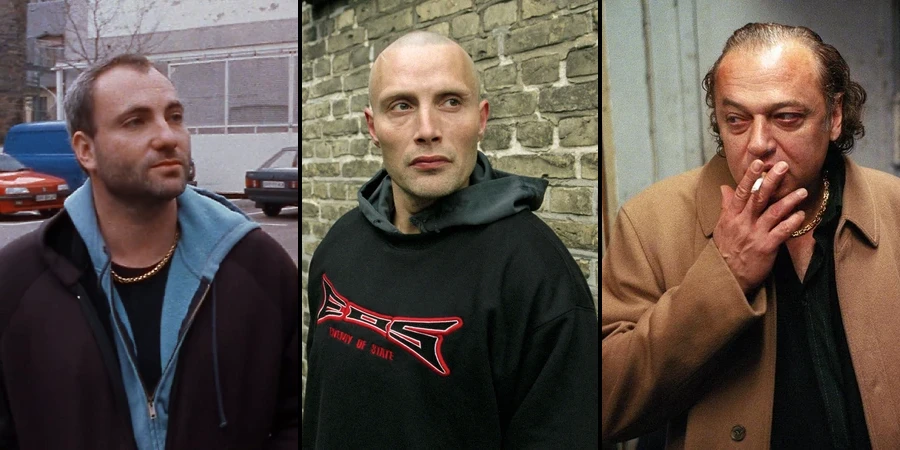
Ask crime-film fans to name the most realistic gangster movie, and a Danish answer keeps coming up. It isn’t The Godfather or Goodfellas, the usual top picks on lists of must-watch mafia movies. Instead, it’s a low-budget trilogy shot on the streets of Copenhagen: Nicolas Winding Refn’s Pusher (1996), Pusher II: With Blood on My Hands (2004) and Pusher 3: I’m the Angel of Death (2005).
The claim isn’t just forum talk, either. Taste of Cinema ranks the first film among its ten most realistic gangster movies, alongside A Prophet, crediting its handheld, documentary-style portrait of the drug business.
So is the claim right? To find out, we went back to the production record. That includes a 20th-anniversary oral history the cast and crew gave Danish magazine Soundvenue, plus what Refn himself has said in interviews.
The short answer: the fans have a strong case, but only for one kind of realism. Pusher may be the most convincing portrait of what daily life in the drug trade feels like. However, it is not a map of how organized crime works. This article explains the difference. Spoilers for all three films follow; our full plot recaps are linked above.
Table of Contents
What Makes a Gangster Movie “Realistic”?
“Realistic” can mean several different things, and few films score high on all of them. To keep the comparison fair, we use four tests:
- Method: Was the film made in a way that lets reality in, through real locations, non-professional performers and research inside the milieu?
- Economics: Does it treat crime as a job, with debts, suppliers and deals that go wrong?
- Glamour: Does it refuse to turn criminals into icons?
- Scope: Does it show the wider system around the street, such as police, politics and the legal economy?
Pusher passes the first three tests with ease. The fourth is where the argument gets complicated.
How Pusher Was Made: Realism From the Street Up
Research in Vesterbro
Refn was in his mid-twenties when he made Pusher. He had become the first student ever to quit Denmark’s national film school after being admitted. His stated aim was to make the film as realistic as it could possibly be: the more authentic the people and the substances on screen, the better.
To get there, he and co-writer Jens Dahl went looking for the people the story was about. In the mid-1990s, Copenhagen’s underworld centered on Vesterbro, around Vesterbrogade and Istedgade, a district of strip clubs, porn shops and early-morning bars. Refn later said the milieu was easy to reach, and that people there were eager to talk, often about desperation and pain.
Rules That Let the Street In
Producer Henrik Danstrup set rules that cut costs and shaped the film’s look. According to him, everything was shot within about 500 meters of the production base in Vesterbro, using available light, in locations that already looked right.
The film was shot entirely with handheld cameras because Refn wanted a documentary feel, and it was filmed almost completely in chronological order. Refn says shooting in sequence keeps him alert to whatever happens around the set. The budget was modest, at roughly DKK 6 million to about 7 million, depending on the source.
This toolkit has a long lineage. Location shooting and non-professional performers were hallmarks of Italian Neorealism decades earlier. Refn also notes that his father was editing Lars von Trier’s Breaking the Waves while Pusher was in the edit. Both films relied on handheld, naturalistic technique, a combination Refn says von Trier drew on when he formalized Dogme.
Non-Actors and Real Reactions
Casting followed the same logic. Mads Mikkelsen, then an acting student in Aarhus, recalls that Refn was mainly looking for people who were not actors. Many minor roles went to Refn’s friends or to people accustomed to street life. Kim Bodnia joined as Frank only after Refn fired the original lead two weeks before shooting for being too polished.
Bodnia’s arrival changed the temperature on set. Zlatko Burić, who played Milo, says he first met Bodnia on set at five in the morning. He adds that skipping small talk between takes kept a sense of danger in their scenes.
Sometimes reality simply walked into frame. Mikkelsen says that when he and Bodnia sat in a car during the shoot, many people missed the camera and came over to buy or sell drugs. That only worked once, he adds. By the next film, people wanted autographs instead.
Milo’s Refrigerator
The most revealing detail involves Milo. Before Pusher, Burić worked in experimental theater in Zagreb, where heroin arrived in the late 1970s. He partly based Milo on a trip to Belgrade with a friend who needed to buy opium. The sellers welcomed them warmly and casually, more like a village visit than a Hollywood deal. Burić told Refn, who rewrote scenes to match.
That is why the terrifying Milo greets Frank with Balkan pastries and asks him to help move a refrigerator.
When Realism Crossed a Line
Not every method would pass today. Laura Drasbæk, who played Vic, says she took drugs before and during filming. People from the milieu hung around the set and brought them, and nobody checked on her afterward. She also says Refn told Bodnia to slap her for real in the final scene to provoke a reaction. Looking back, she argues good work can be made without such tactics.
Mikkelsen took a different route. He says the drug-taking happened after his scenes were done, and that he prefers to study the real world and then simply act. It’s a useful reminder that commitment and method acting excess are not the same thing.
What the Trilogy Gets Right About Criminal Life
Crime Is a Job, and Mostly a Bad One
Frank’s week is less a crime spree than a list of errands. After police interrupt a heroin deal, the drugs are destroyed while he escapes, and Milo then demands even more than Frank already owed.
What follows is grinding work. Frank squeezes customers who can’t pay, pawns his belongings and asks his estranged mother for money. As AV Club critic Scott Tobias observed, Frank can do everything right and still owe. That focus on cash flow rather than conquest is the trilogy’s most realistic idea.
The Gangster Myth Is a Costume
Frank’s apartment is decorated with stills from Scarface and Taxi Driver, while Tonny has RESPECT tattooed on the back of his head. Both men are acting out a fantasy the films never endorse.
Even the marketing turned the genre’s promise upside down. Where Scarface sold the idea that the world is yours, Pusher’s tagline read: “You don’t have a chance. Seize it!”
Power Doesn’t Last
Pusher 3 follows Milo through a single day. He slips in and out of Narcotics Anonymous meetings and cooks for 50 guests at his daughter’s 25th birthday. He also receives a box of ecstasy he has no idea how to price. Meanwhile, a younger generation of immigrant gangsters is taking over his market.
It’s an unusually unheroic picture of a crime boss. There is no last stand, only a man falling behind a business he no longer understands.
Nobody Wins
Refn says his own view shifted while making the films. He started out fascinated by crime as a kind of anti-society, then found that nothing he had thought romantic actually was. In his account, the trilogy moves from fascination to something destructive and nihilistic.
Pusher II makes the point most painfully. It is the series’ best-reviewed entry, with a 100% Rotten Tomatoes score. The film follows Tonny as he craves approval from his cynical gangster father while facing fatherhood himself.
Where Pusher Bends Reality
The Ticking Clock Is a Thriller Device
Each film squeezes a lifetime of bad luck into days. Pusher covers one week, and Pusher 3 covers a single day. Real criminal lives rarely unravel on such a tidy schedule.
The structure also has a cinematic ancestor. Refn says the idea grew from the helicopter-paranoia sequence in Goodfellas, because people under pressure always make good drama. Pusher, in other words, began as a riff on Goodfellas, not on a police file.
The Violence Is Meant to Repel
Pusher 3’s dismemberment scene is often cited as proof of the trilogy’s brutal honesty. Refn frames it as a statement instead. Fed up with how the media glamorize crime, he told Reverse Shot he wanted a scene “so dehumanizing to emphasize that this is what this world is about.”
That is a moral argument as much as a report. Ironically, he also recalls a festival audience in Montreal applauding the gore.
The Sequels Were Built Like Television
Refn never planned a trilogy. His English-language thriller Fear X flopped, leaving him with a personal debt of DKK 5.5 million. The documentary Gambler (2006) follows his struggle to clear it by making Pusher II and Pusher III.
Refn says he conceived the sequels like a TV series, inspired by The Sopranos. Passing the lead to a minor character from the previous film is smart storytelling. Still, it’s a writer’s design, not documentary observation.
The Director Isn’t Interested in Crime
The biggest caveat comes from Refn himself. He told Time Out: “I don’t have any interest in crime or drugs whatsoever.”
Mikkelsen sees Refn as drawn to classic, almost Shakespearean stories of dying kings and successors, rather than to the criminal milieu itself. In other words, the realism serves the tragedy, not the other way around.
Not Everyone Bought It in 1996
At home, the film’s realism was disputed from the start. Refn remembers a critic at the Danish paper Det Fri Aktuelt calling it very unrealistic.
The film’s route abroad was rocky too. Festivals turned it down, and it found international buyers only after a British distributor spotted it at the Berlin film market. Our piece on how film festivals launch independent voices shows how unusual that path is.
Once foreign critics saw it, the surprise ran the other way. The New York Times opened its review of the trilogy by pointing to Copenhagen’s mean streets, adding that “they evidently exist.”
Pusher vs. Goodfellas, Gomorrah and The Wire
The claim only means something in comparison. Here is how the trilogy measures up against the titles it is most often compared with.
| Built on | Cast | Scope | |
|---|---|---|---|
| Pusher trilogy (1996–2005) | Original story, researched in Copenhagen’s underworld | Professionals mixed with first-timers and people from street life | One person’s crisis at a time |
| Goodfellas (1990) | Nicholas Pileggi’s nonfiction book Wiseguy | Hollywood stars | A crew inside a New York crime family |
| Gomorrah (2008) | Roberto Saviano’s investigative book | A few professionals plus local non-actors | Several parallel lives inside the Camorra’s economy |
Goodfellas: Accurate Procedure, Seductive Rise
Martin Scorsese’s film is based on Wiseguy, Pileggi’s nonfiction book about Henry Hill. When Hill died in 2012, the AP noted that most people considered it far more realistic than Coppola’s mob films. Yet the same coverage observed that book and film dwelled on the gangster as rock star, at least until the life caught up with him.
Real insiders tend to grade Scorsese well. Former Colombo capo Michael Franzese, for example, gave Casino a 7 out of 10 for realism in an Insider video. Pusher, by contrast, skips the thrilling rise entirely. In effect, it lives inside Goodfellas’ frantic final act and never leaves.
Gomorrah: The Strongest Rival
If any film beats Pusher on method, it is Gomorrah. Director Matteo Garrone shot almost entirely in and around Naples, pairing a handful of professionals with Neapolitans hired on the spot.
Reality soon caught up with the cast. Several cast members were later arrested, and Italian outlet Fanpage counts ten so far. Italian media have dubbed it “the curse of Gomorrah.”
Gomorrah also has wider scope. It follows how the Camorra reaches into ordinary trades, from tailoring to waste management.
The Wire: The Big Picture Pusher Avoids
AV Club described the trilogy as the inverse of The Wire, because it deliberately avoids the big picture to stay with individual choices. If realism means showing how police, politics and the drug trade feed each other, HBO’s series goes much further.
The Verdict
Measured against our four tests, the picture is clear:
- Method: Among the strongest of any gangster film, matched mainly by Gomorrah.
- Economics: Arguably the best. Crime here means debt, logistics and bad luck.
- Glamour: Close to zero, by design.
- Scope: Narrow, by choice.
So the fans have a point. Few films capture the texture of small-time crime as convincingly: the errands, the boredom, the debts and the fear.
Calling Pusher the most realistic gangster film ever made overstates it, though. The trilogy is fiction built on real material, with a thriller’s clock and a director’s moral argument. For the system behind the street, Gomorrah and The Wire go further.
The best way to watch Pusher, then, is as the most honest account of what it feels like to be trapped inside the trade. If you enjoy this kind of reality check, our breakdown of how historically accurate Downfall is applies the same test to a very different film.
Refn later traded street grit for style. Drive (2011), his best-known film, is a neo-noir cult hit. To see where that turn fits, read our guide to the global influence of neo-noir cinema.



Frequently Asked Questions
Is Pusher based on a true story?
Nothing suggests it is. It’s credited as an original story by Refn, co-written with Jens Dahl. However, it grew out of research among people in Copenhagen’s underworld, and Milo’s casual hospitality comes from Burić’s own experience.
Were real criminals cast in Pusher?
Many minor roles went to Refn’s friends or people used to street life. People from the drug milieu also spent time on set. Some fan sites go further and name specific cast members with later convictions. We could not verify those claims against court or press records, so treat them with caution.
Do you need to watch the Pusher films in order?
Not strictly. Each film centers on a different lead: Frank, then Tonny, then Milo. Still, watching in release order gives the recurring faces more weight. Milo, for example, appears in all three films.
Which Pusher film is best?
Critics lean toward the sequels. The three films score 83%, 100% and 93% on Rotten Tomatoes. Refn has called the third his personal favorite. Actor Charlie Hunnam has called Pusher III a masterpiece.
Where was Pusher filmed?
In Copenhagen, mostly around Vesterbro. Producer Henrik Danstrup says the team shot within about 500 meters of its base.
Who directed Pusher, and what did he make next?
Nicolas Winding Refn directed it and later made Bronson, Drive and Only God Forgives. Pusher was also Mads Mikkelsen’s film debut.