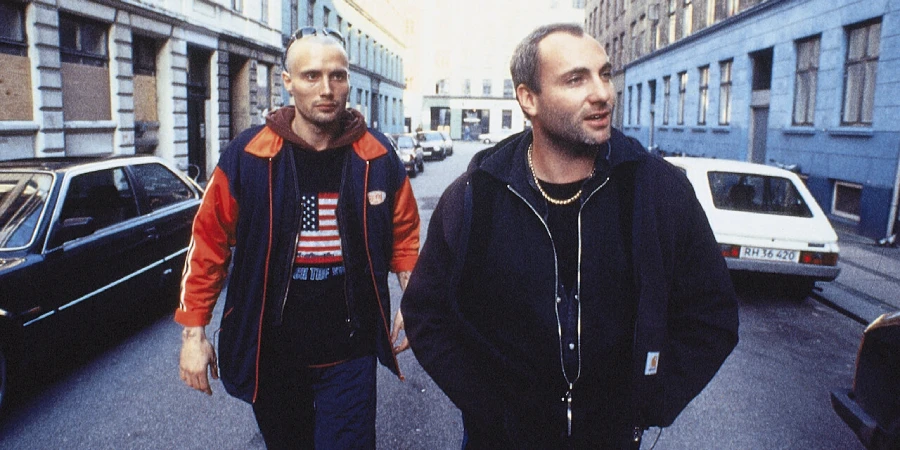
Most crime movies promise you a big score. Pusher hands you a debt instead, then watches you drown in it for one long week. Nicolas Winding Refn’s 1996 debut follows a Copenhagen heroin dealer whose single bad deal turns every ally into a threat. It feels raw, sweaty, and alarmingly real, and it still bites today.
Table of Contents
Detailed Summary
Frank and Tonny Work the Streets
Frank (Kim Bodnia) sells heroin on the lower rungs of Copenhagen’s drug trade. He spends his days with Tonny (Mads Mikkelsen), a motor-mouthed partner with zero filter. Their opening deal only moves part of the product, so the two drift around town wasting time.
Refn builds these early scenes around boredom and banter. Nothing here looks glamorous. This is a job, and a cheap one.
Vic Keeps the Stash
Frank drops in on Vic (Laura Drasbæk), a prostitute who stores some of his supply in exchange for a fee. She clearly wants more than a business arrangement. Frank, however, keeps things casual.
That emotional distance looks minor at first. By the final scene, it costs him everything.
Hasse’s Big Swedish Deal
An old cellmate, a Swede named Hasse (Peter Andersson), turns up, and the two plan a large heroin sale. Frank smells a payday.
To fill the order, he visits his supplier, the Serbian kingpin Milo (Zlatko Burić). Frank already owes Milo money and can’t pay for the new batch, yet Milo fronts him the drugs on one condition: bring the cash back right away.
Police Crash the Deal
Cops show up mid-deal. Frank runs, and during the escape he tumbles into Sankt Jørgen’s Lake, ruining the heroin. His future sinks right along with it.
At the station, detectives convince Frank that Tonny confessed and implicated him, but Frank admits nothing. Police release him after a full day.
Milo Raises the Stakes
Frank goes straight to Milo and explains the disaster. Milo doesn’t believe a word and demands even more than the original debt.
Furious, Frank tracks down Tonny and beats him brutally with a baseball bat. He acts on the police story alone.
Debt Collection With Radovan
Milo sends his enforcer Radovan (Slavko Labović) along as Frank chases his own debtors. Surprisingly, the two get along. Radovan even confides that he secretly dreams of opening a restaurant.
One stop turns grim. An addicted customer gets pressured to rob a bank to cover what he owes, and he kills himself right in front of them.
Vic Wants Something Real
Meanwhile, Frank’s money schemes keep collapsing. Vic pushes harder for them to act like a couple. He takes her clubbing and plans to drive her to the vet to see her sick dog.
It’s the closest Frank gets to tenderness. Even so, his mind never leaves the debt.
The Baking Soda Betrayal
Frank finally lines up a sale. His drug mule, Rita (Lisbeth Rasmussen), double-crosses him and replaces the heroin with baking soda.
After that, Radovan’s friendliness evaporates. He starts warning Frank about serious injury if the money doesn’t appear soon.
Rampage, Robbery, and Torture
Panic takes over. Frank robs a gym run by drug-dealing bodybuilders, grabbing their cash and drugs. Soon after, Radovan picks him up and tortures him.
Frank escapes and starts planning to run away to Spain with Vic. For the first time, he has an exit.
Movie Ending
Frank pulls off one final deal in Copenhagen. Then Milo calls and promises to accept a token payment to end the feud. He sounds calm, even generous.
It’s a trap. Milo and his men actually plan to kill Frank when he arrives.
Frank chooses Milo’s offer over escape. He bluntly tells Vic the Spain plan is off, so she steals his money and runs. In a single beat, he loses his cash, his partner, and his way out.
Refn closes on a man with nothing left. Frank’s enemies spread across the city, preparing to get rid of him. We never see what happens next.
Does Frank Die at the End of Pusher?
Refn leaves it open. Interestingly, dialogue in Pusher II suggests that Milo, at least, never caught up with Frank. Frank himself never returns in the sequels.
Why Does Vic Steal the Money?
Vic spends the whole film asking for loyalty and getting scraps. When Frank tosses their escape plan aside without discussion, she finally protects herself.
Her theft mirrors Frank’s own behavior all week. He uses people, so someone finally uses him.
Did Tonny Really Snitch?
The film only gives us the police version. Frank believes it instantly, and that paranoia sums him up perfectly.
Tonny’s story continues elsewhere. Pusher II follows him after his release from prison.
What the Ending Really Means
Frank burns every bridge he has. He beats his partner, neglects his girlfriend, and trusts the man who wants him dead.
Ultimately, nobody remains to save him. The Danish tagline, Du har ikke en chance. Grib den. (“You don’t have a chance. Take it.”), says it best.
Are There Post-Credits Scenes?
No. Pusher has no post-credits scene, so you can leave once the credits start rolling.
Type of Movie
Pusher is a Danish crime thriller. Many regard it as the first Danish-language gangster film. The tone is bleak, tense, and claustrophobic. Refn shot everything handheld to get a realistic, documentary feel. Some fans go further and call it the most realistic gangster film ever made. We put that claim to the test. Still, dark humor sneaks in. Tonny’s crude chatter and Milo’s grandfatherly menace keep things unpredictable.
Cast
- Kim Bodnia – Frank
- Zlatko Burić – Milo
- Laura Drasbæk – Vic
- Slavko Labović – Radovan
- Mads Mikkelsen – Tonny
- Vanja Bajičić – Branko
- Peter Andersson – Hasse
- Lisbeth Rasmussen – Rita
- Levino Jensen – Mike
- Thomas Bo Larsen – Junkie
- Lars Bom – Police Officer
- Nicolas Winding Refn – Brian
- Gordon Kennedy – Scorpion
- Jesper Lohmann – Mikkel
Film Music and Composer
Danish punk rocker Peter Peter and composer Povl Kristian wrote the score. They formed a temporary band called Prisoner to play it, with Peter on guitar and Kristian on keyboard.
Their sound is restless and grimy. It never comforts you, which suits Frank’s spiral.
Kristian also wrote “Summer’s Got the Colour,” with lyrics by Lars K. Andersen and vocals by Aud Wilken. Other tracks on the soundtrack include “Knucklehead,” “Jeg skal dø ved Arresø,” and “Into the Sun.”
Notably, the “Pusher Theme” became the franchise’s signature. Kristian skipped the sequels, yet the theme returned in every later film.
Filming Locations
Refn shot the film in Copenhagen, on real streets, in real clubs and apartments. Those grubby interiors make the drug trade feel ordinary instead of cinematic.
The city’s lakes play a key role, too. Frank’s fall into Sankt Jørgen’s Lake destroys the heroin and sets the whole story in motion.
Location shooting came with a price. Expensive permits, along with Danish union rules limiting shoots to eight hours a day with no weekends, squeezed both time and budget.
Awards and Nominations
Zlatko Burić won a Bodil Award in 1997 for his turn as Milo. That prize came in the Best Supporting Actor category.
Behind the Scenes Insights
- Refn originally cast Anders Nyborg as Frank but found him too placid. He fired Nyborg two weeks before shooting, with no replacement lined up.
- Kim Bodnia, already an established actor, accepted the role.
- Bodnia played Frank with far more aggression than the cast expected. According to Refn, some of the startled reactions on screen are genuine, because those actors hadn’t rehearsed with him.
- Experienced actors filled most major roles, while Refn’s friends and people familiar with street life took many minor parts.
- The crew kept lighting very low. As a result, actors often appear backlit or hard to see.
- Refn shot the film almost entirely in chronological order, since shooting out of sequence confused him.
- Burić, a Croat, plays a Serbian drug lord. When violence between Serbs and Croats flared during the shoot, Refn worried, but the set stayed calm.
Inspirations and References
Pusher grew out of a five-minute short that Refn made as a film school application. He co-wrote the feature with film student Jens Dahl.
Refn wanted to show a man under pressure without glamorizing drug dealing. He has said the idea grew from the helicopter-paranoia sequence in Goodfellas. Other influences often cited include The Battle of Algiers, Cannibal Holocaust, The French Connection, The Killing of a Chinese Bookie, and Mean Streets.
That mix explains a lot. You get Scorsese’s street energy, Cassavetes’ messy intimacy, and a near-documentary rawness.
Alternate Endings and Deleted Scenes
Refn has not released any known alternate ending. Nonetheless, the film changed during production.
The junkie scene came after principal photography wrapped. It replaced a discarded scene that reflected an outdated version of Frank.
Refn also redid the scene where Frank fires at Milo’s thugs. The first take lacked effects, so he reshot it with squibs.
Book Adaptations and Differences
Pusher is not based on a book. Refn developed it from his own short film.
The story did travel, though. A Hindi remake arrived in 2010, followed by an English-language version in 2012. Luis Prieto directed the British remake, with Refn as executive producer.


Memorable Scenes and Quotes
Key Scenes
- The lake plunge: Frank flees the cops and lands in the water, destroying the heroin and his future in one splash.
- The baseball bat: Frank savagely beats Tonny, his only real friend, based purely on a police claim.
- Radovan’s confession: A feared enforcer quietly shares his restaurant dream, a rare soft moment.
- The junkie’s suicide: A debt collection ends in sudden, shocking death.
- The baking soda reveal: Frank’s comeback deal collapses because his own mule cheated him.
- Milo’s final call: A polite phone call hides a death sentence.
- Vic’s exit: She takes the money and leaves Frank stranded.
Iconic Quotes
- Du har ikke en chance. Grib den. (“You don’t have a chance. Take it.”) The film’s tagline doubles as Frank’s entire arc.
- Radovan’s restaurant dream (paraphrased): he admits he wants out of the business to run his own restaurant.
- Milo’s final offer (paraphrased): a small payment, he promises, and all is forgiven.
Easter Eggs and Hidden Details
- Refn makes a cameo as Brian, a young man who buys drugs from Frank and Tonny.
- Milo has a fondness for baking. That detail pays off in Pusher 3, where he cooks for his daughter’s birthday party.
- Refn mapped the story by days of the week in his notes, and that structure carried into the finished film. Watch the countdown tighten.
- Tonny’s beating sets up his later story. Similarly, Milo’s calm menace foreshadows his own starring turn.
Pusher Trivia
- Pusher marked Refn’s directorial debut and Mads Mikkelsen’s first film.
- It opened in Denmark on 30 August 1996, runs 105 minutes, and features dialogue in Danish, Swedish, and Serbian.
- The budget came to roughly DKK 6 million.
- Refn never planned a franchise. Money troubles pushed him to make the two sequels.
- Refn claimed the film spawned devoted fan cults and even influenced Danish fashion.
- Kim Bodnia’s leading-man career in Danish cinema took off largely thanks to this role.
- On Rotten Tomatoes, 83% of critics’ reviews are positive. Metacritic gives it 72 out of 100.
Why Watch?
Pusher strips the gangster movie down to sweat, panic, and bad decisions. Kim Bodnia gives a ferocious lead performance. Moreover, you get to watch Mads Mikkelsen and Nicolas Winding Refn arrive fully formed. Few crime films feel this real.
Nicolas Winding Refn’s Other Movies
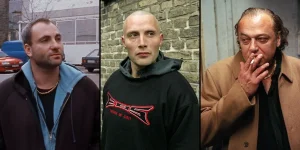
- Bleeder (1999)
- Fear X (2003)
- Pusher II (2004)
- Pusher III (2005)
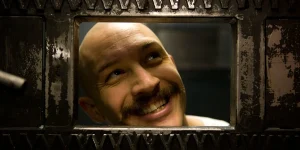
- Bronson (2008)
- Valhalla Rising (2009)
- Drive (2011)
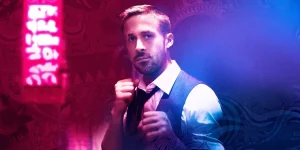
- Only God Forgives (2013)
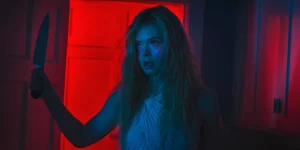
- The Neon Demon (2016)
- Her Private Hell (2026)
Recommended Films for Fans
- The French Connection (1971)
- Mean Streets (1973)
- The Killing of a Chinese Bookie (1976)
- La Haine (1995)
- Trainspotting (1996)
- Gomorrah (2008)
- Easy Money (2010)
- Good Time (2017)
- Uncut Gems (2019)