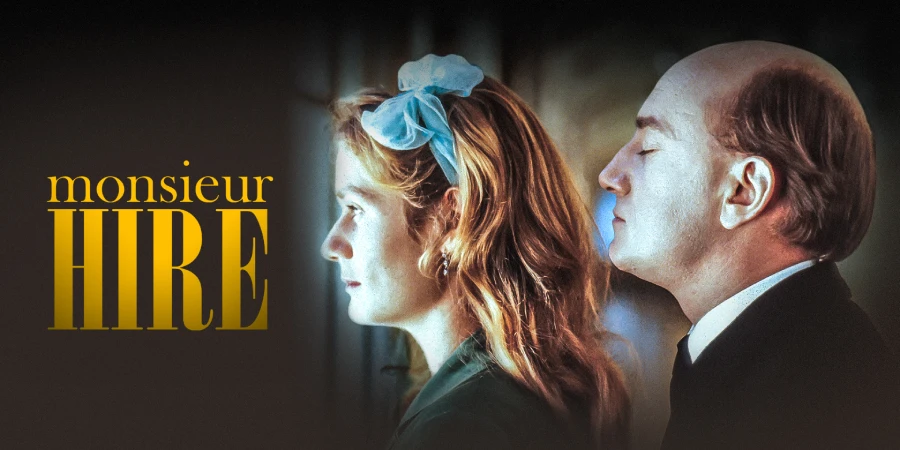

A man watches a woman through a window every night, and she knows. Monsieur Hire (1989) is a French psychological thriller that turns voyeurism into something achingly tragic rather than simply sinister. Director Patrice Leconte crafts a film where obsession, loneliness, and moral ambiguity collide with devastating results. This is not a comfortable film, but it is an unforgettable one.
Detailed Summary
Hire’s Isolated World
Monsieur Hire (played by Michel Blanc) lives alone in a small Parisian apartment. He works as a tailor, keeps to himself, and speaks rarely. His neighbors dislike him instinctively, treating him as suspicious and cold.
Meanwhile, the local community buzzes with anxiety over a murdered young woman found nearby. Police, led by Inspector Maigret (played by André Wilms), quietly circle Hire as a suspect. He fits the community’s image of someone capable of violence, simply because he is strange and solitary.
The Nightly Ritual
Each night, Hire stands at his darkened window and watches Alice (played by Sandrine Bonnaire) in the apartment across the narrow courtyard. Alice is young, vibrant, and involved with a reckless man named Émile. Hire observes her dressing, laughing, living, with an intensity that borders on devotion.
One night, Alice notices him watching. Rather than screaming or reporting him, she holds his gaze. This moment of mutual acknowledgment shifts everything the film has established.
Connection Across the Courtyard
Alice approaches Hire directly and confronts him without hostility. She is curious about him rather than frightened. In contrast to everyone else in his life, she treats him as a person worth understanding.
A strange, tender relationship develops between them. Hire opens up in small, painful increments. He takes Alice ice skating in one of the film’s most quietly beautiful sequences, and for a brief time, the audience genuinely believes he might find happiness.
Alice’s True Allegiance
Alice, however, loves Émile fiercely. Émile is charming but dangerous, and crucially, he is the actual killer of the murdered woman. Alice knows this. She carries his secret, choosing loyalty to him over justice for the victim.
As a result, Alice begins using her relationship with Hire instrumentally. She keeps him close and cooperative while she works to protect Émile. Her kindness toward Hire is never entirely false, but it is never entirely free either.
Hire’s Confession of Love
Hire, fully aware on some level that Alice does not love him as he loves her, confesses his feelings anyway. He tells her she is the only real thing in his life. Consequently, this confession makes his vulnerability complete and devastating.
He also reveals to her that he knows she has been protecting Émile. This knowledge makes him both a threat and a hostage to the situation. Furthermore, it locks him into a tragic position from which there is no clean exit.



Movie Ending
Police close in on Hire as the primary suspect in the murder. He attempts to flee across the rooftops of Paris in a desperate, almost dreamlike sequence. Below him, a crowd of neighbors gathers and watches from the courtyard.
Alice steps forward. She could clear him, or at least redirect suspicion toward Émile. Instead, she says nothing that saves him. Her silence is her final choice, and it condemns Hire as surely as any accusation.
Hire falls from the roof. Whether he slips, loses his footing in panic, or lets himself fall is deliberately left ambiguous by Leconte. That ambiguity is the point. His death could read as accident, as surrender, or as a quiet act of a man who understood that his world had finally, completely closed around him.
Alice watches from below. Her expression is unreadable, which is precisely what makes the ending so haunting. She has protected Émile, lost Hire, and must now live inside the knowledge of what her silence cost. Justice does not arrive. Émile presumably escapes consequence. The system convicts no one it was hunting while the real truth dissolves into the crowd.
On the other hand, the film refuses to present Alice as a pure villain. She is trapped too, between love and complicity, and Leconte never lets the audience off the hook of that complexity. Hire dies not because of a monster but because of ordinary human selfishness and fear, which is far more disturbing.
Are There Post-Credits Scenes?
Monsieur Hire contains no post-credits scenes. Leconte ends the film on its final image without any supplementary material. Nothing follows.
Type of Movie
This film sits firmly in the psychological thriller genre, with a strong undercurrent of film noir and French literary drama. Its tone is melancholic, restrained, and deeply unsettling without relying on conventional genre mechanics like jump scares or action sequences.
Notably, it functions as a character study above all else. Leconte keeps the thriller elements subordinate to the emotional and psychological portrait of Hire himself. The result is a film that disturbs you quietly, long after it ends.
Cast
- Michel Blanc – Monsieur Hire
- Sandrine Bonnaire – Alice
- André Wilms – Inspector Maigret
- Luc Thuillier – Émile
Film Music and Composer
Michael Nyman composed the score for Monsieur Hire, and his contribution is essential to the film’s emotional texture. Nyman, a British composer closely associated with minimalist and repetitive musical structures, had already gained international recognition through his collaborations with director Peter Greenaway.
His score for this film is sparse and hypnotic. It mirrors Hire’s inner world, circling the same emotional territory repeatedly without resolution. The music never dramatizes; instead, it observes alongside the character, making it feel almost as lonely as he is.


Filming Locations
Production took place primarily in Paris, France, specifically in dense, working-class residential neighborhoods. Leconte favored narrow courtyards, cramped staircases, and close apartment buildings, all of which physically embody Hire’s world of proximity without connection.
The rooftop setting of the climax is also a Parisian constant, instantly recognizable as part of the city’s visual grammar. In contrast to romantic visions of Paris, Leconte renders these spaces as isolating and claustrophobic. Place becomes psychology in this film.
Awards and Nominations
Monsieur Hire received significant recognition at the César Awards, with Michel Blanc earning a nomination for Best Actor. Sandrine Bonnaire also received attention for her performance during the film’s release period.
Moreover, the film gained wider international visibility through festival screenings and strong critical reception across Europe. It stands as one of Leconte’s most celebrated works, though its awards tally is modest relative to its critical reputation.
Behind the Scenes Insights
- Director Patrice Leconte deliberately kept the tone cold and restrained on set, avoiding any sentimentality that might soften Hire’s tragedy.
- Michel Blanc, primarily known for comedic roles in French cinema before this film, used his casting against audience expectation to generate sympathy for Hire.
- Leconte focused cinematography tightly on faces and windows, reinforcing the theme of watching and being watched throughout production.
- Sandrine Bonnaire worked to keep Alice morally opaque, deliberately avoiding choices that would simplify her character into either victim or predator.
- Leconte has cited the challenge of making voyeurism feel tragic rather than exploitative as the central creative problem he worked to solve during production.
Inspirations and References
Monsieur Hire directly adapts Les Fiançailles de M. Hire, a 1933 novel by Belgian author Georges Simenon. Simenon, best known for creating detective Inspector Maigret, wrote this novel as a dark psychological study rather than a conventional crime story.
Simenon’s recurring interest in ordinary people crushed by circumstance and social judgment runs throughout his body of work. Leconte, consequently, inherited a source text already rich in moral ambiguity. He amplified the emotional intimacy while compressing the narrative structure.
Alternate Endings and Deleted Scenes
No documented alternate endings or significant deleted scenes from Monsieur Hire appear in widely available production materials. Leconte has not publicly discussed major structural changes during editing. Simenon’s source novel provides a slightly different set of emphases, but no evidence of a filmed alternate conclusion exists in the public record.
Book Adaptations and Differences
Monsieur Hire adapts Simenon’s Les Fiançailles de M. Hire quite faithfully in its central premise. Both works follow a solitary, socially rejected man who observes a young woman and becomes entangled in a murder investigation surrounding her.
However, Leconte’s film deepens the visual and emotional intimacy between Hire and Alice in ways the novel does not fully develop. Leconte also places greater weight on silence and ambiguity, particularly in the ending. Simenon’s prose is spare and somewhat detached, while Leconte’s direction draws the audience uncomfortably close to Hire’s inner life.


Memorable Scenes and Quotes
Key Scenes
- Hire standing motionless in darkness, watching Alice across the courtyard, while Nyman’s score plays softly beneath the image.
- Alice catching Hire watching her and holding his gaze instead of looking away, the moment that cracks open the entire film.
- Hire and Alice ice skating together, a scene of rare warmth surrounded by the film’s pervasive cold.
- Hire’s confession of love to Alice, delivered with quiet devastation rather than melodrama.
- Hire on the rooftop, the crowd below, and Alice’s silence as he falls.
Iconic Quotes
- “You are the only real thing.” (Hire to Alice, expressing the full weight of his isolation in a single sentence.)
- Alice’s silence at the film’s climax functions, in its own way, as the most powerful statement in the entire film, louder than any line of dialogue.
Easter Eggs and Hidden Details
- Hire’s apartment contains very few personal objects, a visual detail that reinforces how empty his life is before Alice enters it.
- Leconte frames Alice’s window as a kind of cinema screen for Hire, subtly drawing a parallel between his voyeurism and the act of watching a film.
- Hire’s profession as a tailor is quietly ironic: he works to shape and fit things for others while his own life remains shapeless and ill-fitting.
- Bonnaire’s costuming in the film keeps Alice in warm tones while Blanc’s wardrobe remains persistently gray and dark, a color-coded emotional divide.
- Police surveillance of Hire mirrors his own surveillance of Alice, suggesting that watching without full understanding is a universal human failing in this story.
Trivia
- Monsieur Hire was not the first adaptation of Simenon’s novel; director Julien Duvivier had adapted the same source material in 1946 under the title Panique.
- Michel Blanc won the Best Actor award at the Cannes Film Festival for his performance, a significant recognition for a role so deliberately minimalist.
- Leconte shot much of the film using natural light from the apartment windows, a choice that reinforces the surveillance aesthetic throughout.
- Simenon wrote the source novel in the early 1930s, and its portrait of social scapegoating feels remarkably prescient across decades of adaptation.
- Monsieur Hire marked a significant tonal shift in Leconte’s career, moving him away from comedy toward the darker, more intimate dramas he became celebrated for internationally.
Why Watch?
Monsieur Hire offers something rare: a thriller that operates entirely through emotional precision rather than plot mechanics. Michel Blanc delivers one of French cinema’s great minimalist performances, and Leconte transforms a small, quiet story into something that lingers for days. For fans of intelligent, morally complex cinema, this film is essential.
Director’s Other Movies
- The Hairdresser’s Husband (1990)
- Tango (1993)
- Ridicule (1996)
- The Girl on the Bridge (1999)
- The Man on the Train (2002)
- Intimate Strangers (2004)
Recommended Films for Fans
- Panique (1946)
- Rear Window (1954)
- The Comfort of Strangers (1990)
- La Femme Nikita (1990)
- Cache (2005)
- A Prophet (2009)