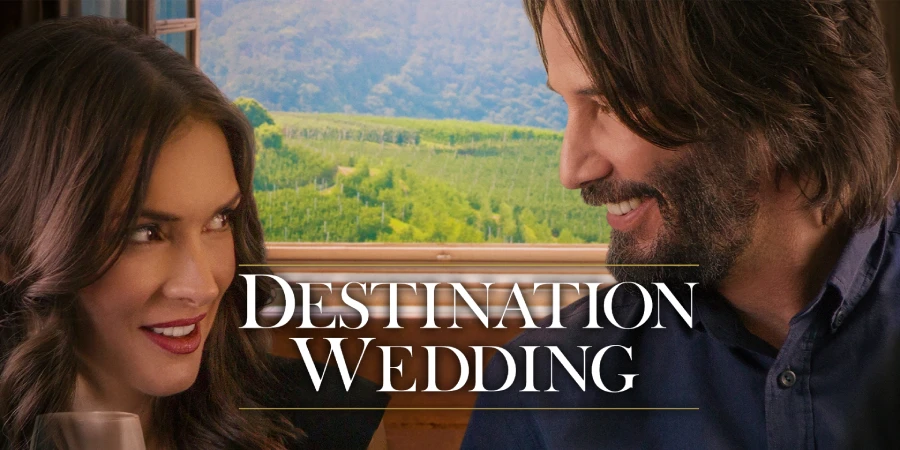

Two people who openly hate weddings, romance, and possibly each other spend an entire weekend agreeing about how much everything is terrible, and somehow that becomes one of the most watchable love stories of the decade. Destination Wedding (2018) puts Keanu Reeves and Winona Ryder in a box together and just lets them talk, almost exclusively, for 87 minutes straight. Writer-director Victor Levin makes an audacious structural bet: strip away the supporting cast, the visual spectacle, the wedding itself as an emotional centerpiece, and see if two sharp performances can carry a film on pure conversational friction. They can.
Detailed Summary
Two Strangers at the Airport Gate
Frank and Lindsay meet at a small airport, both traveling to a wedding in San Luis Obispo wine country. Frank is blunt to the point of social offense, announcing that he dislikes people as a general policy. Lindsay fires back rather than retreating, and the two establish their dynamic within sixty seconds of screen time.
Neither wants to attend. Frank is the groom’s half-brother, a man nobody particularly invited with warmth. Lindsay is the groom’s ex-fiancee, attending for reasons she cannot fully articulate even to herself.
The Rehearsal Dinner and First Real Clash
At the rehearsal dinner, Frank and Lindsay find themselves seated together, separated from everyone else at the table by invisible walls of social awkwardness. Their conversation starts as competitive misanthropy and slowly reveals two people with genuine wounds. Frank lost his relationship with his father largely because of the groom, Keith. Lindsay was left by Keith and has never entirely processed it.
Victor Levin keeps the camera close. Faces dominate the frame. The dinner sequence is where Reeves does his best work, delivering Frank’s caustic philosophy with a deadpan precision that never tips into caricature.
The Wedding Day Itself
On the day of the ceremony, Frank and Lindsay are both clearly out of place among the cheerful guests. They drift toward each other by default and by choice. Their conversations range from brutally honest self-assessment to quiet admissions of loneliness.
A cougar attacks them during a walk through the vineyard, and the film plays this completely straight. They fight off the animal together, and the shared absurdity of nearly being eaten by a mountain lion cracks something open between them.
Physical Intimacy and Immediate Regret
Frank and Lindsay sleep together, and the film handles the aftermath with characteristic honesty. Neither performs romantic excitement. Frank immediately articulates why this is probably a mistake. Lindsay agrees and also disagrees. Their post-sex conversation is the most emotionally vulnerable exchange in the film, and Ryder plays it with a brittle fragility that earns every laugh and every wince simultaneously.
The Wedding Reception and Quiet Revelation
At the reception, watching Keith with his new wife, Lindsay finally sees her ex-fiancé clearly. He is not the person she grieved. Frank watches her watching Keith and says almost nothing. Reeves communicates Frank’s shift entirely through stillness, a slight softening around the eyes, a pause before a sentence that never quite comes.
Both characters arrive at the same unspoken conclusion: they are more interested in each other than in any of the reasons they came.
Movie Ending
Frank and Lindsay leave the wedding separately and then meet again, almost immediately, at the same small airport where the film began. It is the same gate, the same uncomfortable chairs. The visual callback is deliberate and earns its sentiment without overselling it.
Neither character confesses love in operatic terms. Frank suggests they share a cab. Lindsay accepts. For two people who opened the film declaring their opposition to human connection, this is as close to a grand romantic gesture as either of them will ever make.
Victor Levin wisely resists giving them an airport kiss or a swelling score moment. The film cuts before anything is resolved with conventional romance logic. Audiences asking whether Frank and Lindsay end up together get the only honest answer the film can offer: probably, tentatively, and on their own complicated terms.
What makes this ending satisfying rather than evasive is the accumulation of small honesty throughout the previous 80 minutes. By the time they share that cab, you believe it completely. You believe it precisely because neither of them oversells it.
Are There Post-Credits Scenes?
Destination Wedding has no post-credits scene. Once the film ends, it ends. No stingers, no callbacks, no bonus content.
Type of Movie
This is a romantic comedy-drama with heavy emphasis on the dialogue-driven comedy of manners. The tone sits somewhere between sharp wit and genuine melancholy. Think of it as a two-hander chamber piece that happens to include a mountain lion.
Audiences expecting a conventional rom-com with misunderstandings, ensemble hijinks, and a big public declaration will be surprised. This film trusts its two leads and almost nothing else.
Cast
- Keanu Reeves – Frank
- Winona Ryder – Lindsay
Film Music and Composer
Mark Mothersbaugh composed the score. Mothersbaugh, co-founder of the art-rock band Devo, has built a substantial film scoring career across projects ranging from Rushmore to various animated features. His work here is restrained and dry, matching the film’s conversational register rather than pushing the audience toward emotional conclusions.
The score does not romanticize what is on screen. It accompanies rather than editorializes, which is exactly the right call for a film this verbally aggressive.

Filming Locations
Principal photography took place in and around San Luis Obispo County, California, specifically in the wine country surrounding Paso Robles. The vineyards, rolling hills, and golden-hour light give the film a paradoxically beautiful backdrop for two people complaining about everything.
The location choice matters thematically. Wine country is shorthand for romance, celebration, and aesthetic pleasure, and Frank and Lindsay spend the entire film refusing to enjoy it. The contrast between the gorgeous setting and their mutual disdain for it generates a low-key visual comedy that runs throughout.
Awards and Nominations
Destination Wedding did not receive major awards attention or significant nominations during its release cycle. It landed quietly and found its audience mostly through word of mouth and streaming.
Behind the Scenes Insights
- Keanu Reeves and Winona Ryder had previously appeared together in Bram Stoker’s Dracula (1992), giving their on-screen chemistry a genuine history to draw from.
- Victor Levin wrote the screenplay specifically with the two-person format in mind, deliberately limiting the speaking cast to Reeves and Ryder.
- Reeves and Ryder are the only two characters who speak with any real dialogue. Other characters appear visually but are essentially mute background figures, a bold formal choice that reinforces the film’s hermetic atmosphere.
- Ryder has spoken in interviews about finding the material genuinely funny and connecting with Lindsay’s particular brand of self-aware neurosis.
Inspirations and References
Victor Levin drew on the tradition of literary conversation films, works where dialogue is the primary dramatic engine. The film owes a clear debt to Eric Rohmer’s “Comedies and Proverbs” cycle, where characters articulate their romantic philosophies with almost comic precision.
Richard Linklater’s Before Sunrise is an unavoidable reference point, though Destination Wedding is deliberately more brittle and less sentimental than that film. Levin seems aware of the comparison and leans into the contrast rather than hiding from it.
Alternate Endings and Deleted Scenes
No alternate endings or significant deleted scenes have been publicly documented for Destination Wedding. Given the film’s tight, dialogue-driven structure, major cuts would fundamentally alter the pacing in ways that Levin appears to have avoided.
Book Adaptations and Differences
Destination Wedding is not based on a book, novel, or pre-existing source material. Victor Levin wrote the original screenplay specifically for this production.
Memorable Scenes and Quotes
Key Scenes
- Frank and Lindsay’s first airport conversation, which establishes their entire dynamic in under two minutes and never wastes a word.
- The rehearsal dinner, where two people with genuinely painful histories connected to the groom discover each other through competitive cynicism.
- The mountain lion attack, played completely straight, which functions as both physical comedy and a turning point in their emotional relationship.
- The post-sex conversation, where both characters immediately begin analyzing and partially dismantling what just happened, and Ryder’s delivery of Lindsay’s conflicted honesty is the single best performance moment in the film.
- The airport ending, where a shared cab offer does the work that a speech or a kiss would do in a lesser film.
Iconic Quotes
- Frank, introducing his philosophy early: “I don’t like people. I don’t dislike them. I just don’t like them.”
- Lindsay responding to Frank’s blunt worldview: “I think you like me.” Frank: “I’m withholding judgment.”
- Frank on the wedding: “There is no such thing as a good wedding. There are only degrees of bad.”
Easter Eggs and Hidden Details
- The film opens and closes at what appears to be the same airport gate, a visual rhyme that rewards attentive viewers who catch the matching details in the set dressing.
- Other wedding guests are visible throughout but never speak, quietly underlining Frank and Lindsay’s self-imposed exile from normal social interaction.
- The vineyard setting, associated culturally with celebration and pleasure, appears most prominently during scenes where both characters are at their most pessimistic, a contrast that feels intentional rather than incidental.
Trivia
- Reeves and Ryder have jokingly suggested in interviews that their characters in Bram Stoker’s Dracula were technically married on screen, making their pairing in this film a kind of long-delayed reunion.
- The film’s near-exclusive focus on two speaking characters is extremely rare for a feature-length studio-adjacent romantic comedy.
- Victor Levin previously worked as a writer and producer on television before directing features, and the film’s precise, rhythmically tight dialogue reflects that background.
- Despite its minimal cast structure, the film runs at a length that never feels padded, a credit to how much information Levin packs into each exchange.
Why Watch?
Keanu Reeves delivers Frank’s lines with a comic specificity that most critics undervalued on release, landing each blunt observation with a timing that only works because he plays it completely straight. If you have ever found yourself genuinely funnier than the people around you at a social event you did not want to attend, this film will feel uncomfortably personal. Ryder matches him beat for beat.
Director’s Other Movies
- 5 to 7 (2014)
Recommended Films for Fans
- Before Sunrise (1995)
- Before Sunset (2004)
- My Dinner with Andre (1981)
- Certified Copy (2010)
- Much Ado About Nothing (1993)
- The Overnight (2015)