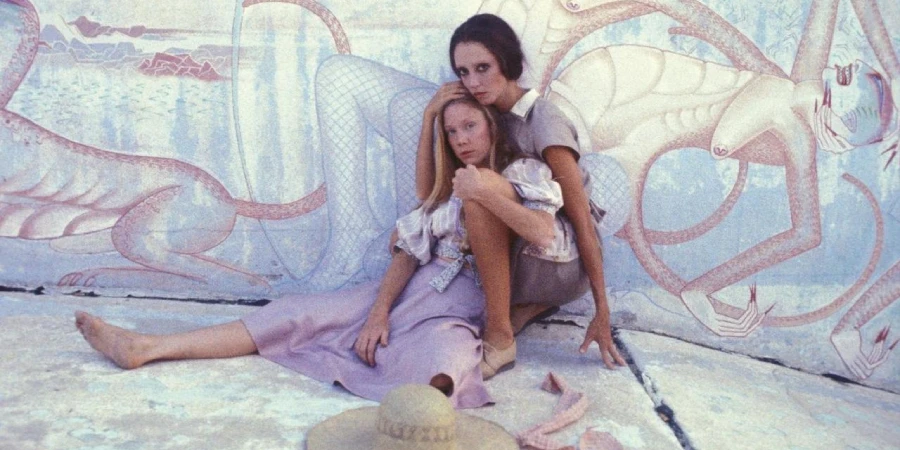

Robert Altman dreamed 3 Women into existence, literally, waking from a dream with the entire film already formed in his mind. What arrived on screen in 1977 was something closer to a fever than a story: three women in the California desert, slowly dissolving into each other like watercolors left in the rain. Sissy Spacek plays Pinky, a childlike newcomer who absorbs the identity of her coworker Millie like a parasite wearing a smile. This is one of the strangest, most genuinely unsettling American films ever made, and it earns every ounce of that strangeness.
Detailed Summary
Pinky Arrives at the Desert Spa
Pinky Rose, played by Sissy Spacek, arrives in a dusty California desert town to work at a therapeutic spa that treats elderly patients in a warm pool. She is assigned to shadow Millie Lammoreaux, played by Shelley Duvall, a relentlessly cheerful, delusional woman who talks constantly and believes herself to be enormously popular with everyone around her.
Nobody actually likes Millie. Her coworkers ignore her, her neighbors avoid her, and her dinner parties go unattended. Pinky watches all of this with wide, unblinking eyes and decides, inexplicably, that Millie is the most fascinating person alive.
She Moves In
Pinky moves into Millie’s apartment at a complex called Dodge City, a tacky Western-themed housing development run by Edgar Hart and his pregnant wife Willie, played by Janice Rule. Willie barely speaks. She spends her days painting enormous, disturbing murals on the bottom of the complex’s pool and around the shooting range, depicting interlocked reptilian figures with ambiguous, anguished faces.
Willie’s paintings are the film’s visual heartbeat. They pulse underneath every scene set at the complex, a constant reminder that something ancient and menacing is operating beneath the cheerful surface.
Pinky’s Obsession with Millie
Pinky begins mirroring Millie compulsively. She reads Millie’s diary, borrows her clothes, and starts adopting her speech patterns. Millie, oblivious and flattered, treats Pinky like a little sister she can lecture about womanhood, cooking, and men.
Edgar Hart, a crude and indifferent man, has a sexual relationship with Millie. Pinky witnesses this and grows increasingly agitated. Her attachment to Millie deepens into something neither romantic nor sisterly, more like consumption.
The Fall Into the Pool
After reading Millie’s diary and discovering that Millie finds her annoying, Pinky falls, or possibly jumps, into the pool. She sinks into the water above Willie’s painted creatures. This is the film’s pivot, the sequence where 3 Women stops pretending to be a character study and commits fully to dream logic.
Pinky nearly drowns and loses her unborn baby, a pregnancy that was never mentioned before this moment. She falls into a coma. Her parents, whom we have never seen, arrive and feel entirely wrong, flat and distant, like figures from a dream someone else is having.
Pinky Wakes Up Different
When Pinky regains consciousness, she is no longer Pinky. She now calls herself Mildred and begins acting with a cold, assertive confidence that the old Pinky never possessed. She takes Millie’s name, reads her diary openly, flirts with men at the shooting range, and discards her old self completely.
Millie, now displaced from her own identity, softens and retreats. She becomes quieter, more nurturing, more like the innocent Pinky used to be. The two women have essentially traded souls, and neither seems to notice or care.
Willie’s Baby and Edgar’s Death
Willie goes into labor. Pinky and Millie attempt to help her deliver the baby, far from any hospital, in a chaotic, terrifying sequence shot with almost no score. The baby is stillborn.
Edgar dies at some point during this period, shot, though the film presents this with deliberate vagueness. It is never entirely clear whether the women killed him or whether his death simply happened, absorbed into the desert like everything else.



Movie Ending
Sometime later, the three women live together in an isolated arrangement at the shooting range property. Millie now cooks and cares for the others with maternal efficiency. Pinky, who has fully claimed the identity of Mildred, is assertive and distant. Willie sits in a rocking chair on the porch, silent, spent, her paintings apparently abandoned.
An older woman drives up and asks for directions. The three women respond with a flat, rehearsed calm that makes the visitor visibly uneasy before she drives away. This is the final image before the credits: three women on a porch, indistinguishable in their shared stillness, having become something singular and self-contained.
What Altman refuses to do is explain. Edgar’s death has no police investigation, no consequence, no scene of resolution. The baby’s death has no funeral. Pinky’s parents disappear from the narrative as abruptly as they arrived. Identity, the film argues, is not stable enough to mourn when it shifts.
The ending asks whether individuality was ever real for these women in the first place. Millie performed a self nobody witnessed. Pinky had no self to speak of. Willie communicated only through her painted figures. By the end, they have collapsed into a single organism that needs nothing from the outside world.
Are There Post-Credits Scenes?
No. 3 Women has no post-credits scene of any kind. Once the image fades, it is done with you.
Type of Movie
3 Women is a psychological drama with strong elements of surrealism and body horror. Its tone is slow, hypnotic, and deeply unsettling without ever resorting to conventional thriller mechanics.
Think of it as sitting somewhere between a Bergman character study and a Jungian nightmare. Altman builds dread not from plot but from atmosphere, and the film never fully leaves the register of a waking dream.
Cast
- Sissy Spacek – Pinky Rose / Mildred
- Shelley Duvall – Millie Lammoreaux
- Janice Rule – Willie Hart
- Robert Fortier – Edgar Hart
- Ruth Nelson – Mrs. Rose (Pinky’s mother)
- John Cromwell – Mr. Rose (Pinky’s father)
- Sierra Pecheur – Ms. Bunwell
- Craig Richard Nelson – Dr. Maas
Film Music and Composer
Gerald Busby composed the score for 3 Women, and it is one of the most underrated elements of the entire film. Busby, a classically trained composer, wrote music that sits in the body like low-grade fever, dissonant string textures and choral murmurs that never resolve into comfort.
The score rarely announces itself. It bleeds into ambient sound, making it genuinely difficult to know where the desert wind ends and the music begins. That ambiguity is the point.

Filming Locations
Altman shot the film primarily in the Coachella Valley area of California, including desert communities that felt bleached and alienated from mainstream American life. The spa sequences were filmed at a real therapeutic facility in the region.
The Dodge City apartment complex was a real location in the desert, and its faded Western kitsch reads onscreen as something between a joke and a threat. The landscape itself functions as a character, indifferent, sun-scorched, offering no comfort to anyone trying to establish a stable sense of self within it.
Awards and Nominations
Shelley Duvall won the Best Actress award at the Cannes Film Festival in 1977 for her performance as Millie, which remains one of the great overlooked acting achievements of that decade. Sissy Spacek received recognition from various critics circles for her work as Pinky.
The film received a nomination from the Writers Guild of America for Altman’s original screenplay.
Behind the Scenes Insights
- Altman has said publicly that the entire concept of the film came to him in a dream, and he wrote the script rapidly, essentially transcribing what he remembered from that dream state.
- Shelley Duvall helped shape Millie’s wardrobe and many of her behavioral quirks, contributing directly to how deeply specific the character became.
- Sissy Spacek has described the film as one of the most psychologically demanding experiences of her career, citing the identity-dissolution scenes as genuinely disorienting to perform.
- Janice Rule’s near-total silence throughout production, both as a character and apparently on set, contributed to the uncanny atmosphere other cast members described.
- Altman shot the film with a small crew and encouraged improvisation, particularly in the domestic scenes between Spacek and Duvall, which gives those sequences their unnerving naturalism.
- The murals painted by Willie in the film were created by artist Bodhi Wind, whose work gave the production a visual mythology it could not have sourced elsewhere.
Inspirations and References
Altman cited Ingmar Bergman’s Persona (1966) as an unavoidable reference point, given that film’s own preoccupation with identity merging between two women. He insisted 3 Women was not an imitation but acknowledged the thematic overlap was real.
Jungian psychology sits underneath the film’s structure. The three women map loosely onto aspects of a single psyche, persona, shadow, and anima, though Altman resisted any definitive allegorical reading.
The flat, affectless American suburban landscape draws from a tradition of artists who treated the California desert as a zone of psychological exposure, from photographers like Robert Adams to the fiction of Joan Didion.
Alternate Endings and Deleted Scenes
No officially documented alternate ending or significant deleted scenes from 3 Women have been released or confirmed in interviews. Given that Altman wrote and shot the film in a compressed, intuitive way, major structural alternates seem unlikely to exist.
Altman’s general working method involved improvisation within takes rather than shooting multiple scripted endings, so the version that exists is almost certainly the only version that was ever seriously considered.
Book Adaptations and Differences
3 Women is not based on a book, short story, or any previously existing source material. Altman wrote the original screenplay himself, directly from his dream. No novelization of the film appears to exist.



Memorable Scenes and Quotes
Key Scenes
- Pinky sinks into the pool: Shot from above, Spacek’s body drifts down through the water toward Willie’s painted creatures. The camera holds this position for an unnervingly long time, the painted figures seeming to reach upward toward her.
- Millie’s unattended dinner party: Millie sets the table, dresses carefully, and waits. Nobody comes. Duvall plays the entire scene without collapsing into self-pity, which makes it far more devastating than any tearful reaction shot would have been.
- Pinky wakes up as Mildred: Spacek’s shift in posture, eye contact, and vocal register happens between one scene and the next with no explanatory bridge. It is the best single performance moment in the film, a complete human being replaced by another.
- Willie’s labor sequence: Shot in near-silence, the two women frantically trying to assist with a birth that will end in stillbirth. Altman keeps the camera at a clinical distance that makes the scene feel more horrifying than any close-up could.
- The final porch image: Three women sitting in stillness as a stranger drives away unsettled. No music. No dialogue. Just the desert, the porch, and the feeling that something irreversible has settled into place.
Iconic Quotes
- “I’m going to show you everything you need to know.” (Millie to Pinky, early in the film, carrying a weight she cannot possibly intend.)
- “You don’t even know who I am.” (Pinky, post-transformation, to Millie, which lands as both true and deeply wrong simultaneously.)
Easter Eggs and Hidden Details
- Willie’s pool murals change subtly between scenes, suggesting they are alive or actively being added to, though no scene ever shows Willie painting them during the film’s central timeline.
- The Western decor of Dodge City mirrors the sexual power dynamics at play: saloons, shooting ranges, and cowboy iconography all frame Edgar’s predatory masculinity as a cultural performance rather than a natural fact.
- Pinky’s choice of the name Mildred after her transformation is itself a ghost. “Mildred” is a conspicuous echo of Millie’s full name, Millie Lammoreaux, suggesting the new identity is still feeding on the old one.
- The elderly patients at the spa appear in several background shots throughout the film, frail and semi-submerged, visually rhyming with Pinky’s near-drowning before it happens.
- Millie’s recipe cards and domestic guides, which she consults compulsively, are never shown to produce a meal anyone else eats. Food preparation appears throughout the film as performance rather than nourishment.
Trivia
- Altman wrote the screenplay in a matter of days after waking with the dream fully formed, an unusual production origin even by his unconventional standards.
- Shelley Duvall’s Cannes win for this film preceded her work with Stanley Kubrick on The Shining by three years, and it is genuinely debatable which performance is the more complex achievement.
- Sissy Spacek shot this film the same year Carrie was in wide release, making 1977 a remarkable year for her exploration of young women under psychological siege.
- The film’s distributor had difficulty marketing it because it defied every available genre category, a problem that limited its initial theatrical reach considerably.
- Janice Rule was also a practicing psychotherapist in real life, which adds a peculiar dimension to her role as the most psychically opaque character in the film.
- 3 Women was produced by 20th Century Fox and Lion’s Gate Films, an early credit for the latter company long before it became a major studio.
Why Watch?
Watch this film because Shelley Duvall does something in the dinner party scene that no acting class can teach: she sits with humiliation and refuses to acknowledge it, which is somehow more exposing than any breakdown. Altman built an entire film around what American women perform for each other when nobody is watching, and he did it without a single false note from either of his leads.
Director’s Other Movies
- M*A*S*H (1970)
- McCabe and Mrs. Miller (1971)
- The Long Goodbye (1973)
- Nashville (1975)
- Popeye (1980)
- Short Cuts (1993)
- The Player (1992)
- Gosford Park (2001)
- A Prairie Home Companion (2006)
Recommended Films for Fans
- Persona (1966)
- Mulholland Drive (2001)
- Images (1972)
- The Piano Teacher (2001)
- Repulsion (1965)
- A Woman Under the Influence (1974)
- Safe (1995)
- Inland Empire (2006)