
Terry Gilliam made The Zero Theorem as a film about a man waiting for a phone call that will give his life meaning, and then spent every frame making sure that phone call would never satisfy him. Qohen Leth sits in a burned-out church in a neon-soaked near-future city, crunching numbers toward a mathematical proof that everything amounts to nothing. Christoph Waltz plays him with a hollow, twitching urgency that feels genuinely unsettling rather than merely eccentric. This is Gilliam at his most pessimistic, and arguably his most honest.
Detailed Summary
Qohen Leth and the World He Inhabits
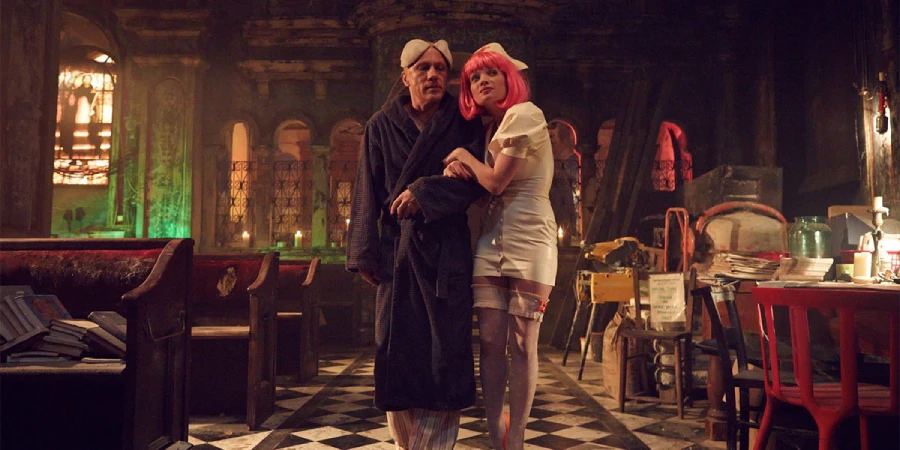
We meet Qohen Leth (Christoph Waltz) as a bald, pale, anxious man working at Mancom, a vast corporation devoted to crunching meaningless data. He refers to himself as “we” rather than “I,” a verbal tic that signals profound psychological fragmentation. His apartment is a derelict, half-burnt chapel, and he has never fixed it up because he does not plan to stay long.
Qohen obsessively waits for a phone call he believes will reveal the purpose of his existence. He has been expecting this call for years. Nobody believes it will come, including his supervisor, Joby (David Thewlis), who treats him with weary, bureaucratic concern.
The Assignment from Management
At a company party, Qohen encounters Management (Matt Damon), a sleek, boyish figure who operates the entire system with cheerful corporate nihilism. Management assigns Qohen to work on the Zero Theorem, a classified and possibly impossible mathematical project. Working from home, Qohen is supposed to prove that zero equals one hundred percent, meaning that existence amounts to nothing.
Qohen is thrilled to work from his chapel. He believes isolation will help him receive his awaited call. What he gets instead is increasing madness.
Bainsley and the Virtual World
Management sends Bainsley (Melanie Thierry), a vivacious young woman, to befriend Qohen and keep him productive. She introduces him to a virtual reality beach environment accessed through full-body suits. Qohen, who has spent years hiding in his chapel, finds the simulation intoxicating.
His feelings for Bainsley grow into something genuine and desperate. She is paid to be there, which she never fully denies. Gilliam frames the beach sequences with over-saturated colors, making them feel deliberately fake even as Qohen treats them as his most real experiences.
Bob and the Equations
Bob (Lucas Hedges, in one of his earliest film roles), Management’s teenage son, appears at Qohen’s chapel uninvited. Bob is a prodigy who understands the Zero Theorem mathematics far better than Qohen does. He becomes an unlikely helper and, briefly, a kind of surrogate connection for the isolated Qohen.
Bob explains that the project is essentially designed to fail, or at least designed to grind people down. He shows Qohen shortcuts and patches in the system, suggesting that Mancom already knows the theorem is either unsolvable or already solved. Nobody tells the workers anything useful.
The Psychiatrist and Institutional Control
Dr. Shrink-Rom (Tilda Swinton), a garish, cartoonish virtual psychiatrist, appears on Qohen’s screens to monitor his mental health. She is clearly a surveillance tool rather than a therapeutic resource. Swinton plays her as a parody of corporate wellness programs, all synthetic cheerfulness and zero genuine engagement.
Qohen’s sessions with her are funny and horrifying in equal measure. Every question she asks is designed to keep him compliant and on-task. She never once treats him as a person.
Qohen’s Breakdown and Bainsley’s Departure
Qohen’s feelings for Bainsley push him toward a crisis point. He wants something real, something permanent, in a world where everything is transactional. She is fond of him, genuinely so, but she cannot offer what he needs.
Bainsley leaves for a place where she can use her virtual reality skills freely, away from Mancom’s control. Her departure devastates Qohen. He loses the one relationship that gave him any warmth, and he plunges deeper into the theorem equations with nothing left to protect him from their implications.
The Theorem Reaches Its Conclusion
Qohen pushes through the final calculations. Bob disappears from the picture, recalled by Management. Alone in his collapsing chapel, Qohen completes the Zero Theorem proof.
It confirms what Management always knew: everything collapses into nothing. Zero equals one hundred percent. Existence has no inherent meaning. The corporation wanted this result so it could sell that nihilism as a product, packaging meaninglessness as liberation.

Movie Ending Explained
After Qohen finishes the proof, Mancom’s machinery consumes the chapel entirely. The physical space dissolves around him in a sequence that is part system crash, part apocalyptic implosion. Waltz plays this moment with a strange, quiet stillness, his hands loose at his sides, his face emptied out.
What follows is the film’s most debated sequence. Qohen finds himself on the virtual beach from his sessions with Bainsley, alone this time, sitting under a perfect sun. His phone rings. He answers it. We hear nothing from the other end before the screen cuts to black.
Gilliam refuses to tell us what the call contains. That silence is the entire point. Qohen spent his life waiting for external validation of his existence, and the film ends by giving him the call while withholding its contents. Whether the call delivers meaning, or silence, or simply a dial tone dressed up as revelation, the audience has to decide.
The beach itself is ambiguous. It could be a comforting delusion generated by a dying mind. It could be a virtual afterlife Mancom constructed for used-up workers. It could simply be Qohen’s imagination, finally at peace because he has stopped fighting.
What the ending refuses to offer is consolation. Qohen proved that everything is nothing, and then he sat down in a simulation and waited. That is either tragic or quietly liberating, depending on your tolerance for Gilliam’s brand of bleak humor. The most honest reading is probably that Qohen finally accepted the void, and found that acceptance softer than the waiting had been.
Are There Post-Credits Scenes?
The Zero Theorem has no post-credits scene. Once the screen goes black after Qohen answers his call, that is everything Gilliam intends to give you. Sitting through the credits yields nothing extra.
Type of Movie
The Zero Theorem is a science fiction dark comedy with heavy philosophical and dystopian undertones. Its tone sits somewhere between Kafka and Monty Python, melancholy but frequently absurd. Gilliam never lets the sadness become earnest enough to tip into melodrama.
Fans of existentialist cinema will recognize the preoccupations immediately. This is not action-oriented sci-fi. It is a character study wrapped in garish production design, more interested in loneliness than technology.
Cast
- Christoph Waltz – Qohen Leth
- Matt Damon – Management
- Melanie Thierry – Bainsley
- David Thewlis – Joby
- Tilda Swinton – Dr. Shrink-Rom
- Lucas Hedges – Bob
- Ben Whishaw – 2045 Jesus
Film Music and Composer
George Fenton composed the score for The Zero Theorem. Fenton is a veteran British composer with a long career in both film and television. His work here avoids grand orchestral statements, preferring something quieter and more unsettling.
The score leans into electronic textures and sparse arrangements that mirror Qohen’s psychological isolation. Music in this film rarely swells to reassure the audience. It hovers, unresolved, like Qohen himself.

Filming Locations
Principal photography took place in Bucharest, Romania. The city’s mix of communist-era brutalist architecture and ornate older buildings gave Gilliam exactly the kind of visual contradiction he wanted: a world that feels both oppressively constructed and strangely decayed.
Bucharest stood in for a near-future version of a generic Western city, its streets dressed with neon advertising and surveillance infrastructure. The choice was partly practical (lower production costs) and partly aesthetic. Gilliam has always been drawn to locations that feel slightly wrong, slightly off-register from the familiar.
The burned-out chapel that serves as Qohen’s home was a real location in Bucharest, dressed by the production design team. Its crumbling walls and residual ecclesiastical imagery gave the film a layer of religious symbolism that a purpose-built set might have made too clean.
Awards and Nominations
The Zero Theorem received limited awards attention after its premiere at the Venice Film Festival in 2013. It did not make a significant impact on the major awards circuits. Waltz’s performance drew critical respect but no substantial nominations.
Behind the Scenes Insights
- Terry Gilliam described the film as completing an informal trilogy alongside Brazil and 12 Monkeys, all three centered on lone individuals crushed by overwhelming systems.
- Christoph Waltz and Gilliam developed Qohen’s “we” affectation together during pre-production, deciding it should never be explained or resolved.
- Tilda Swinton shot her scenes relatively quickly, appearing primarily via screen inserts and pre-recorded segments within the film’s world.
- Lucas Hedges was a teenager during filming, and Gilliam has spoken about wanting the dynamic between Hedges and Waltz to feel genuinely intergenerational rather than performed.
- The production design team covered Bucharest’s streets with layers of digital advertising and signage, a process that required significant post-production compositing work.
- Gilliam shot the film quickly by his standards, working with a relatively modest budget compared to his earlier studio productions.
Inspirations and References
Franz Kafka looms large over The Zero Theorem. Qohen navigating a bureaucracy that assigns him meaningless labor toward an undefined goal reads directly as Kafkaesque, and Gilliam has acknowledged that debt openly.
Samuel Beckett’s influence is visible too, especially Waiting for Godot. Qohen waiting for a call that defines his existence mirrors Beckett’s Vladimir and Estragon waiting for someone who never arrives in any satisfying way.
Gilliam’s own Brazil is the most obvious cinematic antecedent. Both films feature a solitary man crushed by a dystopian corporate state, both use production design as a form of psychological pressure, and both end in a space that may be real or imagined.
Pat Rushin wrote the original screenplay, and he has cited his own experiences with existential anxiety and the modern data economy as direct inspirations. The idea of human beings reduced to number-crunchers inside systems they cannot understand or exit clearly drew from contemporary anxieties about corporate culture.
Alternate Endings and Deleted Scenes
No widely documented alternate endings or significant deleted scenes from The Zero Theorem have entered the public record. Gilliam has not publicized any major cuts or significant structural changes between the Venice premiere cut and the general release version.
Given Gilliam’s troubled history with studios on projects like Brazil and The Man Who Killed Don Quixote, it is worth noting that The Zero Theorem appears to have reached audiences relatively close to his intended vision.
Book Adaptations and Differences
The Zero Theorem is not based on a book. Pat Rushin wrote an original screenplay, which he later adapted into a novel after the film’s release. Any reader approaching Rushin’s novelization should treat it as a companion piece rather than a source text.

Memorable Scenes and Quotes
Key Scenes
- Qohen’s first virtual beach session with Bainsley: the colors shift from the film’s dominant grays and greens into aggressive yellows and pinks, making pleasure look almost aggressive.
- Management’s party sequence, where Gilliam fills the frame with costumed partygoers, holographic advertisements, and surveillance cameras, creating a carnival atmosphere that reads as a kind of elegant horror.
- Bob sitting cross-legged on Qohen’s floor, casually dismantling the Zero Theorem’s core logic while eating snacks, reducing a supposedly impossible intellectual task to something almost boring.
- The chapel’s collapse as Qohen completes the proof: walls dissolving in digital fragments while Waltz stands motionless, his face registering nothing.
- Qohen alone on the virtual beach, the phone ringing, lifting it to his ear. The sustained silence before the cut to black is the best directed moment in the film.
Iconic Quotes
- “We are waiting for a very important call.” (Qohen, to virtually everyone he meets)
- “If you were happy, would you know it?” (Management to Qohen)
- “Everything will be clear soon. We just need more time.” (Qohen)
Easter Eggs and Hidden Details
- Ben Whishaw appears briefly as a Christ-like street preacher figure, adding a layer of religious iconography to the film’s meditation on faith and meaning-seeking.
- Qohen’s chapel apartment retains visible burn marks and religious symbols throughout, suggesting his search for meaning began in or around genuine spiritual loss rather than mere eccentricity.
- Mancom’s logo and visual identity are deliberately designed to resemble real-world tech corporations, with clean sans-serif fonts contrasted against the chaotic human environments below.
- The virtual beach that Bainsley introduces is visually consistent across all scenes, suggesting it is a corporate product with fixed parameters rather than an adaptive personal space.
- Qohen’s use of “we” instead of “I” subtly echoes the corporate plural used by institutions, implying he has already been colonized by the system he thinks he is separate from.
Trivia
- The Zero Theorem premiered in competition at the Venice Film Festival in 2013.
- Pat Rushin’s screenplay had been circulating in Hollywood for several years before Gilliam attached himself to direct it.
- Christoph Waltz shaved his head for the role, a physical transformation he prepared for methodically according to production accounts.
- Matt Damon’s Management character has no name in the screenplay beyond his title, reinforcing the idea that he represents a system rather than a person.
- Gilliam chose to shoot in Romania partly because the country’s architectural mix matched his vision without requiring extensive location construction.
- The film’s marketing struggled to categorize it for mainstream audiences, contributing to its limited theatrical reach despite its strong cast.
Why Watch?
Waltz’s performance alone justifies the runtime. He plays Qohen’s self-erasure with physical specificity, his shoulders permanently hunched inward, his eyes scanning every room for a phone that never rings on cue. Gilliam builds a world so visually suffocating that Qohen’s desperation feels entirely rational. If you want a film that takes its own pessimism seriously enough to follow it all the way to the bottom, this is a rare one.
Director’s Other Movies
- Monty Python and the Holy Grail (1975)
- Brazil (1985)
- The Adventures of Baron Munchausen (1988)
- The Fisher King (1991)
- 12 Monkeys (1995)
- Fear and Loathing in Las Vegas (1998)
- The Brothers Grimm (2005)
- Tideland (2005)
- The Imaginarium of Doctor Parnassus (2009)
- The Man Who Killed Don Quixote (2018)
Recommended Films for Fans
- Brazil (1985)
- 12 Monkeys (1995)
- Barton Fink (1991)
- Synecdoche, New York (2008)
- Alphaville (1965)
- Dark City (1998)
- Naked Lunch (1991)
- I Heart Huckabees (2004)