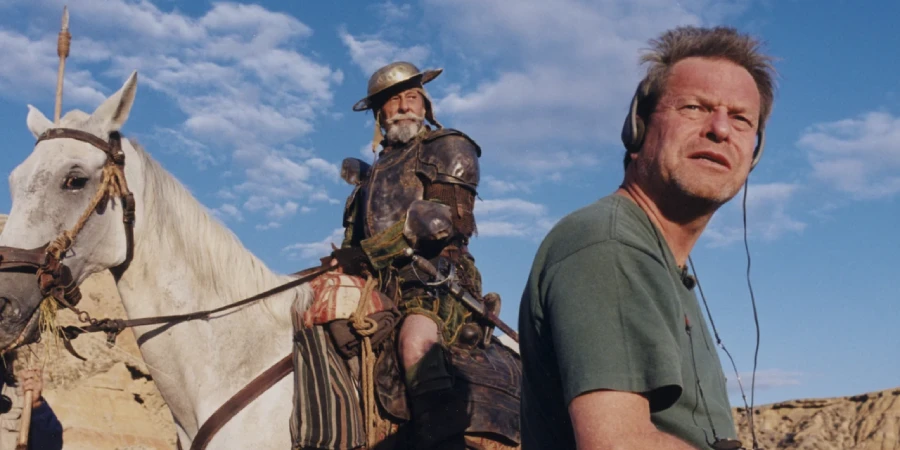
Terry Gilliam’s Don Quixote adaptation never got made, and somehow that disaster became a better film than the finished version ever could have been. Lost in La Mancha (2002), directed by Keith Fulton and Louis Pepe, follows Gilliam’s catastrophic attempt to shoot The Man Who Killed Don Quixote across a single harrowing production in Spain. Everything that could go wrong did, in spectacular and almost biblical fashion. Watching the footage is like watching a very expensive dream drown in a puddle.
Detailed Summary
The Dream Takes Shape
Fulton and Pepe embedded themselves in the production before a single frame of Gilliam’s film had been shot. Their original intention was to make a standard “making-of” documentary. What they actually captured was something far more interesting: a director walking toward catastrophe with total confidence in his vision.
Gilliam had spent years developing The Man Who Killed Don Quixote, a time-travel fantasy in which a modern advertising executive gets pulled into the world of Cervantes’s deluded knight. Johnny Depp was cast as the ad man, and veteran French actor Jean Rochefort was cast as Don Quixote himself. The production budget was tight, the schedule was aggressive, and the whole thing had a precarious, held-together-with-tape quality from the very start.
First Days and Early Warning Signs
Filming began in Spain, and the documentary cameras caught every anxious detail. Gilliam’s team scouted locations in arid, visually striking terrain, looking for something that matched the sun-blasted geography of Cervantes’s La Mancha. On paper, everything looked achievable.
Beneath the surface, the problems were already accumulating. The budget constraints meant compromises on nearly every department. Gilliam himself, characteristically enthusiastic, pushed forward with the kind of momentum that tends to paper over logistical cracks until those cracks become chasms.
The NATO Jets
One of the first visible disasters arrived from the sky. A NATO military exercise operated directly above the primary shooting location, and jet fighters roared through the soundscape at regular intervals. Every exterior shot with sync sound became unusable when the jets passed over.
This is one of the documentary’s most grimly funny sequences. Gilliam and his crew stand in the blazing sun, watching the sky, waiting for windows of quiet that never quite come. It is absurd. It is also the first clear sign that the production has no buffer, no room to absorb any disruption at all.
The Flash Flood
If the jets were darkly comic, the flash flood was genuinely destructive. A freak storm rolled through and sent water tearing across the location, damaging sets, equipment, and costumes. Production halted while the crew assessed what was salvageable. Very little was.
Fulton and Pepe’s cameras capture the aftermath with unflinching honesty. You can see the waterlogged wreckage of weeks of preparation. Gilliam walks through it with a kind of stunned calm that is, honestly, more unsettling than anger would have been.
Jean Rochefort’s Health Crisis
Then came the decisive blow. Jean Rochefort, already struggling with a serious back problem, could no longer ride a horse. Riding was not a minor requirement for the film; it was absolutely central to the character of Don Quixote. His health deteriorated to the point where he had to return to France for treatment.
This is where the documentary shifts tone completely. Without Rochefort, Gilliam essentially had no film. You can see it register on everyone’s face. The cast and crew who had committed to this production now faced the very real possibility that there was simply nothing left to shoot.
Insurance, Lawyers, and the Unraveling
With Rochefort medically unfit and the production stalled, the insurance and legal machinery ground into action. completion bond company representatives arrived on set, and the atmosphere turned hostile and bureaucratic. Gilliam, a director who has always fought studios and financiers, now found himself in an especially bleak version of that fight.
Fulton and Pepe document the meetings, the phone calls, the exhausted faces. These sequences are genuinely painful to watch. What had been a creative disaster was now a financial and legal one, and the two things fed each other in ways that made recovery nearly impossible.
The Shutdown
Production on The Man Who Killed Don Quixote officially shut down. Gilliam’s film was over, at least for now. The documentary captures his response with remarkable intimacy: not a breakdown, not a rage spiral, but something quieter and more defeated. He keeps his dark humor intact, but you can tell the cost was real.
Fulton and Pepe pull back slightly here and let the silence speak. Crew members pack up. Equipment gets loaded onto trucks. Spain, which had looked so cinematically perfect in the pre-production footage, now just looks hot and indifferent.
Movie Ending
What makes the final stretch of Lost in La Mancha so affecting is that Gilliam refuses to position himself as a tragic victim. He talks about returning to the project. He talks about finding another way. And you believe him, not because he sounds certain, but because he has always been the kind of filmmaker who cannot stop even when stopping is clearly the rational choice.
Fulton and Pepe close the film by returning to the footage Gilliam actually managed to capture before everything collapsed. It is beautiful and strange and full of Gilliam’s unmistakable visual sensibility. Seeing it makes the loss feel sharper, not softer. You are watching a ghost film, something that almost existed.
The documentary ends on a note of suspended grief rather than resolution. No funding has been secured. No replacement cast has appeared. Gilliam is left with his notebooks, his designs, and a conviction that the story is not finished. For fans who know that Gilliam did eventually make The Man Who Killed Don Quixote in 2018, that final image lands differently. For audiences watching in 2002, it was simply a very honest portrait of a dream deferred.
Are There Post-Credits Scenes?
No. Lost in La Mancha has no post-credits scene of any kind. Once the documentary ends, it ends. There is nothing additional waiting for viewers who sit through the credits.
Type of Movie
Lost in La Mancha is a documentary film. Its tone moves between dry comedy and genuine elegy. It functions simultaneously as a production diary, a portrait of a specific creative temperament, and a study in how filmmaking can be derailed by forces completely outside any director’s control.
Audiences who enjoy behind-the-scenes filmmaking content will find it gripping. Film students will find it instructive and sobering. Anyone who has watched a project collapse around them will find it uncomfortably relatable.
Cast
- Terry Gilliam – Himself (Director of The Man Who Killed Don Quixote)
- Jean Rochefort – Himself (Cast as Don Quixote)
- Johnny Depp – Himself (Cast as Toby Grisoni)
- Tony Grisoni – Himself (Screenwriter)
- Bernard Bouix – Himself (Producer)
Film Music and Composer
The score for Lost in La Mancha draws on source music appropriate to the Spanish setting and to the Cervantes source material Gilliam was attempting to adapt. Music choices throughout reinforce the documentary’s melancholy undertow.
No single composer dominates the film’s sonic identity in the way a fictional feature would. The sound design and music choices serve a largely atmospheric function, keeping the focus squarely on the unfolding production disaster rather than on scoring it for emotional manipulation.

Filming Locations
The documentary was shot primarily in Spain, following Gilliam’s production to the same locations his film intended to use. The arid, sun-scorched landscape of the Spanish interior doubles as a visual metaphor for the production’s vulnerability: beautiful, harsh, and completely unforgiving.
The same terrain that Gilliam chose for its Cervantes-appropriate grandeur becomes, in the documentary, a reminder of how location can work against you. The NATO jets used that airspace. The flash floods came through that valley. Spain is almost a character in the film, and not a benevolent one.
Awards and Nominations
Lost in La Mancha received strong critical attention and was recognized at several documentary-focused festivals and by various critics’ organizations, though it did not capture major mainstream awards. Its reputation has grown steadily in the years since release, particularly as Gilliam’s eventual completion of the project gave the documentary an unexpected new context.
Behind the Scenes Insights
- Directors Keith Fulton and Louis Pepe had previously made The Hamster Factor and Other Tales of Twelve Monkeys, a behind-the-scenes documentary about Gilliam’s 12 Monkeys, which is why Gilliam trusted them with such intimate access.
- Fulton and Pepe originally intended to document a successful production. What they ended up with was structurally accidental, though their editorial instincts shaped it into a coherent film.
- The completion bond company’s intervention was one of the most damaging elements of the shutdown; their representatives effectively had financial authority over production decisions.
- Jean Rochefort’s health issues were not minor or quickly resolved. His back condition was serious enough that returning to the physically demanding role was genuinely impossible at that time.
- Gilliam had struggled to get The Man Who Killed Don Quixote into production for years before this attempt, reflecting a long pattern of attachment to the project.
- Some footage Gilliam managed to capture before shutdown was incorporated into the documentary, giving audiences a glimpse of what the fictional film might have looked like.
Inspirations and References
The entire documentary exists in the shadow of Miguel de Cervantes and his novel Don Quixote. Gilliam’s film-within-the-documentary was an adaptation drawing on that source, and the documentary itself cannot help but echo Cervantes’s themes of delusion, impossible ambition, and reality refusing to cooperate with imagination.
Gilliam’s broader filmography also functions as a reference point throughout. His reputation for difficult productions, from Brazil to The Adventures of Baron Munchausen, gives this particular disaster a pattern to fit into. Fulton and Pepe are clearly aware of that context and let it inform the film’s structure without overstating it.
Alternate Endings and Deleted Scenes
No formally released alternate cut of Lost in La Mancha has been publicly documented. Given the documentary’s origins as a making-of project that pivoted into disaster footage, the editing process itself was essentially a process of discovering what story the existing material told.
It is worth noting that Fulton and Pepe shot a great deal of pre-production material that presumably did not make the final cut. What a longer or more exhaustive version would look like is an interesting question, but no such version has been officially released.
Book Adaptations and Differences
Lost in La Mancha is not based on a book. It is an original documentary. Gilliam’s failed film was itself based loosely on Cervantes’s Don Quixote, but the documentary draws on no direct literary source beyond the production materials and footage its directors gathered.
Memorable Scenes and Quotes
Key Scenes
- The NATO jets sequence: Gilliam and his crew standing in the open landscape, watching military aircraft destroy their audio take after take, capturing a specific quality of helpless frustration that no scripted film could manufacture.
- The flash flood aftermath: waterlogged costumes, ruined sets, and Gilliam walking through the debris with an expression that seems to be daring itself not to crack.
- Rochefort’s goodbye: the French actor leaving the production, visibly unwell, the cameras catching a moment of private loss as the central casting choice of the film boards a flight home.
- The actual Gilliam footage: brief glimpses of the film Gilliam had started shooting, full of his characteristic wide-angle distortion and period-grotesque design, make the loss concrete in a way that descriptions alone cannot.
- The bond company scenes: financial representatives arriving on set with clipboards, turning a creative nightmare into a contractual one, the atmosphere visibly shifting from creative despair to institutional confrontation.
Iconic Quotes
- Terry Gilliam, on the production falling apart: “It’s a film about a man unable to distinguish fantasy from reality. Maybe it shouldn’t be made.” (paraphrased from documentary content; check primary source for exact wording)
- The documentary itself ends on Gilliam’s insistence that the project is not dead, a statement delivered with enough conviction that it functions as both a promise and a warning.
Easter Eggs and Hidden Details
- The visual parallels between Don Quixote’s windmill battles and the NATO jets disrupting Gilliam’s filming are not accidental. Fulton and Pepe clearly structured the documentary to let that irony surface without underlining it.
- Early pre-production artwork and storyboards appear briefly on screen, and they reveal how fully formed Gilliam’s vision was. Comparing those drawings to the collapsed production gives the documentary much of its elegiac quality.
- Gilliam’s body language throughout mirrors his central character in telling ways: he keeps tilting at obstacles long after any rational assessment would suggest retreat.
- The landscape photography in the documentary is, at certain moments, genuinely as beautiful as what Gilliam was trying to capture for his fictional film. Fulton and Pepe may have done this consciously to show exactly what was lost.
Trivia
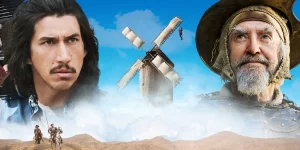
- Gilliam eventually completed The Man Who Killed Don Quixote in 2018, nearly two decades after this failed attempt, with Adam Driver and Jonathan Pryce in the lead roles.
- The film’s title echoes Cervantes’s own subtitle for Don Quixote: “The Ingenious Hidalgo Don Quixote of La Mancha.” Fulton and Pepe chose the title to place the disaster squarely in a literary context.
- Lost in La Mancha is frequently taught in film schools as a case study in production risk, completion bonds, and the vulnerability of independent productions with tight margins.
- Jean Rochefort remained publicly regretful about the project for years. In interviews, he expressed genuine grief at not being able to complete the role.
- Fulton and Pepe gave their documentary a formal theatrical release rather than a straight-to-video one, which reflected genuine confidence in the material as a standalone film.
- The production had roughly six days of actual shooting before it effectively collapsed, though the pre-production period documented in the film ran considerably longer.
Why Watch?
Watching Gilliam pace through the wreckage of his own production with a kind of furious optimism is more instructive about creative obsession than any masterclass on filmmaking. This documentary is one of the most honest records of what ambition actually looks like when the infrastructure fails it. No other behind-the-scenes film captures that specific grief this clearly.
Director’s Other Movies
- The Hamster Factor and Other Tales of Twelve Monkeys (1996)
- Lost Soul: The Doomed Journey of Richard Stanley’s Island of Dr. Moreau (2014) (note: this was directed by David Gregory, not Fulton and Pepe)
Keith Fulton and Louis Pepe’s directorial output has remained relatively small and focused primarily on documentary work. Their most significant films remain their two Gilliam projects.
Recommended Films for Fans
- Hearts of Darkness: A Filmmaker’s Apocalypse (1991)
- Burden of Dreams (1982)
- American Movie (1999)
- Side by Side (2012)
- Overnight (2003)
- The Man Who Killed Don Quixote (2018)
- Jodorowsky’s Dune (2013)