
When The Bear exploded onto Hulu in 2022, critics spent weeks praising its performances, its kitchen choreography, its suffocating single-take episode. Almost nobody outside the industry talked about Christopher Storer, the person who built the whole thing. Storer created the show, ran the writers’ room, directed multiple episodes, and held final say over every cut that went out. He is the showrunner. On a film set, the director holds that authority. On prestige television, the showrunner does, and the two jobs are nothing alike. If you watch a lot of high-budget TV and you have never thought hard about this role, you are missing the single most important creative force shaping what ends up on your screen.
The Showrunner Role Explained: What the Title Actually Means
A showrunner is a writer who also functions as an executive producer with full creative and operational control over a television series. That combination matters. Film directors control the set; showrunners control everything, from the script in episode one through the color grade on the season finale.
Most working directors do not write. Most writers do not direct. A showrunner has to do both, or at least supervise both with genuine authority. It is a hybrid job that has no real equivalent in film.
What a Showrunner Controls Day to Day
- Hiring and managing the entire writers’ room
- Approving or rewriting every script before production
- Working directly with the network or streaming platform on budget and schedule
- Overseeing casting decisions alongside the casting director
- Sitting in on edits and often directing episodes themselves
- Handling press, notes from executives, and damage control when something goes sideways on set
That list explains why burnout is so common in this role. Shonda Rhimes was running three network shows at once during her peak ABC years. That is not a creative exercise; that is a logistics operation with a writers’ room attached.
How the Showrunner Role Grew Out of the Writers’ Room
American television has always been writer-led, which is where it splits from British TV and from film. Network TV in the 1970s and 80s had head writers who functioned loosely as what we now call showrunners, but the title and the full scope of authority came later.
Steven Bochco is one of the clearest early examples. His work on Hill Street Blues in the early 1980s showed what a writer with genuine production control could build. The serialized storytelling, the ensemble chaos, the moral ambiguity: those choices came from the top of the writing staff, not from rotating directors.
Cable changed the math significantly. David Chase on The Sopranos and David Simon on The Wire both operated with a level of creative authority that network TV rarely allowed. When HBO gave Chase final cut and a long leash, the showrunner stopped being a production coordinator and started functioning more like an auteur.
Showrunner vs. Director: Who Actually Makes the Creative Calls
This is where film-trained viewers get confused. On a film, the director shapes the performances, frames the shots, and controls the pace of what you watch. On a television series, the director of a given episode is usually hired per-episode and has far less authority than that title implies.
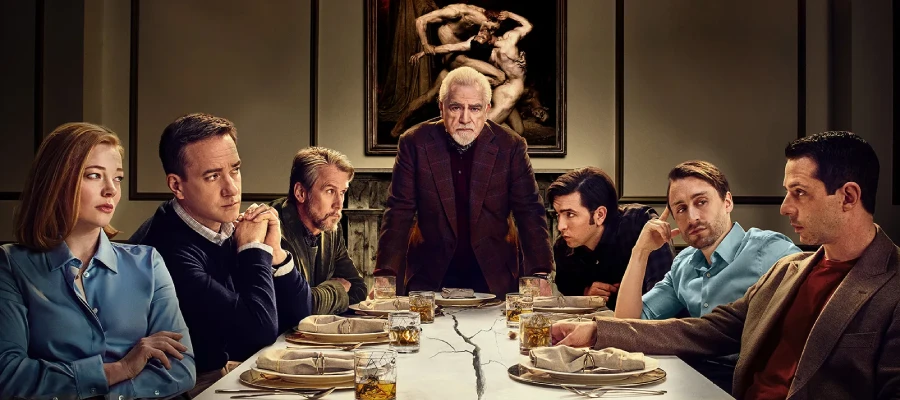
Consider Succession. Different directors shot different episodes across its four seasons. Mark Mylod directed a large portion of the series and brought real visual intelligence to it. But the voice of Succession, the rhythm of the dialogue, the way characters withhold and weaponize information, came from Jesse Armstrong‘s writers’ room. Armstrong is the showrunner. The directors served his vision, not the other way around.
That is not a knock on the directors. It is simply how the hierarchy works on prestige drama.
When the Showrunner Also Directs
Some showrunners direct heavily to maintain tighter control. Noah Hawley on Fargo did this deliberately, shaping not just story but visual tone across episodes. Issa Rae directed episodes of Insecure for similar reasons: she knew exactly what she wanted the show to feel like and did not want that filtered through someone else’s eye.
Christopher Storer directed the now-famous single-take episode of The Bear, “Review.” He did not hand that off. When the showrunner directs the most technically demanding episode of a season personally, that tells you everything about where the real creative investment sits.
Why Streaming Made This Job Harder and More Powerful
Netflix, HBO Max, Amazon, and Apple TV Plus all operate on a different model than network TV. Shorter seasons, bigger per-episode budgets, and fewer episodes per order. That structure gives the showrunner more creative control per episode, but it also raises the stakes on every single decision.
A network showrunner running 22 episodes a season can absorb a weak hour. A showrunner with six or eight episodes cannot. Every episode has to carry weight, which means the showrunner’s judgment is tested constantly and visibly.
- Streaming platforms often greenlight a full season at once, giving showrunners more planning room
- Fewer episodes mean less filler, but also less room to recover from a misstep
- Bigger budgets attract top directors and cinematographers, raising expectations for visual quality
- Platform executives still give notes, and managing those notes is a major part of the job
The power is real, but so is the pressure. Damon Lindelof has spoken openly about the psychological weight of running Lost and then The Leftovers. The audience relationship on serialized TV is long and demanding in ways that a two-hour film never is.
Not Every Showrunner Is an Auteur, and That Matters

Here is the honest part: the showrunner title does not automatically mean creative genius. Some showrunners are excellent writers who are poor managers. Some are brilliant at holding a room together but produce mediocre scripts. Some are hired specifically because they are safe pairs of hands that studios trust with expensive IP.
When Game of Thrones ended the way it did in its final two seasons, the conversation inevitably landed on David Benioff and D.B. Weiss. They are the showrunners. Attribution works both ways: when a show succeeds, the showrunner gets the credit; when it collapses, they own that too.
My read on the Benioff and Weiss situation: they were gifted adapters working from source material, and when that source material ran out, it became clear that the underlying dramatic architecture had been George R.R. Martin’s all along. That is not an insult. It is just a useful illustration of what showrunning actually requires at the highest level.
The Most Underrated Showrunners Working Today
- Lila Byock, who took over The Idol and tried to save a production that was already in trouble before she arrived
- Cord Jefferson, who adapted American Fiction and has moved into TV with real structural ambition
- Patrick Somerville, whose work on Station Eleven showed a rare ability to manage nonlinear storytelling across a large ensemble without losing emotional clarity
What Happens When the Showrunner Leaves Mid-Run
This is the stress test for the role. When a showrunner exits a show mid-production, the results are almost always visible on screen. Tone shifts. Character decisions that had been building toward something quietly reverse. The voice changes.
Roseanne losing its showrunner structure in its later original run showed how dependent a sitcom’s coherence is on whoever is running the room. More recently, troubled productions often trace back to a showrunner firing or an irreconcilable creative dispute between the showrunner and the studio.
Studios know this. It is why locking in a showrunner with a strong overall deal has become a standard play at every major streamer.


Why Fans Should Think About This Role More

If you credit a director when you love a film, credit the showrunner when you love a TV series. That is the honest version of how authorship works in this medium. When The White Lotus feels like nothing else on television, that is Mike White. He wrote every episode of both seasons and ran every room. You are watching his specific sensibility.
Learning to track showrunners the way cinephiles track directors changes what you notice and what you seek out next.
The Showrunner Is the Show
If the showrunner role explained anything clearly in the last decade of prestige TV, it is this: the writer is the auteur in television, not the director. Film culture took a century to build the director up as the singular creative voice. TV had a different power structure from the start, and streaming has made that structure more visible, not less.
My honest opinion is that we are currently in the best period for showrunner-driven television in the history of the medium, and the names worth following are the ones in the writers’ room, not just behind the camera. If you want a place to start, watch both seasons of The White Lotus back to back and pay attention to how completely Mike White controls tone, pacing, and moral perspective across wildly different casts and locations. No other single example makes the showrunner’s fingerprint clearer.