Eighteen years after Neo’s body vanished into the machine city, Keanu Reeves put the sunglasses back on. The Matrix Resurrections is not a reboot; it is a sequel that mocks the very idea of being made. Lana Wachowski returned alone, revived two dead heroes, and pointed the camera squarely at Hollywood’s nostalgia machine. Below, we unpack the modal, the Analyst, and the love story that powers the whole thing.
Detailed Summary
Inside the Modal
A woman in black leather fights police in a familiar hotel room while a stranger watches from the shadows. Bugs, a blue-haired rebel captain, has hacked into a looping simulation called a modal. She realizes the Trinity she is watching is a copy, and the scene is a replay of the original film’s opening.
An Agent chases Bugs through the building, then stops and begins asking questions of his own. He is a program slowly realizing he is Morpheus, or a version of him, built inside the modal. Bugs offers him a way out, and he takes it.
Thomas Anderson, Game Designer
In San Francisco, Thomas Anderson runs a studio called Deus Machina. His claim to fame is a trilogy of games called The Matrix, which he insists came from his dreams. His business partner Smith informs him that their parent company, Warner Bros., wants a fourth game whether Thomas likes it or not.
Thomas is barely holding together. He sees a therapist, the Analyst, who prescribes blue pills to quiet the visions, and he has already tried to kill himself by jumping from a rooftop. His only comfort is a coffee shop called Simulatte, where a married woman named Tiffany reminds him of a character he once wrote.
Red Pill, Again
Morpheus appears in a restroom stall and offers Thomas a red pill. Thomas refuses, convinced he is hallucinating. Bugs and her crew then stage an extraction that spills across the office while the building’s workers turn into mindless bots and hurl themselves at him.
Smith is more than a boss. He remembers being Agent Smith, and he attacks Thomas with the same hatred as before. Thomas swallows the pill during the chaos and wakes inside a pod.
A New Pod Field
Bugs’s ship, the Mnemosyne, pulls Neo from the fluid. Her crew includes humans and a synthient, a machine that chose to side with people. As Neo rises, he spots a second pod nearby holding Trinity.
Morpheus explains that his body in the real world is made of programmable nanoparticles. He was coded by Thomas himself, drawing on memories of both Morpheus and Smith. Bugs takes Neo to the last human city, which is no longer Zion.
Welcome to IO
Niobe, now a general in her nineties, runs a city called IO. She tells Neo that sixty years have passed since the truce. Zion fell after a civil war among the machines over dwindling energy, and some machines defected to the human side.
Niobe locks Neo in a cell to protect the city from whatever his return might trigger. Grown-up Sati visits him. She reveals that the Analyst rebuilt Neo and Trinity because their proximity, without union, generates more power than any other pairing.
Breaking Out
Bugs defies Niobe and frees Neo. The crew jacks into the Matrix with a plan: wake Trinity. Neo meets Tiffany at Simulatte and tries to tell her the truth while her husband and children wait outside.
The conversation crumbles until time freezes. Every customer stops mid-motion, and the Analyst strolls in. He has been in control the whole time.
The Analyst’s Confession
The Analyst replaced the Architect after Neo’s war. He discovered that fear and desire produce more energy than cold logic, so he rebuilt the Matrix around emotion. Neo and Trinity were his masterpiece; keep them close, deny them each other, and the output spikes.
He offers a deal. Neo may ask Trinity to choose, and if she picks her family, Neo returns to his pod quietly. Otherwise, the Analyst threatens to pull her plug.
The Merovingian and Smith
The crew retreats into an abandoned theater, where an aging Merovingian ambushes them with a gang of exiled programs. He blames Neo for the ugly modern Matrix and rants about social media and streaming. Smith, out for himself, crashes the fight and sides with Neo long enough to clear the room.
Neo’s powers are weaker than before. He can conjure force fields and push people away, but he can no longer fly. Smith slips away once the Merovingian’s gang is finished.
Trinity’s Choice
Niobe relents and lends IO’s support to the rescue. Neo meets Trinity at Simulatte for the final time while Bugs’s team moves on her pod in the real world. Trinity hesitates, walks out, and comes back.
She announces she never liked the name Tiffany and takes Neo’s hand. The Analyst’s machines fight to reel her back into the pod, and Bugs’s crew tears her loose. Smith arrives and shoots the Analyst, settling his own score.
Movie Ending
Trinity wakes in the real world for the first time in sixty years, but the fight inside the Matrix is far from over. The Analyst survives Smith’s attack and activates a swarm mode across the entire city. Every civilian becomes a bot, and the bots pour out of windows like rain to crush the fleeing pair.
Neo and Trinity race through the streets on a motorcycle as bodies fall from the sky. Neo throws up force fields to deflect the human hail, but the Analyst keeps raising the pressure. Cornered on a rooftop with no way down, they take each other’s hand and jump.
Neo falls. Trinity does not. She catches him in midair and discovers that she can fly, a power the Analyst never anticipated. Together they soar away from the swarm.
In the real world, Bugs’s crew celebrates, and Trinity’s pod sits empty for good. The Analyst keeps his job because the suits above him fear a reset more than they fear him. Neo and Trinity pay him a final visit in his office.
Trinity thanks him for giving her a second chance and warns him that they plan to redecorate his world. They promise rainbows and a sky worth looking at. Then they fly out of the window side by side.
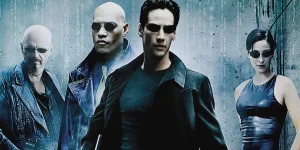
Why does it land? The original trilogy ended with Neo dying to save everyone; this one ends with two people refusing to be used as batteries for someone else’s story. Interestingly, the finale strips Neo of his flight so Trinity can finally take the lead. Love, not prophecy, becomes the literal engine of the Matrix and the thing that breaks it.
Are There Post-Credits Scenes?
Yes. After the credits finish, the film returns to the Deus Machina conference room. The game designers brainstorm a new project and conclude that nobody wants movies anymore. One of them pitches The Catrix, a product built entirely around cat videos.
The scene runs barely a minute, but it is the film’s final joke about the industry that produced it. Stay through the full credits if you want to see it.
Type of Movie
The Matrix Resurrections is a science fiction action film that doubles as a meta-commentary on sequels and reboots. It spends its first hour as a satire of the games industry and studio nostalgia, then shifts into a straightforward rescue adventure. The tone is warmer and more playful than the trilogy, with a romantic core.
Action takes a back seat to character. Expect fewer wire-fu set pieces and more conversation; the film carries an R rating for violence and language.
Cast
- Keanu Reeves – Neo / Thomas Anderson
- Carrie-Anne Moss – Trinity / Tiffany
- Yahya Abdul-Mateen II – Morpheus
- Jessica Henwick – Bugs
- Jonathan Groff – Smith
- Neil Patrick Harris – The Analyst
- Jada Pinkett Smith – Niobe
- Priyanka Chopra Jonas – Sati
- Lambert Wilson – The Merovingian
- Christina Ricci – Gwyn de Vere
- Brian J. Smith – Berg
- Toby Onwumere – Sequoia
- Eréndira Ibarra – Lexy
- Max Riemelt – Sheperd
- Andrew Caldwell – Jude
- Daniel Bernhardt – Agent Johnson
- Chad Stahelski – Chad
Film Music and Composer
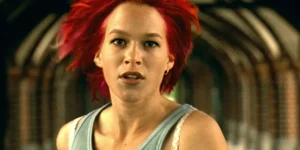
Johnny Klimek and Tom Tykwer composed the score. Both had worked with Lana Wachowski on Cloud Atlas and Sense8, and Tykwer directed Run Lola Run. Their music keeps traces of Don Davis’s brass motifs but leans toward electronic pulses and softer, more melodic themes for Neo and Trinity.
Davis did not return for this entry. Licensed music matters once again: Jefferson Airplane’s “White Rabbit” underscores Thomas’s pill-addled routine, and a brass cover of “Wake Up” by Brass Against plays over the credits, nodding to the original film’s closer.
Filming Locations
Lana Wachowski shot much of the film in San Francisco, a deliberate break from Sydney and the anonymous city of the trilogy. The Financial District hosted the bot-rain chase, and the rooftop jump took place downtown. Choosing a real, named city reflects the film’s preference for the tangible over the abstract.
Production began in February 2020 and paused weeks later because of the pandemic. Filming resumed in August 2020 at Studio Babelsberg near Berlin, where interiors such as IO and the pod fields came together. Berlin’s role explains the number of German actors in the crew of the Mnemosyne.
Awards and Nominations
The Matrix Resurrections received no Academy Award nominations. It drew some genre and fan award recognition, mostly for its visual effects and for Reeves and Moss, but no major wins.
Behind the Scenes Insights
- Lana Wachowski directed alone; her sister Lilly chose not to participate and gave the project her blessing.
- Lana co-wrote the script with novelists David Mitchell and Aleksandar Hemon, her collaborators from Cloud Atlas and Sense8.
- Lana has said that the deaths of her parents led her to revive Neo and Trinity as a way of processing grief.
- Reeves and Moss performed the rooftop jump themselves on wires, leaping from a real downtown building around twenty times.
- Hugo Weaving was in talks to return as Smith but could not resolve a scheduling conflict with a stage commitment.
- Laurence Fishburne has said he was not asked to return, and the film explains the new Morpheus as a program built from memories.
- Chad Stahelski, who plays Tiffany’s husband, was Reeves’s stunt double in the original trilogy before directing the John Wick films.
- Warner Bros. released the film in theaters and on HBO Max on the same day, which led Village Roadshow to sue the studio over lost revenue.
- The film grossed well under its budget and became the lowest-earning entry in the series.
Inspirations and References
The movie’s biggest influence is the franchise itself. Clips from the original trilogy play on screens throughout, and the modal recreates the 1999 opening shot for shot before breaking it. Lana Wachowski treats nostalgia as a theme, a drug, and a trap.
Grief and therapy shape the story as much as philosophy. The Analyst’s blue pills work like antidepressants, and the film frames Thomas’s dismissal of his memories as a kind of medicated denial. The ship Mnemosyne takes its name from the Greek goddess of memory.
Alice imagery survives in Bugs’s white rabbit tattoo, while her name honors a cartoon rabbit instead. IO is the binary pair one and zero, the building blocks of code. The Merovingian’s rant about social media reads as the director’s own frustration with modern online culture.
Alternate Endings and Deleted Scenes
No alternate ending has been released, and the home video edition favored behind-the-scenes featurettes over deleted footage. Neo and Trinity flying away together was always the intended finish. Because the film explicitly refuses to end on a sacrifice, there was no darker version waiting on the cutting room floor.
Wachowski has described the ending as the one she wanted after losing people she loved. In short, the happy ending is the point rather than a compromise.
Book Adaptations and Differences
The Matrix Resurrections is not based on a book. The screenplay is an original work by Lana Wachowski, David Mitchell, and Aleksandar Hemon. The involvement of two novelists is notable, but neither adapted an existing novel for the project.
Within the story, the games created by Thomas Anderson function as a fictional adaptation of the first three films. That meta layer, not any outside text, is the film’s real source.
Memorable Scenes and Quotes
Key Scenes
- Bugs watching a replica of Trinity’s hotel fight inside the modal.
- Thomas pitching ideas for the fourth game while his staff recite marketing buzzwords.
- Morpheus offering the red pill in a restroom stall.
- Smith revealing his true identity and brawling with Neo in the office.
- Neo waking in the pod and seeing Trinity’s pod beside him.
- The Analyst freezing Simulatte to deliver his confession.
- The Merovingian’s theater ambush and his rant about the modern world.
- Trinity taking Neo’s hand while the machines fight to pull her back.
- The bot rain chase through downtown San Francisco.
- Trinity catching Neo in midair and flying.
Iconic Quotes
- “Nothing comforts anxiety like a little nostalgia.”
- “The sheeple aren’t going anywhere.”
- “I’m not a believer in pills.”
- “Welcome back, Mr. Anderson.”
- “Time to fly.”
Easter Eggs and Hidden Details
- The Analyst’s cat is named Déjà Vu, a callback to the black cat glitch from the first film.
- The coffee shop Simulatte mashes together simulation and latte, and it is where Neo and Trinity keep almost meeting.
- Deus Machina echoes Deus Ex Machina, the machine god Neo bargained with in Revolutions.
- Thomas’s coworker Jude behaves like a handler for the Analyst, and his name points to Judas.
- Agent Johnson from Reloaded returns briefly, played again by Daniel Bernhardt.
- The office escape reverses the cubicle scene from 1999: this time the workers attack instead of staring.
- Bugs’s crew includes a synthient, proof that the truce Neo negotiated changed the machines too.
- Footage of the original Morpheus and Smith appears on screens, so the new actors are literally playing characters based on characters.
- Trinity’s old motorcycle skills from the freeway chase resurface in her job building bikes.
Trivia
- Warner Bros. released the film on December 22, 2021, more than eighteen years after Revolutions.
- It is Lana Wachowski’s first feature directed without her sister.
- The budget ran close to $190 million, and worldwide box office came in well below that figure.
- Jonathan Groff has said he studied Hugo Weaving’s performance closely before building his own version of Smith.
- Priyanka Chopra Jonas plays the adult Sati, a character introduced as a child in Revolutions.
- The pandemic shutdown split production across two continents and more than six months.
- Neo can no longer fly in this film, but he develops force shields instead.
- The post-credits scene pitches a cat-video product called The Catrix.
Why Watch?
The Matrix Resurrections is messy, sincere, and unlike any other legacy sequel. It skewers the machine that demanded it, then earns a romantic ending the trilogy never allowed. Reeves and Moss still crackle together, and Lana Wachowski’s playful honesty makes it worth the ride.
Director’s Other Movies
- Bound (1996)
- The Matrix (1999)
- The Matrix Reloaded (2003)
- The Matrix Revolutions (2003)
- Speed Racer (2008)
- Cloud Atlas (2012)
- Jupiter Ascending (2015)