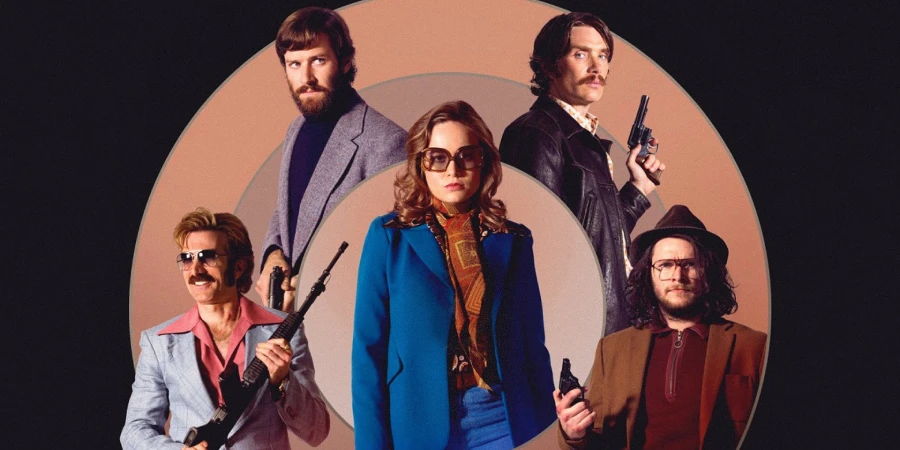

Twelve people walk into a warehouse. None of them walk out. Free Fire is a 70-minute exercise in escalating chaos, built almost entirely around a single gunfight that refuses to end politely. Director Ben Wheatley strips action cinema down to its most absurd, painful, and darkly funny bones, delivering a film where nobody is competent enough to win and everybody is too stubborn to quit.
Detailed Summary
The Deal is Set Up
Boston, 1978. A weapons deal between two IRA members and a group of American arms dealers takes place inside an abandoned warehouse at night. Chris (Cillian Murphy) and Frank (Michael Smiley) represent the Irish side, looking to buy rifles for the IRA. They arrive with muscle in tow, ready to close the deal quickly and cleanly.
Brokering the transaction are Justine (Brie Larson) and Ord (Armie Hammer), two middlemen who clearly enjoy the money more than the cause. On the other side, Vernon (Sharlto Copley) shows up as the flamboyant, self-aggrandizing arms dealer, backed by his own crew. Vernon immediately makes a bad impression; he shows up with the wrong rifles.
Wrong Guns, Wrong Night
Chris ordered M16s. Vernon delivers AR-70s instead. This immediately sours the mood, but pragmatism wins out and the deal limps forward anyway. However, the real problem is not the rifles.
Two members of the opposing crews, Stevo (Sam Riley) and Harry (Jack Reynor), recognize each other from the night before. Harry had beaten Stevo’s cousin badly in a prior altercation. Stevo escalates verbally, Harry snaps, and suddenly a gun goes off. That single shot detonates the entire evening.
Everyone Starts Shooting
Within moments, both sides open fire and the warehouse becomes a battlefield. Notably, nobody here is a trained soldier or a movie-perfect marksman. People get hit immediately but rarely fatally, dragging themselves across dirty floors with wounds that slow them down rather than stop them cold.
In addition to the core conflict, it quickly becomes clear that Leary (Babou Ceesay) and Martin (Brendan Gleeson’s son Domhnall… actually, this is Martin played by Babou Ceesay as Ord’s right-hand man) and other peripheral crew members make alliances fluid and loyalties suspect. Justine, meanwhile, proves herself more resourceful than anyone anticipated, crawling through the crossfire with sharp, calculating eyes.
Hidden Snipers Change Everything
Partway through the firefight, two mysterious snipers open up from the warehouse rafters. Ord realizes there are players in this game that nobody invited. Consequently, both sides find themselves caught between each other and an unseen threat from above.
It turns out Justine had hired the snipers herself. She made a separate deal, planning to take the money and leave everyone behind. Her betrayal reframes the entire film; she was never a neutral broker. She was running her own exit strategy from the start.
Alliances Collapse and Bodies Pile Up
As the gunfight drags on, characters who seemed allied start shooting each other for convenience or survival. Vernon is spectacularly useless under pressure, whimpering and scheming in equal measure throughout. Frank and Chris try to maintain some semblance of a plan, but the warehouse keeps eating their options.
Stevo, whose drunken aggression started the whole disaster, gets picked off relatively early. His death underscores the film’s central joke: the man who lit the fuse does not get to see the explosion through. Characters make desperate crawling journeys across the warehouse floor just to accomplish simple goals, and it is frequently hilarious despite the blood.
Movie Ending
Bodies accumulate rapidly in the final act. Frank dies. Vernon takes multiple wounds but keeps surviving in increasingly pitiful fashion, dragging himself around and begging for mercy. Chris and Ord, who have developed a grudging mutual respect across the carnage, find themselves among the last people standing.
Justine kills one of her own snipers when he becomes a liability. She shoots Vernon herself before he can cause any more chaos, ending his insufferable presence with a matter-of-fact pragmatism that feels entirely earned. Her cold efficiency in these final moments confirms she was the most dangerous person in the room all along.
Ord, wounded but functional, and Chris, barely holding together, finally face each other. Their confrontation feels less like a climactic showdown and more like two exhausted survivors settling a debt. Chris shoots Ord. Both men effectively neutralize each other in the film’s closing moments, leaving Justine as the last person alive in the warehouse.
Justine retrieves the money and walks toward the exit. Police sirens wail outside; the authorities are finally arriving after an evening of distant gunshots in a derelict building. She has the cash, she has survived, and she has exactly zero seconds to enjoy it before the police close in. Free Fire ends without a clean getaway, without a triumphant survivor, and without sentimentality. It is a punchline delivered in sirens.
This ending matters because it refuses every genre convention. Nobody wins cleanly. The most calculating person survives the violence only to walk into a different trap. Wheatley argues, with bleak comic precision, that competence in one area does not guarantee freedom from consequences in another.
Are There Post-Credits Scenes?
Free Fire does not include any post-credits scenes. Once the film ends, it ends completely. There are no stingers, no bonus footage, and no teases for a sequel. Wheatley closes the door firmly and locks it behind him.
Type of Movie
Free Fire is a black comedy action thriller. Its tone sits at a very specific intersection: genuinely funny, consistently tense, and periodically grim. It belongs to a tradition of single-location, real-time action films, but its comedic sensibility sets it apart from straightforward genre entries.
In contrast to slick Hollywood action, Wheatley deliberately undercuts every moment of supposed cool. Nobody reloads efficiently. Nobody delivers a clean one-liner without immediately getting shot. The comedy and the violence inform each other at every turn.
Cast
- Brie Larson – Justine
- Cillian Murphy – Chris
- Armie Hammer – Ord
- Sharlto Copley – Vernon
- Michael Smiley – Frank
- Sam Riley – Stevo
- Jack Reynor – Harry
- Babou Ceesay – Ord’s associate
- Noah Taylor – Gordon
- Enzo Cilenti – Bernie
Film Music and Composer
Ben Salisbury and Geoff Barrow composed the score for Free Fire. Both composers had previously worked with director Alex Garland on Ex Machina and Annihilation, building a reputation for tense, atmospheric electronic work. Their score for Free Fire leans into the period setting while maintaining a contemporary unease.
The film also makes notable use of John Denver’s “Annie’s Song,” which plays at a key moment and contrasts beautifully with the surrounding carnage. That musical choice is pure Wheatley: sincere, absurd, and slightly devastating all at once.
Filming Locations
Free Fire was primarily filmed in Brighton, England, despite being set in Boston. The production found a large derelict building that could convincingly serve as the abandoned warehouse at the story’s center. Shooting in a real, dilapidated space gave the film a tangible grittiness that a built set might not have achieved.
The confined location is not merely a budget decision; it is a narrative one. Every visual choice reinforces the feeling of entrapment. There is nowhere to go, and the camera constantly reminds you of that fact.
Awards and Nominations
Free Fire received recognition on the UK awards circuit, including attention from the British Independent Film Awards. However, it did not secure major mainstream awards wins or high-profile nominations at the biggest ceremonies.
Behind the Scenes Insights
- Ben Wheatley and co-writer Amy Jump wrote the script specifically to be contained within one location, partly as a practical production challenge they set for themselves.
- Cast members rehearsed extensively so that every actor knew where every character was in the warehouse at any given moment during filming.
- Sharlto Copley improvised several of Vernon’s more outrageous lines, which Wheatley kept in the final cut.
- Producer Andrew Lowe and executive producer Martin Scorsese were involved in bringing the project to international audiences.
- Shooting on location in a real derelict building created genuine physical discomfort for the cast, who spent long days crawling on concrete floors.
- The 1978 setting was chosen partly to remove mobile phones from the equation, since modern communication technology would have changed or ended the standoff quickly.
Inspirations and References
Wheatley has cited classic crime films and the work of Sam Peckinpah as touchstones for Free Fire. Peckinpah’s interest in the messy, unglamorous reality of violence clearly influenced Wheatley’s decision to make every gunshot hurt and every wound linger. The film wears that influence openly without feeling derivative.
There is also a clear debt to Reservoir Dogs in the DNA here: criminals in a confined space, loyalties fracturing under pressure, violence that is simultaneously ugly and absurd. Furthermore, the period setting nods to 1970s crime cinema broadly, evoking the grimy texture of films from that era.
Alternate Endings and Deleted Scenes
No officially released alternate endings or significant deleted scenes for Free Fire have been made widely available. Wheatley tends to work with precise, tightly constructed edits, and the film’s real-time structure leaves little room for radically different narrative conclusions. What ended up on screen appears to reflect the script’s intended destination from early on.
Book Adaptations and Differences
Free Fire is not based on a book, a comic, or any previously existing source material. Ben Wheatley and Amy Jump wrote the original screenplay themselves. There are no source material comparisons to make.
Memorable Scenes and Quotes
Key Scenes
- The first gunshot, fired by Harry after Stevo provokes him, which triggers the entire firefight from a standing start with almost no warning.
- Justine’s reveal as the person who hired the snipers, recontextualizing her calm demeanor throughout the preceding chaos.
- Vernon’s prolonged, whimpering survival across multiple wounds, crawling desperately while simultaneously trying to negotiate his way out of consequences.
- “Annie’s Song” playing over a moment of bleak, blood-soaked absurdity, creating one of the film’s most tonally perfect sequences.
- The final confrontation between Chris and Ord, two men too exhausted and wounded to do anything dramatic, settling things with grim, quiet inevitability.
- Justine walking toward the exit with the money as sirens fill the soundtrack, the perfect anticlimactic punctuation to everything that preceded it.
Iconic Quotes
- “I’m shot. I’ve been shot. This is really bad.” – Vernon, providing the film’s most accurate self-assessment.
- “I think everybody needs to calm down.” – Ord, with supreme understatement, as the warehouse descends into chaos.
- “Why do I always get the idiots?” – Vernon, before becoming the biggest idiot in the room.
Easter Eggs and Hidden Details
- The wrong rifles that Vernon delivers are a visual callback to real-world arms deal complications during the IRA conflicts of the 1970s, grounding the absurdity in historical texture.
- Justine’s wardrobe is notably more practical than anyone else’s from the start, a subtle visual hint that she came prepared for things to go wrong.
- Several background bullet holes accumulate in specific warehouse walls throughout the film; attentive viewers can track the geography of the fight by reading the damage.
- Ord’s sunglasses, worn throughout the firefight, are a running visual gag that comments on his insistence on maintaining cool in the most uncool circumstances imaginable.
- The snipers’ positions in the rafters are briefly visible in wide shots before their identities and purpose are revealed, rewarding careful viewers on a second watch.
Trivia
- Free Fire runs approximately 90 minutes, with the gunfight itself occupying the vast majority of that runtime.
- Martin Scorsese served as an executive producer on the film, lending significant credibility and helping secure distribution.
- The film had its world premiere at the Toronto International Film Festival in 2016.
- Wheatley and Jump have collaborated as writer-director partners on multiple films, and Free Fire represents one of their most commercially accessible works.
- Sharlto Copley’s South African accent for Vernon was the actor’s own idea, adding another layer of inexplicable randomness to the character.
- Several cast members sustained minor bruises and scrapes from the prolonged shooting on concrete floors inside a real derelict structure.
- The film’s poster and marketing leaned heavily into its black comedy credentials, positioning it as a fun, irreverent night out rather than a serious crime drama.
Why Watch?
Free Fire does something genuinely rare: it makes incompetence entertaining for an entire feature runtime. If you enjoy films that find dark humor in human failure without flinching from real consequences, this is essential viewing. Wheatley and his cast commit fully to the premise, and that commitment pays off in a film that is funnier, sharper, and stranger than its elevator pitch suggests.
Director’s Other Movies
- Kill List (2011)
- Sightseers (2012)
- A Field in England (2013)
- High-Rise (2015)
- Rebecca (2020)