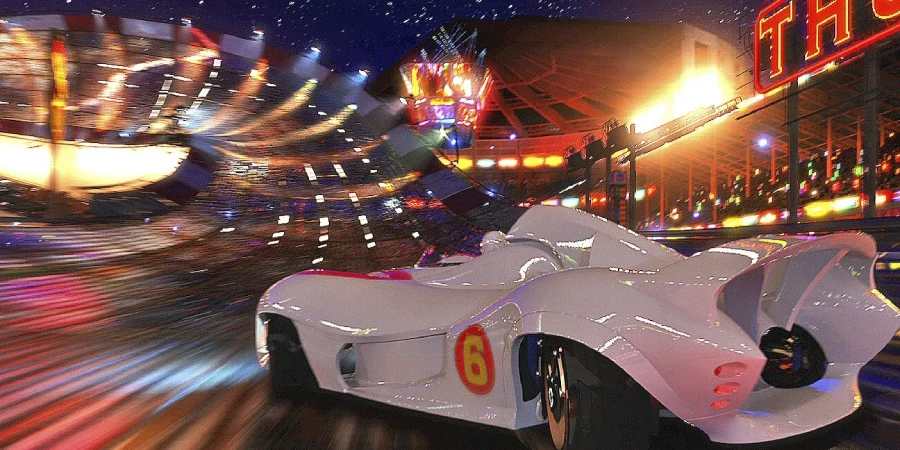

Nobody warned audiences that Speed Racer would look like a neon fever dream projected directly onto their retinas. The Wachowskis built a film where the racetrack exists outside of physics, outside of geography, and arguably outside of time, with cars trading paint at speeds that make Formula One look like a parking lot. Every frame is saturated to the point of mild visual aggression, and that is entirely the point. This is a film that works precisely because it refuses to behave.
Detailed Summary
Speed’s Childhood and the Shadow of Rex Racer
We meet Speed Racer as a kid, daydreaming about cars during class while his older brother Rex tears up tracks across the world. Rex is Speed’s entire universe. Speed measures his own lap times against Rex’s records, chalked secretly on his bedroom wall.
Rex eventually dies in a crash during the brutal Casa Cristo Classic rally race, a cross-country endurance event notorious for corruption and danger. Speed carries that loss into adulthood. It shapes everything: his driving style, his loyalty to his family’s independent racing outfit, and his stubborn refusal to sell out.
Royalton Industries Makes Its Move
Adult Speed, played by Emile Hirsch, is now a serious racer driving for his family’s team. He wins a major race with enough flair to attract E.P. Royalton, the slick and predatory head of Royalton Industries, the biggest corporate sponsor in racing. Royalton throws money, a penthouse, and a buffet at Speed’s family to seduce them into a contract.
Speed turns him down. He wants to race for his family, full stop. Royalton does not take rejection well. He reveals, with chilling corporate calm, that major races are fixed by a cartel of corporate sponsors, and that Speed will never win another sponsored event. Then he sets out to prove it, personally.
Inspector Detector and Racer X Enter the Picture
Inspector Detector and the mysterious Racer X approach Speed with a proposition. They want him to enter the Casa Cristo Classic and gather evidence against the corrupt racing cartel. Racer X is cool, masked, and clearly harboring secrets he will not share.
Speed agrees. He enters the race alongside his navigator Taejo Togokhan, a corporate racer with his own complicated agenda, and Racer X. Speed’s girlfriend Trixie provides aerial support. His mechanic brother Spritle and the family chimpanzee Chim Chim mostly provide comic relief, though they do manage to stow away in a cargo transport at one point.
The Casa Cristo Classic
Casa Cristo is spectacular and brutal. Cars race across deserts, frozen mountain passes, and jungle terrain while assassins, saboteurs, and corporate hitmen try to eliminate threats to the cartel. Ninja fighters drop onto moving vehicles. Speed and Racer X develop a grudging mutual respect while fighting off attacks together.
Taejo, it turns out, only wanted to finish in the top three to inflate his family company’s stock value before a buyout. He achieved that goal. He has no intention of actually testifying against the cartel. Speed feels used. The investigation stalls.
Royalton Tightens the Noose
Royalton rigs the prestigious Fuji Helexicon race to destroy Speed publicly. His sponsored drivers physically wreck Speed’s car mid-race. Speed still manages a heroic but ultimately futile performance. Royalton’s message lands: you cannot beat the system from inside the system.
Speed’s family faces mounting financial pressure. His father Pops Racer watches his son get dismantled on live television and quietly fumes. This is one of the film’s best emotional beats, John Goodman playing Pops as a man absorbing fury through his jaw muscles.
Taejo’s Sister Provides a Way Forward
Taejo’s sister Horuko gives Speed an entry to the Grand Prix as a gesture of personal respect. It is not Taejo keeping his word; it is a private act of honor from someone who actually believes in Speed. That distinction matters thematically.
Speed now has a shot at the one race Royalton has staked his reputation on. Royalton’s driver, the ruthless Cannonball Taylor, is the defending champion. The cartel expects to control the outcome.
Movie Ending
Speed qualifies for the Grand Prix under genuine threat of sabotage and assassination. Royalton throws everything at stopping him, legal, mechanical, and physical. Speed’s car gets enhanced by the Racer family working through the night, Pops putting decades of engineering knowledge into a vehicle that feels like the family itself made manifest in metal.
During the race, the Wachowskis go fully abstract. Cars spin through tracks that loop and twist like roller coasters designed by someone who slept through physics class. Color bleeds between shots. Speed enters what the film calls a “racing nirvana,” a pure flow state where driver and car dissolve into something unified, shown through a kaleidoscopic visual sequence that crosscuts between young Speed dreaming about racing and adult Speed actually doing it.
He wins. Speed crosses the finish line and breaks Rex’s record. It is an unambiguously triumphant ending, and the film earns it because it has spent two hours insisting that joy and sincerity are not naive.
The reveal that Racer X is actually Rex Racer, Speed’s supposedly dead brother, lands quietly. Racer X confirms the truth to himself in private, then chooses not to tell Speed. He had reconstructive surgery and built a new identity to work undercover against the cartel. Telling Speed would only reopen wounds and compromise his ongoing work. It is the film’s most genuinely adult emotional choice.
Royalton faces arrest. The cartel collapses under the weight of the evidence gathered. Speed’s family team survives, intact and vindicated. Trixie runs to Speed on the podium. Spritle and Chim Chim eat a lot of candy. Everything resolves with warmth and color, which is exactly right for what this film set out to be.
Are There Post-Credits Scenes?
Speed Racer does not include any post-credits scenes. Once the credits roll over the final celebration, the film is done. You can leave the theater, or streaming queue, without penalty.
Type of Movie
Speed Racer is a live-action family action film with heavy science fiction aesthetics and an anti-corporate thematic spine. Its tone sits somewhere between a Saturday morning cartoon and a psychedelic pop art installation. It plays sincerely, never winking at the audience or apologizing for its own enthusiasm.
Genre-wise, it combines racing action, family drama, and corporate conspiracy thriller. The comedy is broad and physical. The emotional beats are genuine. It is not ironic about any of it.
Cast
- Emile Hirsch – Speed Racer
- John Goodman – Pops Racer
- Susan Sarandon – Mom Racer
- Christina Ricci – Trixie
- Matthew Fox – Racer X / Rex Racer
- Roger Allam – E.P. Royalton
- Paulie Litt – Spritle Racer
- Rain – Taejo Togokhan
- Hiroyuki Sanada – Mr. Togokhan
- Scott Porter – Rex Racer (young adult)
- Kick Gurry – Sparky
- Benno Furmann – Inspector Detector
Film Music and Composer
Michael Giacchino composed the score for Speed Racer, drawing on the original Mach GoGoGo anime theme while building his own orchestral and electronic hybrid around it. His work here is one of the most underrated elements of the film. It carries genuine momentum without overselling the emotion.
Giacchino incorporates the classic Speed Racer television theme in ways that feel earned rather than nostalgic. During the Grand Prix finale, the score surges with enough intensity to make a car race feel like a space launch. His background scoring animated and action films made him a natural fit for material this kinetically conceived.
Filming Locations
Speed Racer shot almost entirely on soundstages in Berlin, Germany, at Babelsberg Studio. This was a deliberate choice. The Wachowskis wanted complete control over the environment so they could blend live-action performances with digital backgrounds seamlessly.
There are essentially no practical outdoor locations in the film. Every racetrack, every landscape, every sky was constructed digitally or physically built on set. This explains the film’s hermetically artificial quality, which is a feature, not a bug. Real geography would have undercut the cartoon logic the Wachowskis were building.
Awards and Nominations
Speed Racer did not collect significant awards attention. It received some recognition in technical and visual effects categories at smaller industry events, but major awards bodies largely ignored it.
Behind the Scenes Insights
- The Wachowskis developed a technique they called “hyper-stylized photography,” keeping multiple planes of action in sharp focus simultaneously to mimic the flat, layered look of anime cels.
- Emile Hirsch trained extensively to understand racing dynamics so his physical performance in the cockpit would feel instinctive rather than theatrical.
- John Goodman and Susan Sarandon reportedly improvised some of their quieter domestic scenes together, which accounts for the naturalistic warmth between Pops and Mom Racer.
- The chimpanzee scenes required significant coordination between the animal trainers and the directors to time comedy beats against the film’s frenetic editing rhythm.
- Roger Allam, who plays Royalton, delivered his corporate villain speech about race-fixing in a single extended take during rehearsals, and the energy of that rehearsal influenced how the Wachowskis shot the final version.
- The production used a then-cutting-edge workflow that composited actors against digital backgrounds in real time on set, allowing performers to actually see their environment while acting.
- Matthew Fox wore prosthetics and padding under the Racer X costume to bulk up his silhouette and prevent audiences from recognizing him physically.
Inspirations and References
Speed Racer adapts the Japanese manga and anime series Mach GoGoGo, created by Tatsuo Yoshida and first published in 1966. The American animated adaptation, titled Speed Racer, aired in the late 1960s and became a cult classic through syndication.
The Wachowskis drew heavily on the visual grammar of anime: speed lines, flat color planes, exaggerated action, and emotional sincerity delivered without embarrassment. Pop art, particularly its embrace of commercial imagery as legitimate aesthetic material, also clearly informed the design philosophy.
Thematically, the film engages with very real concerns about corporate corruption in motorsport. Formula One’s own history of team orders, sponsorship politics, and financial manipulation gave the cartel storyline a factual undertow that grounds the cartoon surface.
Alternate Endings and Deleted Scenes
No officially released alternate ending exists for Speed Racer. The Wachowskis have not discussed significant cut material in detail in publicly available sources. Some footage visible in early trailers does not appear in the final film, suggesting editing adjustments during post-production, but no formal deleted scenes package has been widely released.
Book Adaptations and Differences
Speed Racer is not based on a book. Its source material is the manga and anime series Mach GoGoGo. A junior novelization of the 2008 film was published to accompany the theatrical release, but it follows the film rather than serving as a separate creative work.
Compared to the original anime, the film significantly expands the corporate conspiracy angle and gives the Racer family more emotional depth. The original series was episodic and lighter on serialized drama. Rex Racer’s double identity as Racer X existed in the source material, though the film handles its reveal with considerably more restraint.

Memorable Scenes and Quotes
Key Scenes
- Young Speed sitting at his school desk, mentally racing while his teacher speaks, the classroom dissolving into track imagery in a sequence that establishes his entire psychology in under two minutes.
- Royalton’s monologue revealing the corrupt cartel to Speed, Roger Allam leaning forward across a desk, his voice dropping from charm to contempt in a single sentence. It is the film’s sharpest dramatic scene.
- Pops confronting a corporate spy in Speed’s pit garage and physically removing him with a wordless efficiency that says everything about this family’s values.
- The Casa Cristo desert sequence, where cars fight at two hundred miles per hour across salt flats while a ninja drops from a helicopter onto Speed’s roof.
- Speed entering racing nirvana during the Grand Prix finale, the screen fracturing into layered childhood and adult imagery while the score surges and the car becomes a blur of white light.
- Racer X sitting alone after the race, removing his mask, confirming his identity to himself and to us, and then choosing silence. Matthew Fox holds the frame with almost nothing, and it works completely.
Iconic Quotes
- “I don’t know what’s out there, but I know it’s big and I know it’s mine.” (Speed Racer)
- “You’re an amateur who’s been deluded into thinking that desire is enough.” (E.P. Royalton)
- “Move, get out the way!” (Spritle, shouting from the crowd, a moment of pure comedic timing from Paulie Litt)
- “If you think of your car as just a machine, you’re never going to win.” (Pops Racer)
Easter Eggs and Hidden Details
- Speed’s car number is 5, matching the original Mach 5 from the anime. Every visual detail of the Mach 5’s design, including the cockpit layout and the hood ornament, faithfully mirrors the cartoon.
- Background crowd scenes contain spectators holding signs in Japanese katakana that translate to phrases from the original anime’s theme song.
- During the Casa Cristo race, a destroyed car briefly bears a number that matches a car from the original anime series.
- Spritle’s bedroom contains posters and toys that reference specific episodes of the 1967 American Speed Racer animated series.
- Trixie’s helicopter has a small logo detail that mirrors the design of the original anime’s aircraft sequences.
- Some of the track architecture during the Grand Prix contains hidden patterns that, when frozen frame by frame, resemble the logo of the fictional Racer Motors company from the source material.
Trivia
- The film runs approximately 135 minutes, making it one of the longer family-oriented studio films of its era.
- Warner Bros. released Speed Racer the same summer as Iron Man and The Dark Knight, two films that collectively redefined studio expectations for superhero and action films. The comparison in box office performance was not kind to Speed Racer.
- Despite a difficult theatrical run, the film has since developed a devoted cult following, particularly among viewers who first saw it as children.
- The Wachowskis insisted on casting actors who could hold emotional scenes without irony, specifically because they wanted no winking at the audience about the material’s cartoon origins.
- Christina Ricci prepared for Trixie by studying the original anime’s portrayal of the character as competent and emotionally direct, pushing back against any reading of Trixie as a passive love interest.
- Rain, the South Korean pop star who plays Taejo, learned to deliver his English dialogue phonetically for scenes requiring rapid-fire delivery during action sequences.
- The film’s color grading process was unusually long because the Wachowskis wanted specific hues to carry narrative weight, certain colors appearing only in scenes involving Speed’s childhood memories.
Why Watch?
Watch Speed Racer because Roger Allam’s Royalton delivers one of the great underappreciated villain speeches in studio filmmaking, a four-minute takedown of idealism that makes the eventual triumph feel genuinely necessary. Beyond that speech, this is a film that bets its entire budget on sincerity and wins. Few studio productions from this era had the nerve to be this joyful without flinching.
Director’s Other Movies
- Bound (1996)
- The Matrix (1999)
- The Matrix Reloaded (2003)
- The Matrix Revolutions (2003)
- Cloud Atlas (2012)
- Jupiter Ascending (2015)
Recommended Films for Fans
- The Matrix (1999)
- Dick Tracy (1990)
- Sky Captain and the World of Tomorrow (2004)
- Redline (2009)
- Tron: Legacy (2010)
- Ready Player One (2018)
- Turbo Kid (2015)
- Baby Driver (2017)
- Alita: Battle Angel (2019)