
A young British-Pakistani man runs a laundrette with his white ex-gang-member lover in Thatcher’s London, and the film never once lets you forget how absurd and precarious that situation is. Stephen Frears shot My Beautiful Laundrette on 16mm video for Channel 4, fully expecting it to air on television and disappear. Instead, it got a cinema release, a BAFTA nomination, and a place in the permanent argument about what British cinema can do when it stops being polite. Hanif Kureishi’s screenplay does not waste a single scene on comfort.
Detailed Summary
Omar’s Circumstances at the Start
We meet Omar Ali in a South London flat, caring for his alcoholic, politically romantic father Hussein, a former journalist who left Pakistan full of socialist idealism and landed in England to watch that idealism curdle. Omar has no job, no direction, and no obvious future. His father pushes him toward his uncle, Nasser, a prosperous and thoroughly pragmatic businessman who has thrived by abandoning ideology entirely.
Omar Enters Nasser’s World
Nasser gives Omar small work, running errands and collecting debts, pulling him into a network of South Asian entrepreneurship built on tenacity and moral flexibility. Nasser himself keeps a white English mistress, Rachel, openly, while his wife and daughters live at home. Omar absorbs all of this, watching how his uncle operates: charm on the surface, ruthlessness underneath.
Nasser also has a partner, Salim, whose money comes from sources the film keeps deliberately vague but unmistakably criminal. Omar learns quickly that survival in this world means not asking too many questions.
Johnny Reappears
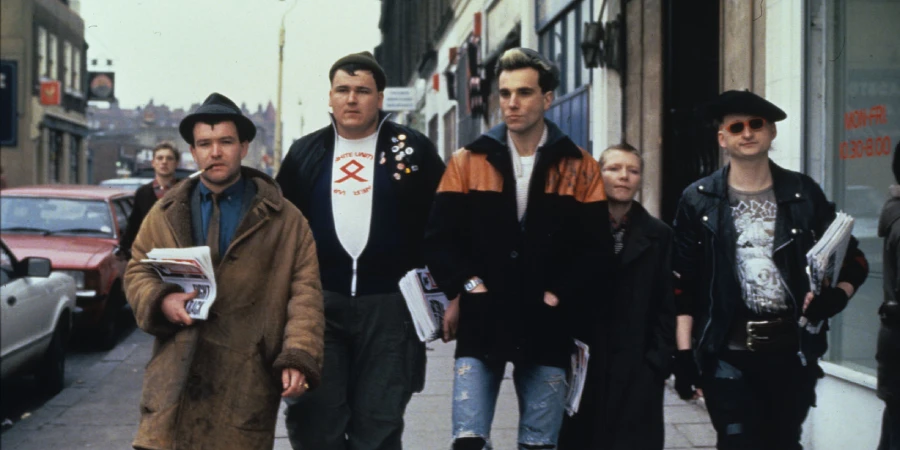
Johnny, played by Daniel Day-Lewis, turns up as a drifter, loitering with a group of National Front-adjacent white youths who had previously harassed Omar and his family. He and Omar have history, the nature of which the film reveals slowly. They were close as teenagers, perhaps more than close.
Omar approaches Johnny without fear or resentment, and that confidence is one of the film’s quietly remarkable moves. He offers Johnny a job helping fix up the laundrette Nasser has handed him to manage. Johnny accepts.
Renovating the Laundrette
Omar has ambitions for the laundrette that go well beyond clean sheets. He wants neon lights, a video screen, a lounge area, something aspirational and flashy that Nasser initially mocks. Omar borrows money from Salim to fund it, which tightens Salim’s grip on him considerably.
Johnny throws himself into the physical work with a kind of desperate gratitude, painting walls and laying floors while his old gang watches from outside with confusion and barely concealed contempt. This section of the film does something smart: it lets the renovation stand for what these two men are trying to build between themselves, without the screenplay ever saying so out loud.
The Relationship Between Omar and Johnny
Their romantic and sexual relationship develops in parallel with the laundrette’s transformation. A key scene has them kissing in the back office while customers wait at the front, the business and the intimacy occupying the same small space. Frears frames it without ceremony or announcement, which in 1985 was a genuinely bold directorial choice.
Johnny’s commitment to Omar is real, but his past sits like a stain he cannot quite clean off. His former associate Genghis and the gang keep circling, pressuring him, sneering at his new life. Johnny holds them off, but not without cost to his sense of self.
Family Pressures and Nasser’s Household
Nasser’s daughter Tania wants out of her father’s world entirely. She is sharp, frustrated, and attracted to Omar in a way that complicates everyone’s arrangements. She sees the laundrette as Omar’s escape hatch and wants one of her own.
Rachel, Nasser’s mistress, becomes a target for Nasser’s wife and daughters, who resent her presence. The film draws a quiet parallel between Rachel’s marginal status and Johnny’s: both are white characters existing on the edges of a South Asian social structure, accepted conditionally and incompletely.
Salim’s Threat and the Drug Connection
Salim, it becomes clear, is moving drugs through the laundrette’s supply chain. Omar and Johnny discover this. Salim threatens Omar directly when he pushes back, making it plain that the loan and the business arrangement come with obligations Omar did not fully understand when he signed up.
Johnny’s old gang spots Salim and attacks him in a scene that is ugly and abrupt, the violence arriving without the film glamorizing it. This act puts Johnny in an impossible position: he has crossed a line against Salim, which endangers Omar’s business arrangement, but he did it to protect Omar.
The Laundrette Opening
The grand opening arrives with cheerful, slightly chaotic energy. Nasser shows up, impressed despite himself. Customers file in. The neon glows. For one brief stretch, Omar’s vision actually works, and you feel the film letting its characters have something good before pulling it away.
Tania, watching from outside, catches Omar’s eye through the glass and then simply walks away, leaving the frame entirely. It is the most quietly devastating exit in the film, a woman choosing the unknown over a gilded cage, and Frears lingers on it just long enough.



Movie Ending
Johnny’s former gang, led by Genghis, descends on the laundrette during or just after the opening night. They attack, smashing the place up, and a brutal street fight breaks out. Johnny fights his old associates, definitively and physically severing himself from that world. Omar’s cousin Salim is also involved in the chaos unfolding outside.
Inside the laundrette, Nasser and Rachel have their own confrontation. Nasser’s wife has put a curse on Rachel, and Rachel, shaken, ends the affair. Nasser is left diminished, his carefully managed double life collapsing in a single night.
The film closes on Omar and Johnny alone together, washing each other’s faces at the sink in the laundrette’s back room. Both are beaten up. Both are still there. It is not a triumphant ending, but it is not a defeated one either. Frears and Kureishi refuse to resolve the question of whether their relationship can survive the pressures around it, and that refusal is exactly right.
What makes the ending work is its physical plainness. Two men at a sink, water and blood. No speeches, no declarations. The laundrette, half-wrecked, still exists. So do they. Whether that counts as hope is something the film wisely leaves to the audience.
Are There Post-Credits Scenes?
No. My Beautiful Laundrette has no post-credits scene of any kind. This is a Channel 4 film from 1985, not a franchise product. When it ends, it ends.
Type of Movie
My Beautiful Laundrette is a drama with strong elements of social realism and romantic drama. Its tone sits in an unusual place: it is funny in patches, bleak in others, and consistently sharp about class, race, and desire without ever becoming a lecture or a pamphlet.
Calling it a kitchen-sink drama undersells it. It has too much wit and too much visual confidence for that label to fit cleanly.
Cast
- Gordon Warnecke – Omar Ali
- Daniel Day-Lewis – Johnny
- Saeed Jaffrey – Nasser
- Roshan Seth – Hussein (Omar’s father)
- Shirley Anne Field – Rachel
- Rita Wolf – Tania
- Derrick Branche – Salim
- Richard Graham – Genghis
Film Music and Composer
The score was composed by Ludus Tonalis, the duo of Stanley Myers and Hans Zimmer. Yes, that Hans Zimmer, well before his Hollywood dominance, working in a distinctly different register here.
The music is spare and electronic, with a slightly dreamlike quality that gives the film some of its tonal ambiguity. It does not push emotions at you. It hums underneath scenes like background static, which suits Kureishi’s screenplay perfectly.



Filming Locations
The film shot primarily in South London, around Brixton and Vauxhall. These neighborhoods in the mid-1980s carried very specific social weight: they were areas of significant South Asian and Black British populations, visible poverty, and the aftermath of the 1981 Brixton riots.
Putting the story here rather than in a generic urban setting was a pointed choice. The streets are not prettified. Graffiti, run-down shopfronts, and grey skies all do real work as setting, grounding the characters’ ambitions in an environment that seems to push back against them.
The laundrette itself, a real location dressed for filming, became almost a character. Its transformation from grimy utility to neon-lit aspiration mirrors Omar’s arc precisely.
Awards and Nominations
Hanif Kureishi received an Academy Award nomination for Best Original Screenplay, a remarkable recognition for a film made on a television budget. The film also received BAFTA nominations, including recognition for its screenplay.
Daniel Day-Lewis’s performance here was an early signal of what British cinema had on its hands with him, though the major awards attention for his work came slightly later.
Behind the Scenes Insights
- The film was shot on 16mm video specifically for broadcast on Channel 4’s Film on Four strand, with no theatrical release planned.
- Director Stephen Frears and screenwriter Hanif Kureishi decided to show it at the Edinburgh Film Festival almost as an afterthought, which led directly to its cinema release.
- Daniel Day-Lewis was shooting A Room with a View simultaneously, sometimes switching between the two productions on the same day, playing a working-class South London drifter for Frears and a repressed Edwardian for James Ivory.
- Kureishi drew directly on his own experience as a British-Pakistani man growing up in South London, though the film is not strictly autobiographical.
- Stephen Frears shot quickly and with a small crew, which gave the film a looseness and energy that a larger production would likely have smoothed away.
- The film’s frank depiction of a gay interracial relationship generated real controversy on its release, both within South Asian communities and among more conservative British audiences.
Inspirations and References
Hanif Kureishi drew on his own South London upbringing and his observations of Thatcherite enterprise culture taking hold in immigrant communities. The figure of Nasser, a man who has traded political conviction for business success, reflects a very specific moment in British social history.
The political backdrop of Thatcherism is not just atmosphere. Kureishi was writing about how an economic ideology reshapes personal morality, and how communities that once defined themselves by solidarity get seduced by individualism.
The influence of earlier British social realist cinema is present but not imitated. Frears was clearly aware of the kitchen-sink tradition and was also clearly determined to do something different with it.
Alternate Endings and Deleted Scenes
No widely documented alternate endings or significant deleted scenes are part of the film’s public record. Given its origins as a television film shot quickly on a tight budget, elaborate alternative versions were unlikely to have been produced.
Book Adaptations and Differences
My Beautiful Laundrette is not based on a book. Hanif Kureishi wrote it as an original screenplay. Kureishi did later publish the screenplay in print, but the film came first and the script is the source material.



Memorable Scenes and Quotes
Key Scenes
- Omar and Johnny kissing in the back office of the laundrette while customers are visible through the glass panel in the door, Frears holding the shot steadily without cutting away.
- Tania watching the laundrette opening from the pavement and then turning to walk away, her figure getting smaller as Omar watches from inside through the neon-lit window.
- The gang attack on the laundrette, quick and chaotic, shot without the choreography that would make it feel exciting rather than frightening.
- Omar and Johnny washing their faces together at the back-room sink in the final scene, bloodied and quiet, the camera staying close on their hands and the water.
- Nasser holding court at his home, telling Omar that in England you have to be a proper businessman, delivering the line with the cheerful certainty of a man who genuinely believes it.
Iconic Quotes
- “There’s money in muck.” (Nasser, on the laundrette business, delivering Thatcherism’s core pitch with a grin)
- “We’re not in the business of charity. We’re in the business of business.” (Nasser, to Omar)
- Hussein to Omar, on England: “This is not a country to be proud of.”
Easter Eggs and Hidden Details
- The neon lighting in the renovated laundrette uses pink and blue tones that some critics have read as a subtle visual coding of the film’s queer themes, though Frears never confirmed this as intentional.
- Johnny’s clothing throughout the film shifts gradually from his gang-associated look toward something cleaner and less coded, a visual record of his moving away from his old identity.
- The television playing in the background of Hussein’s flat shows news footage, grounding the personal story in the specific political moment without a single line of expository dialogue.
- Salim’s car, large and conspicuously expensive, appears in several scenes as a recurring marker of the dirty money running through the film’s economy.
Trivia
- Daniel Day-Lewis has cited this role as one of the experiences that shaped his approach to physical preparation for a character, though Johnny required a kind of deliberate unpreparedness, a looseness that Day-Lewis said was harder for him than more controlled roles.
- The film’s budget was extremely low, in line with Channel 4 television production costs of the period.
- Hanif Kureishi’s Oscar nomination made him one of the first British-Asian writers to receive that recognition.
- Stephen Frears shot the film in approximately six weeks.
- My Beautiful Laundrette is regularly cited in discussions of British queer cinema as one of the first mainstream films to depict a gay interracial relationship without tragedy or punishment as the narrative resolution.
- Gordon Warnecke, who plays Omar, was relatively unknown at the time and has given very few interviews about the film since, which has made his casting feel, in retrospect, like one of the more inspired gambles of the production.
Why Watch?
Gordon Warnecke’s performance as Omar is probably the most underrated element of this film: he plays ambition, desire, and moral compromise simultaneously, without a single moment of actorly signposting. Day-Lewis gets the attention, rightly, but Warnecke is in every scene, and he never drops the ball. Watch this film to see two performers working in perfect, unshowy sync inside a screenplay that trusts its audience completely.
Director’s Other Movies
- Prick Up Your Ears (1987)
- Dangerous Liaisons (1988)
- The Grifters (1990)
- The Snapper (1993)
- Mary Reilly (1996)
- The Van (1996)
- High Fidelity (2000)
- Dirty Pretty Things (2002)
- Mrs Henderson Presents (2005)
- The Queen (2006)
- Cheri (2009)
- Philomena (2013)
- Florence Foster Jenkins (2016)
- Victoria and Abdul (2017)
Recommended Films for Fans
- Sammy and Rosie Get Laid (1987)
- Bhaji on the Beach (1993)
- Beautiful Thing (1996)
- East is East (1999)
- Bend It Like Beckham (2002)
- Brick Lane (2007)
- Weekend (2011)
- Rocks (2019)