
Seydou and Moussa leave Dakar with nothing but cheap phones, borrowed money, and the kind of optimism that makes you want to look away. Matteo Garrone’s Io Capitano (2023) drops two teenage boys into one of the most documented humanitarian crises on earth and refuses to let you watch it from a safe distance.
Shot partly on actual migration routes through the Sahara and along the Libyan coast, the film achieves something rare: it makes statistics feel like people. Seydou Sarr’s performance in the lead role is one of the most quietly devastating debuts in recent European cinema.
Detailed Summary
Dakar: Dreams and a Plan
Seydou and his cousin Moussa are teenagers living in Dakar, Senegal. Music obsesses them. They spend their nights at local parties, dreaming about performing in Europe, specifically in Italy, where they imagine fame and a different life waiting for them.
They pool money in secret, borrowing from relatives without telling their mothers. Seydou’s mother senses something. She pleads with him to stay, and the film holds that scene long enough to make it sting before he lies to her face and walks out the door.
Mali and the First Betrayal
Crossing into Mali, the two cousins pay a fixer who promises to connect them to a smuggler network heading north. Garrone shoots these early stages almost like a road movie, with light and color still present, the danger not yet fully visible.
They hand over most of their savings. A man disappears with a portion of their money and leaves them stranded temporarily in an unfamiliar city. It is the first in a long series of predatory transactions that the film catalogs without melodrama.
The Sahara Crossing
This is where Io Capitano stops being a road movie and starts being something closer to a survival film. A truck packed with dozens of migrants crosses the Sahara. Heat, dehydration, and dust consume everything. Garrone shoots the desert landscape as vast and indifferent, a place that simply does not care whether anyone lives or dies.
Two women on the truck die from dehydration and heat exposure. Their bodies get left behind in the sand. Seydou witnesses this and cannot process it. His face tells you everything Garrone wisely refuses to spell out in dialogue.
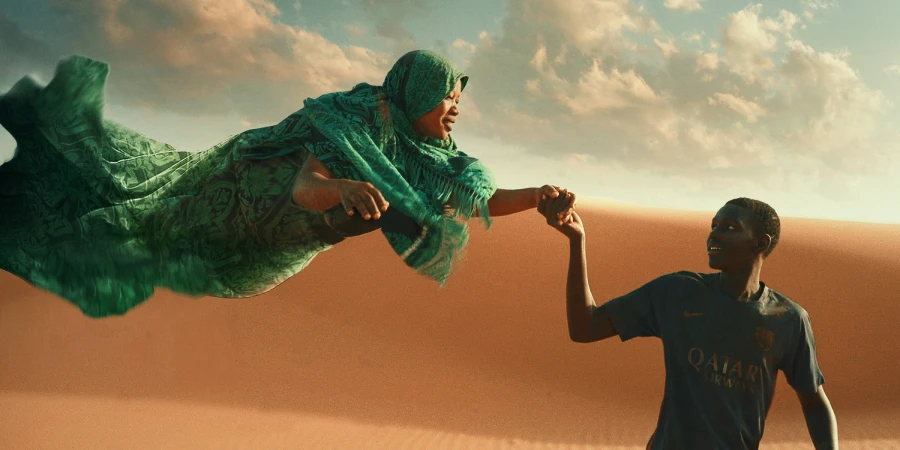
One of the film’s most striking visual choices comes here: Seydou imagines one of the dying women rising into the air, briefly suspended above the desert, a surreal and grief-soaked moment that breaks from the film’s otherwise grounded realism.
Agadez and the Machinery of Migration
In Niger, specifically Agadez, the cousins encounter the layered, business-like infrastructure of the smuggling network. Middlemen collect fees. People wait in cramped houses for days, sometimes weeks. Garrone portrays this system without reducing it to cartoon villainy; these are ordinary economic arrangements built on desperation.
Seydou starts doing small jobs for the smugglers to earn passage money. He carries bags, runs errands. Each task pulls him deeper into complicity with the system exploiting him.
Libya: Detention and Violence
Libya is where the film turns brutal. Seydou and Moussa get detained in a Libyan prison camp. Guards beat inmates. People sleep on concrete. Food is scarce. Garrone does not aestheticize any of it; the camera stays close and steady, refusing to give the audience the relief of a composed, beautiful shot to hide behind.
Moussa gets seriously ill inside the detention facility. Seydou bribes and maneuvers to get medical help for his cousin. He negotiates with guards, does more work for the smugglers, and spends whatever he has left. His desperation to protect Moussa is the emotional engine of the film’s second half.
Seydou also witnesses a fellow prisoner murdered by a guard. He does nothing. He cannot do anything. Garrone holds on Seydou’s expression during this moment, and Sarr plays it with a stillness that is more devastating than any outburst would be.
Working for the Smugglers
To secure release for both himself and Moussa, Seydou agrees to work more directly for the smugglers. He transports migrants in vehicles, acts as a guide in the desert. He becomes, briefly, part of the machine that chews people up.
Garrone refuses to moralize here. Seydou is not a villain. He is a teenager doing what he must to survive and to keep his cousin alive. The film trusts the audience to hold that complexity.
The Mediterranean: Steering the Boat
Released eventually from captivity, Seydou and Moussa reach the Libyan coast. They board an overcrowded rubber dinghy headed for Italy. Shortly after departure, the smuggler who was meant to pilot the boat abandons it, leaving dozens of terrified passengers with no one at the helm.
Seydou, who has no nautical experience, takes control. He grips the rudder. People around him are crying, praying, and vomiting. He stares forward. Sarr plays these scenes with a physical exhaustion and a quiet authority that feels completely earned after everything we have watched him endure.

Movie Ending
Seydou steers the boat through the night and into daylight. An Italian coast guard vessel spots them and moves in to intercept. The rescue is not triumphant so much as it is overwhelming; Seydou can barely stand, barely speak.
Italian coast guard personnel take over. Passengers weep with relief. Seydou collapses into a seated position near the side of the boat, his hands still gripping nothing, his body still braced for a wave that is no longer coming.
A coast guard officer looks at him and asks, in Italian, who was steering the boat. Other passengers point to Seydou. Someone says to the officer: “He saved us.” The officer looks at Seydou and addresses him with the film’s title: “Io Capitano,” meaning “I am the captain.” It is not a triumphant declaration. It is something the officer says almost quietly, a small recognition of what this teenager just did.
Seydou looks back at the officer. His expression carries no triumph. No celebration. Garrone cuts to the Italian coastline in the distance. Moussa is alive. They made it. What comes next, the film refuses to show. That refusal is the point. Europe was the dream, and the film ends precisely at the moment the dream becomes a question mark.
What makes this ending so specifically effective is what Garrone leaves out. There is no reunion scene, no tearful phone call to Seydou’s mother, no glimpse of what Italy actually holds for them. Garrone denies catharsis deliberately. The landing is not an arrival; it is just the end of one kind of suffering and the start of something unknown.
Are There Post-Credits Scenes?
No. Io Capitano has no post-credits scene of any kind. Once the film ends, it ends completely. Sitting through the credits will not reveal anything additional.
Type of Movie
Io Capitano is a drama with strong elements of survival cinema and road film. Its tone shifts from coming-of-age warmth in the Dakar sequences to something closer to a waking nightmare by the time Libya appears.
Garrone resists pure misery-tourism. He builds enough human detail early in the film that the suffering later has specific weight rather than generic impact. It is not an easy watch, but it is a purposeful one.
Cast
- Seydou Sarr – Seydou
- Moustapha Fall – Moussa
Film Music and Composer
The score for Io Capitano was composed by Andrea Farri. Farri works with a restrained palette, avoiding the kind of swelling orchestral music that would push an audience toward predetermined emotions. His compositions sit underneath scenes rather than directing them.
Afrobeat and Senegalese musical traditions color the early Dakar sequences. The music in those scenes feels lived-in and specific to place. As the film moves north and the geography becomes more hostile, the score pulls back, leaving longer stretches of ambient sound and silence.


Filming Locations
Production filmed on location in Senegal, Morocco, and Tunisia. Morocco and Tunisia stood in for sections of the Sahara crossing and the Libyan detention sequences, since filming inside Libya was not feasible.
Garrone chose to shoot in actual desert locations rather than controlled studio environments, and that decision is visible in every frame. The scale of the Sahara sequences is not a visual effect. You can feel the heat pressing against the image.
Shooting in Dakar gave the opening act a documentary texture that studio sets simply cannot replicate. Local neighborhoods, markets, and music venues ground Seydou and Moussa as real people in a real place before the film dismantles everything around them.
Awards and Nominations
Io Capitano received an Academy Award nomination for Best International Feature Film at the 2024 Oscars, representing Italy. Matteo Garrone won the Silver Lion for Best Direction at the Venice Film Festival in 2023, and Seydou Sarr won the Marcello Mastroianni Award at Venice for best young actor.
Sarr’s Venice win was widely considered one of the most deserved prizes of that festival year. Few debuts in competition that year carried anything close to the same weight.
Behind the Scenes Insights
- Matteo Garrone conducted extensive research into the actual migration routes from West Africa to Europe before writing the script, meeting with migrants and aid workers to understand the specifics of each stage.
- Seydou Sarr had no prior professional acting experience before being cast. Garrone found him through an open casting process in Senegal.
- Moustapha Fall was similarly a non-professional actor discovered through the same casting search in Senegal.
- Cast and crew filmed in temperatures that regularly exceeded 40 degrees Celsius during the desert sequences.
- Garrone worked with a small, mobile crew to maintain the film’s documentary-style intimacy, especially during location shoots in Africa.
- Many of the background performers in the migration sequences were people who had personally made the crossing from Africa to Europe, bringing direct lived experience to those scenes.
- The film was co-written by Garrone with Massimo Gaudioso, Massimo Ceccherini, and Andrea Tagliaferri.
Inspirations and References
Io Capitano draws directly from real testimonies collected by Garrone and his team from migrants who had made the crossing from West Africa to Italy. No single person’s story served as the sole source; the screenplay synthesizes many accounts.
Garrone has cited his desire to tell this story from the perspective of the migrants themselves, rather than from the European shore looking outward. That inversion shapes every structural decision in the film. We are in Dakar at the start, not in Rome or Lampedusa.
Visually, the film draws on a long tradition of Italian neorealism, specifically the impulse to cast non-professionals and shoot in real locations. Garrone does not imitate neorealist films so much as he applies their principles to a contemporary subject.
Alternate Endings and Deleted Scenes
No alternate endings or officially confirmed deleted scenes have been released for Io Capitano. Garrone has not publicly discussed major scenes that were cut from the final edit.
Given the film’s tight, purposeful structure, it reads like a work where the editing served a clear vision rather than a messy one requiring heavy cuts. What is on screen feels intentional from first frame to last.
Book Adaptations and Differences
Io Capitano is not based on a book. It is an original screenplay built from documentary research and firsthand testimonies rather than any single literary source.


Memorable Scenes and Quotes
Key Scenes
- Seydou’s mother pleading with him not to go: She does not shout. She sits with her hands in her lap and asks him to stay. He lies. The scene lasts maybe two minutes and quietly ruins you for everything that follows.
- The woman rising above the desert: Seydou watches a dying woman float upward from the truck, her body lifting into a bleached-out sky. It is the film’s one detour into magical realism and it earns that detour completely.
- The murdered prisoner: A guard kills a man in the detention camp. Seydou watches from a few feet away, motionless. Sarr lets his eyes go flat and distant. It is the film’s most quietly harrowing moment.
- Steering the boat through the night: Seydou grips the rudder in darkness while dozens of people weep around him. No music plays. The sound design fills the silence with water, wind, and fear.
- “Io Capitano”: The coast guard officer’s quiet recognition of Seydou in the film’s final minutes. Nothing swells on the soundtrack. Sarr does not smile. It is a moment of acknowledgment that somehow carries the weight of the entire film.
Iconic Quotes
- “Europe is not what you think. But I am going anyway.” (paraphrased, as heard in the film’s early acts, capturing the paradox of informed hope)
- “Io Capitano” (the coast guard officer’s recognition of Seydou at the film’s close)
Easter Eggs and Hidden Details
- Several background performers in the migration and detention sequences had personally made the West Africa-to-Europe crossing, which lends those scenes an uncomfortable specificity in body language and spatial behavior that scripted extras rarely achieve.
- The film’s magical realism sequence (the woman floating above the desert) mirrors a grief ritual in certain West African traditions, connecting Seydou’s vision to a specific cultural response to witnessing death rather than presenting it as generic fantasy.
- Garrone frames Dakar with warm amber light and tight, populated compositions. As the film moves north through the Sahara, the color palette drains progressively. By Libya, the cinematography is all grey concrete and flat white light. The color shift is gradual enough that you may not notice it consciously until you look back.
- Seydou’s phone, a recurring object in the early Dakar sequences, disappears from the narrative once he enters Libya. Its absence is never commented on but functions as a quiet marker of how much he has lost.
Trivia
- Seydou Sarr was a teenager with no acting background when Garrone cast him. His Venice award for best young actor made him one of the youngest recipients of that prize in recent years.
- Garrone shot the film in multiple languages, including Wolof, French, Hausa, and Italian, reflecting the actual linguistic reality of the migration route.
- Io Capitano was Italy’s official submission for the Academy Award for Best International Feature Film for the 96th Academy Awards.
- Matteo Garrone is best known internationally for Gomorrah (2008). Io Capitano marks a return to socially rooted realism after his mid-career detour into literary fairy tales with Tale of Tales (2015) and Pinocchio (2019).
- The film’s Italian title means “I am the captain,” spoken by the coast guard officer in the final scene, which retroactively gives the entire film its emotional frame.
- Production used a combination of handheld and Steadicam work to maintain physical proximity to the lead actors without the footage feeling aestheticized.
Why Watch?
Seydou Sarr’s face does more dramatic work in this film than most seasoned actors accomplish in a career. Garrone plants you inside a perspective that European cinema almost never chooses, a West African teenager who is the subject of countless news reports but almost never the narrator of his own story. Watch it for Sarr, then watch it again to catch what the draining color palette is quietly doing to you across two hours.
Director’s Other Movies
- Gomorrah (2008)
- Reality (2012)
- Tale of Tales (2015)
- Dogman (2018)
- Pinocchio (2019)
Recommended Films for Fans
- Beasts of No Nation (2015)
- Mediterranea (2015)
- Fire at Sea (2016)
- A Ciambra (2017)
- Les Misérables (2019)
- Atlantics (2019)