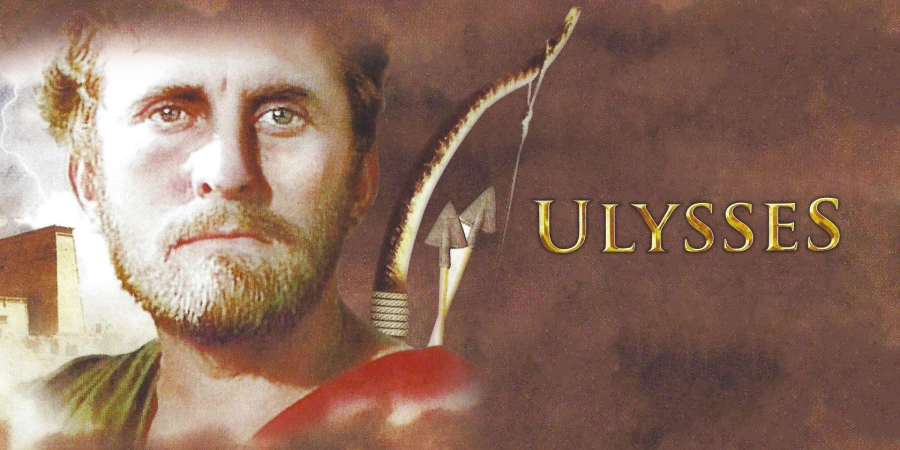

Kirk Douglas flexing his way through ancient Greece as a man who just wants to go home sounds like camp, but this 1954 Italian-American co-production earns genuine dramatic weight by leaning hard into Odysseus as a man haunted by war, not celebrated for it.
Douglas plays the character with a restless physical energy that suits the episodic structure better than a more classical approach ever could. Every island is a trap, every woman a danger, and every homecoming a negotiation with violence. This film remembers that Homer’s hero is, above all else, exhausted.
Detailed Summary
A King Without a Memory
The film opens with Odysseus washed ashore on the island of the Phaeacians, suffering from amnesia. He cannot remember who he is or where he came from. Nausicaa, the Phaeacian princess, finds him and brings him to her father’s court.
King Alcinous welcomes the stranger warmly. A blind bard sings of the Trojan War, and something stirs in the amnesiac stranger’s mind. Slowly, painfully, Odysseus begins to recover his identity.
The Trojan War and Its Aftermath
Through extended flashbacks, the film reconstructs the fall of Troy. Odysseus reveals his greatest stratagem: the wooden horse filled with Greek soldiers. He presents this plan to a skeptical Greek command and persuades them with sheer force of argument.
Troy falls. Greek soldiers pour through its gates. Rather than celebrate cleanly, the film lingers on the destruction and the moral cost paid by everyone involved.
The Land of the Cyclops
Odysseus and his men sail to the island of the Cyclops, Polyphemus. They enter his cave seeking hospitality and instead find themselves imprisoned. Polyphemus begins eating the crew one by one.
Odysseus devises an escape. He gets the Cyclops drunk on strong wine, then blinds him with a sharpened stake driven into his single eye. The crew escapes by hiding beneath the bellies of sheep as Polyphemus rolls away the cave’s stone door. Odysseus, unable to resist taunting the blinded giant, shouts his real name as they sail away, a moment of fatal pride that defines his character throughout the film.
Circe’s Island
Odysseus and his crew reach the island of Circe, a sorceress played by Silvana Mangano, who also plays Penelope. This double-casting is a deliberate choice by the filmmakers, and it works: both women represent powerful pulls on Odysseus, one toward surrender and one toward home.
Circe transforms several of his men into swine. Odysseus resists her magic through divine protection and forces her to restore his crew. He then spends a year on her island, genuinely seduced by comfort and by her. His eventual departure is wrenching for both of them.
The Land of the Dead
Following Circe’s instructions, Odysseus journeys to the underworld to consult the prophet Tiresias. He encounters the shades of the dead, including fallen comrades from Troy. The underworld sequence is brief but chilling, shot with fog-drenched atmosphere that sets it apart from the film’s more sun-baked adventure sequences.
Sirens, Scylla, and Charybdis
Odysseus has himself lashed to the mast so he can hear the Sirens’ song without steering the ship toward destruction. His crew plugs their ears. He writhes against the ropes, face contorted, clearly in genuine agony at what he hears, and Douglas plays this moment with full physical commitment rather than stoic restraint.
The ship also navigates the strait between Scylla, the six-headed monster, and Charybdis, the massive whirlpool. Several more men are lost. Each death chips away at Odysseus’s original crew count, making the later scenes feel appropriately lonely.
The Cattle of the Sun God
Odysseus warns his surviving crew not to eat the sacred cattle of Helios on the island of Thrinacia. Starving and desperate, they slaughter and eat the cattle anyway while Odysseus sleeps. Zeus punishes them with a storm that destroys the ship and kills every man except Odysseus.
Calypso’s Island
Odysseus washes up on the island of the nymph Calypso, who keeps him for years. He wants to leave. She offers him immortality. He refuses, choosing mortality and Penelope over eternal life with a goddess. His longing for home is the film’s emotional core, and this scene articulates it plainly.
Return to the Phaeacians
His memory now fully restored, Odysseus finishes his account. King Alcinous provides him with a ship and escort. He finally sails for Ithaca after twenty years away.
The Return to Ithaca and the Suitors
Ithaca is overrun with suitors competing for Penelope’s hand, assuming Odysseus is dead. Penelope has stalled them for years with a famous trick: weaving a shroud by day and unraveling it by night, claiming she will choose a husband only when it is finished. The suitors have grown violent and entitled.
Odysseus arrives disguised as a beggar. He watches his own palace from the inside, taking the measure of the enemy. His old nurse Eurycleia recognizes him by a scar on his leg while washing his feet, a small, intimate moment that the film handles with surprising tenderness.
The Contest of the Bow
Penelope announces a contest: whoever can string Odysseus’s great bow and shoot an arrow through twelve axe-heads in a row wins her hand. The suitors fail one by one. The beggar asks to try. He strings it with casual ease, shoots through all twelve targets, and then turns the bow on the suitors.
Movie Ending
What follows is wholesale slaughter. Odysseus, joined by his son Telemachus and a handful of loyal servants, systematically kills every suitor in the great hall. The doors are barred. There is no escape. Douglas plays the massacre not with triumphant joy but with cold, grinding efficiency, and that choice makes it disturbing rather than cathartic.
Penelope descends the stairs to find a hall full of bodies and a man she has not seen in twenty years. She does not run to him. She tests him first. She instructs a servant to move their marriage bed, knowing that Odysseus himself built it around a living olive tree rooted in the ground: it cannot be moved. Only her true husband would know this secret.
Odysseus reacts with anger at the suggestion, demanding to know who dared cut the tree. His fury is the proof. Penelope finally weeps and embraces him. After two decades of waiting, tricks, and stubbornness, neither of them has changed enough to stop recognizing each other, and that is quietly the most moving thing about the ending.
The film closes on reunion rather than on the violence. It earns this warmth because it spent two hours insisting that war and wandering hollow a person out. Coming home is not a reward; it is an argument Odysseus has to win all over again.
Are There Post-Credits Scenes?
No. This is a 1954 production, and post-credits scenes were not part of the filmmaking culture of that era. Once the final scene ends and the credits roll, you are done. No hidden footage, no bonus content.
Type of Movie
This is a sword-and-sandal epic, also called a peplum film, a genre that flourished in Italian and Italian-American co-productions throughout the 1950s and 1960s. It blends adventure, mythology, and romance with large-scale battle sequences and monster effects.
In tone, the film is more melancholy than its genre peers. It plays its mythological elements straight rather than campy, and it treats Odysseus’s psychological damage as a real subject rather than window dressing.
Cast
- Kirk Douglas – Ulysses (Odysseus)
- Silvana Mangano – Penelope and Circe
- Anthony Quinn – Antinous
- Rossana Podesta – Nausicaa
- Sylvie – Tiresias
- Daniel Ivernel – Eurylochus
- Jacques Dumesnil – Alcinous
Film Music and Composer
Alessandro Cicognini composed the score. He was one of the most prolific and respected Italian film composers of the postwar period, with a gift for blending orchestral grandeur with emotional intimacy.
His work here supports the film’s tonal range. The Cyclops sequences get heavy, percussive cues. The scenes with Penelope carry a gentler, more sustained melodic line. Cicognini never oversells the emotion; he lets the score sit slightly beneath the action rather than explaining it.

Filming Locations
Principal photography took place in Italy, making heavy use of the Italian coastline and studio facilities at Cinecittà in Rome. Cinecittà was the dominant production hub for Italian epic cinema throughout this era, and its stages were large enough to house the elaborate sets required for the Cyclops cave and Circe’s island.
Outdoor coastal sequences used the rugged Mediterranean landscape to convincing effect. The rocky, sun-bleached terrain genuinely looks like a place where gods might get involved in human navigation. Shooting in Italy rather than on American backlots gave the film a tactile geographic credibility that benefits the mythological material enormously.
Awards and Nominations
This film did not receive major awards recognition from prominent bodies. Its reputation has grown through repertory screenings and reassessment rather than through a trophy shelf.
Behind the Scenes Insights
- The production was an Italian-American co-production, with the Italian side led by producer Dino De Laurentiis and the American side involving Kirk Douglas‘s own production interests. This kind of transatlantic arrangement was common in the 1950s as Hollywood studios sought cheaper overseas production costs.
- Mario Camerini directed, but the production reportedly involved creative input from multiple parties given its co-production structure, which was typical of the genre.
- Silvana Mangano‘s dual casting as both Penelope and Circe was a deliberate thematic decision, not merely a cost-saving measure. It visually argues that Odysseus projects the same idealized femininity onto very different women.
- Kirk Douglas learned enough Italian to communicate directly with his Italian co-stars during production, which helped smooth on-set collaboration despite the language barrier.
- The Cyclops was realized through a combination of oversized set pieces, forced-perspective photography, and a very large performer. Achieving the size differential convincingly required careful blocking in every shared shot.
Inspirations and References
The film adapts The Odyssey by Homer, one of the oldest narrative poems in Western literature. Homer’s epic covers Odysseus’s ten-year voyage home after the fall of Troy, drawing on a vast catalog of encounters with gods, monsters, and temptation.
The screenplay compresses and reorders several episodes from the source material. It also borrows framing from the poem itself: Homer’s Odyssey uses a similar retrospective structure, with Odysseus recounting his adventures to the Phaeacians after the fact. The film preserves this structural choice, which is a smart decision because it means the audience trusts the narrator from the start.
Alternate Endings and Deleted Scenes
No documented alternate endings or significant deleted scenes have entered the public record for this production. Given the era and the international co-production nature of the shoot, detailed behind-the-scenes documentation is sparse. Nothing credible points to a substantially different cut of the film having existed.
Book Adaptations and Differences
Homer’s The Odyssey is the source, and the film is reasonably faithful to its major episodes while making several practical and dramatic compressions. Several encounters from the poem do not appear in the film, including the island of Aeolus and the bag of winds, and the Laestrygonians sequence.
The film also softens or streamlines the role of the gods. In Homer, divine intervention drives many plot turns explicitly, with Athena and Poseidon acting as active characters. The film keeps some divine references but grounds most of the action in human decision-making, which suits the medium.
Penelope’s characterization in the film is somewhat more passive than in Homer, where she is one of the most strategically clever characters in the entire poem. The film gives her the weaving ruse and the bed test, but her interior life is thinner than Homer’s original portrait. This is the screenplay’s weakest area.
Memorable Scenes and Quotes
Key Scenes
- The blinding of Polyphemus: Douglas and several crewmen drive a sharpened stake into the Cyclops’s eye while he sleeps. The camera holds on the Cyclops recoiling and howling, then cuts to Odysseus’s face: sweating, focused, not celebrating.
- Odysseus lashed to the mast: His body strains against the ropes as the Siren song plays. His jaw works, his eyes go wide, and he seems genuinely about to tear himself free. Douglas commits fully and it is the film’s most physically arresting single moment.
- The bed test: Penelope’s face as she watches Odysseus react with fury at the suggestion that his bed could be moved. Her expression shifts from careful guardedness to recognition to tears in about ten seconds. Mangano does more acting here than in any of her Circe scenes.
- The slaughter of the suitors: Doors slam shut. The music drops. Arrows fly. The scene has a cold, workmanlike quality that deliberately refuses to make heroic spectacle out of mass killing.
- The Tiresias consultation in the underworld: Fog fills the frame. Shapes drift past. The blind prophet delivers his warnings in a flat, affectless tone that makes the scene feel genuinely eerie rather than theatrical.
Iconic Quotes
- “Nobody! My name is Nobody!” (Odysseus to the Cyclops, giving his false name, which he later betrays by shouting his real one.)
- Odysseus, departing Calypso’s island: his refusal of immortality, framed as a preference for a real death over an empty eternal life.
Easter Eggs and Hidden Details
- The dual casting of Silvana Mangano as Penelope and Circe rewards attentive viewers who notice that Odysseus is essentially drawn to the same woman twice, once as temptation and once as home.
- Odysseus’s scar on his leg, which Eurycleia recognizes, is a detail preserved directly from Homer. It is one of the film’s most faithful nods to the source text and a small reward for viewers who know the poem.
- When the suitors attempt to string Odysseus’s bow and fail, the camera lingers on each failure individually. This is structurally building the audience’s anticipation for the beggar’s attempt, but it also quietly establishes each suitor as a named individual before they are killed, which gives the massacre slightly more moral weight than a generic action sequence would.
- The Cyclops cave set uses forced perspective throughout: objects in the foreground are scaled larger than those in the background to exaggerate depth and size. Sharp-eyed viewers can spot the transition points where the scale shifts between shots.
Trivia
- This was one of the early high-profile international co-productions overseen by Dino De Laurentiis, who would go on to produce dozens of major films over the following decades.
- Kirk Douglas shot the film in the early 1950s as part of a broader push by American stars to work in Europe, where production costs were lower and creative arrangements were more flexible.
- The film was released in Italy before it reached American audiences, which was standard practice for Italian co-productions of this type.
- Anthony Quinn, playing the lead suitor Antinous, brings a physicality and menace to the role that makes him a legitimate threat rather than a simple obstacle. Quinn was already an established international presence by this point in his career.
- The film predates the larger wave of Italian peplum spectaculars that would flood screens in the late 1950s and early 1960s; in some respects it helped establish the template those later productions would follow.
- An English-language dubbed version was prepared for American distribution, which was standard for Italian co-productions of the era. Whether viewers saw the dubbed or subtitled version significantly affected their experience of the performances.
Why Watch?
Kirk Douglas lashed to a mast, physically fighting his own desire to follow the Sirens, is worth the price of admission alone. This film understands that Odysseus’s greatest enemy is himself, and Douglas’s body sells that argument in ways that dialogue never could. Silvana Mangano playing both wife and temptress is a casting gambit that most productions would fumble; this one makes it the film’s deepest idea.
Director’s Other Movies
- Gli uomini, che mascalzoni! (1932)
- Il grande appello (1936)
- Una storia d’amore (1942)
Recommended Films for Fans
- The Odyssey (2026)
- Hercules (1958)
- Jason and the Argonauts (1963)
- Spartacus (1960)
- Helen of Troy (1956)
- The Return (2024)
- The 300 Spartans (1962)