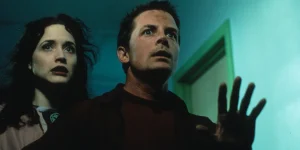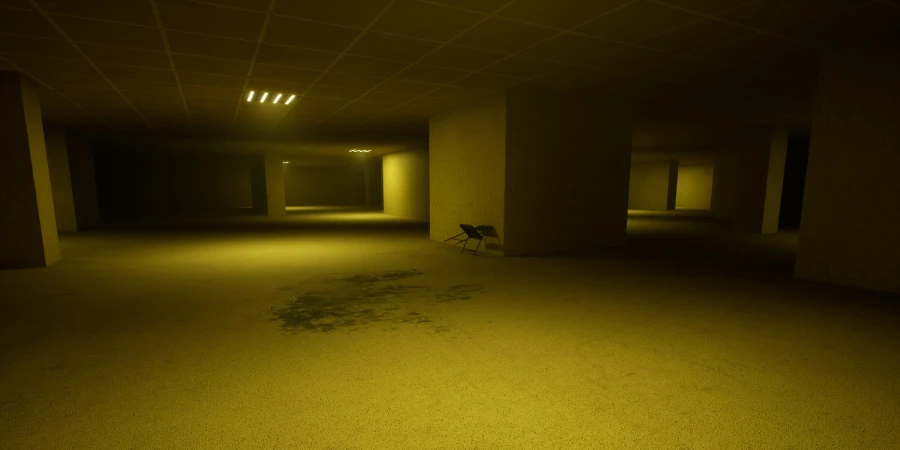

A twenty-year-old YouTuber built 30,000 square feet of yellow hallways and turned an internet ghost story into A24’s biggest hit. Backrooms drags a jaded furniture salesman and his own therapist into a memory-eating maze. It unsettles far more than it scares. Spoilers wait ahead, so tread carefully into these corridors.
Detailed Summary
A Warning From 1990
The movie opens in June 1990, long before Clark ever finds his door. An Async Research Institute researcher named Naren Warne loses his group inside the maze. Something unseen hunts him while his camera keeps rolling.
Async staff later pore over the salvaged footage. That cold open plants the mystery the rest of the film slowly circles back to.
Clark’s Very Bad Year
Clark runs Cap’n Clark’s Ottoman Empire, a struggling pirate-themed furniture store. He is a failed architect, freshly divorced, and now sleeping among his own sofas after losing his home. His therapist Mary keeps trying to pull him out of the spiral.
Late one night in the basement, Clark slips clean through a solid wall. Beyond it waits an endless labyrinth of yellow rooms and fluorescent hum. He starts returning every single day to map it.
The Exploration Goes Wrong
Clark recruits two young employees, Kat and Bobby, to film the space and chart it for “research.” Their grainy handheld footage soon captures a faceless entity closing in. Kat and Bobby do not make it back out.
Clark, however, stays behind by choice. His grip on reality loosens a little more with every passing day.
Mary Follows Him In
Mary never believed a word of Clark’s wild story. After he vanishes, she searches his darkened store and finds the same portal waiting. She steps through.
Wandering the corridors, Mary reaches a dead end covered by a mural: a giant monster and a figure climbing out of a window above it. That image nods directly to the “window” idea from her own therapy work, which Clark had clearly absorbed.
Dinner With the Distorted
Clark ambushes Mary and chokes her out. She wakes tied to a chair at a dinner table, several layers deep in the maze. Three malformed Still Life entities keep watch nearby, and a severed head sits hidden in the fridge.
Then Clark lays out his theory. The Backrooms, he explains, work as an echo chamber for human memory, rebuilding people and places that warp and rot as the real details fade.
The Therapy Session From Hell
Clark forces Mary into a role-play of an old argument with his ex-wife, twisting her own techniques against her. Mary finally snaps and tells him the plain truth. His real problem is that he blames everyone but himself.
The words actually land. Moved for a moment, Clark decides to let her go.
Movie Ending
A monster ducks through the doorway before Clark can untie her. It is Captain Clark, a towering, mutated version of the pirate mascot from his own store commercial. This thing is Clark’s rage and self-pity given a hulking body.
It rips into Clark’s neck and kills him on the spot, then turns and chases Mary through the maze. Their pursuit ends inside a warped copy of his furniture store.
Mary fights back with a chunk of cement she has carried the entire film. That fragment comes from her childhood driveway, and it hides a gut-punch of backstory. Her mother once experienced the Backrooms when their home was demolished, an ordeal that broke her and led to her institutionalization.
Mary then squeezes down a passage far too narrow for the creature. Her freedom lasts about a second. Async scientists in hazmat suits seize her and haul her back through the Threshold to their facility.
Phil, an Async researcher, questions her in a sealed room. He frames the Backrooms as an echo chamber for memory, which explains all the near-perfect but slightly wrong copies. He also admits he does not control what happens to her next, hinting she may never walk free.
The camera then sinks down through the layers one last time. In an echo of that same interrogation room slumps a distorted, multi-faced copy of Mary. The maze has already started building her, too, and whether the real Mary escaped stays deliberately blurry. Parsons wants that argument to follow you out of the theater.
Are There Post-Credits Scenes?
The original theatrical cut skips a traditional post-credits sting. Boards of Canada’s “The Word Becomes Flesh” plays over the credits, and that eerie hum is the send-off.
The extended re-release, Backrooms: Everything Must Go Edition, is a different animal. It adds roughly 15 minutes, most of it landing after the credits. Async employees venture into the Backrooms, and a timestamp pins the moment to June 18, 1990, tying the scene straight back to the film’s cold open and the wider Async mystery.
Type of Movie
Backrooms sits firmly in psychological horror with a strong science-fiction streak. It leans hard on liminal horror, the subgenre that mines dread from empty transitional spaces like offices, warehouses, and corridors drained of life.
The tone is slow, hushed, and creeping rather than jumpy. Parsons has compared the mood to Eraserhead and Skinamarink. As a result, atmosphere and sound design do most of the heavy lifting here, not gore.
Cast
- Chiwetel Ejiofor – Clark
- Renate Reinsve – Mary
- Mark Duplass – Phil
- Finn Bennett – Bobby
- Lukita Maxwell – Kat
Avan Jogia rounds out the ensemble in a supporting role as well.
Film Music and Composer
Kane Parsons co-wrote the score with Canadian composer Edo Van Breemen. Their sound fuses vintage synths, dark ambient textures, and that low fluorescent hum fans of the web series expect. Jeffrey Innes contributed additional composing and piano.
Van Breemen is a frequent Osgood Perkins collaborator, which matters here because Perkins produced the film. His horror credits include The Monkey and Keeper.
The soundtrack runs 27 tracks, opening with “Handprint” and closing on “Complex.” Licensed music does a lot of the thematic work, too. Boards of Canada’s “The Word Becomes Flesh,” pulled from their album Inferno, plays over the end credits.
Two deeper cuts reward attentive listeners. The cult lostwave track “Ulterior Motives,” long known online as “Everyone Knows That,” surfaces in the film. Music from The Caretaker also appears, its themes of memory decay mirroring the maze’s habit of forgetting.
Filming Locations
Production set up in Vancouver, British Columbia, under the working title Effigy. Cameras rolled from early July into mid-August 2025.
Rather than fake the maze digitally, Parsons insisted on practical sets, a striking reversal from his laptop-built YouTube work. His team constructed more than 30,000 square feet of Backrooms across four sound stages. They added vertical layers so actors could climb, crawl, and squeeze through the space instead of walking a single flat plane.
The sheer scale had a fitting side effect. Crew members reportedly got lost inside the set, which is exactly the right hazard for a film about losing your way.
Awards and Nominations
Awards season had not yet caught up with the film at the time of writing, so its headline achievements are commercial rather than ceremonial. Backrooms became A24’s highest-grossing release ever and made Parsons the youngest filmmaker to top the U.S. box office.
Behind the Scenes Insights
- Parsons was seventeen when A24 announced the project, and still a teenager for much of the ride, making him the studio’s youngest feature director.
- Mentors James Wan and Osgood Perkins guided him through the leap from YouTube shorts to a full studio feature.
- He designed the sets in Blender first. His layout file was so dense it reportedly crashed the production designer’s computer.
- Nailing the signature shade of yellow took roughly 50 wallpaper tests.
- Cristin Milioti was originally attached to Mary’s role before her deal fell through and Renate Reinsve stepped in.
- Made for around $10 million, the film went on to gross close to $367 million worldwide.
Inspirations and References
The film grows out of the “Backrooms” creepypasta, an internet legend about no-clipping through reality into an endless yellow void. Parsons first brought that idea to life in his Kane Pixels YouTube series in 2022.
Liminal horror is the guiding spirit throughout. Parsons has pointed to Eraserhead and Skinamarink as touchstones for the movie’s dread-through-emptiness approach.
Async, the Threshold, and the Still Life entities all carry over from his web series. Notably, Parsons has said the feature stays in strict continuity with that online mythology.
Alternate Endings and Deleted Scenes
The big alternate version is entirely official. A24 re-released the film as Backrooms: Everything Must Go Edition with about 15 extra minutes.
Most of that fresh footage lives after the credits. It follows Async staff entering the Backrooms on June 18, 1990, expanding the lore instead of rewriting Mary’s fate.
No separate secret ending has surfaced beyond that addition. Consequently, the theatrical cut’s final image, distorted Mary slumped in the chair, remains the story’s true closer.
Book Adaptations and Differences
Backrooms is not based on a book. Its roots are an internet creepypasta and Parsons’ own found-footage web series.
Readers hunting for a source novel will come up empty. The closest thing to a “text” is a sprawling body of online lore plus Parsons’ videos, never a printed page.
Memorable Scenes and Quotes
Key Scenes
- Clark’s first slip through the basement wall into the yellow maze.
- That found-footage exploration where Kat and Bobby meet the entity.
- A Misery-style dinner where Mary wakes tied to a chair among the Still Life copies.
- Mary’s blunt therapist takedown, forcing Clark to own his failures.
- Captain Clark bursting in to kill his own creator.
- The cement-fueled final chase and the closing descent to distorted Mary.
Iconic Quotes
- Clark, mid-transformation, reassuring Mary: “It’s just me, you know me.”
- The store’s cheerful slogan turned menacing: “Everything Must Go.”
Easter Eggs and Hidden Details
- The 1990 setting and the Async Research Institute wire the movie straight into Parsons’ web series timeline.
- Async started life as an MRI machine company before stumbling onto the Threshold, a detail lifted from the online lore.
- The lostwave song “Ulterior Motives” is a knowing wink to the internet sleuths who chased its origin for years.
- Music from The Caretaker quietly echoes the film’s rule that the Backrooms forget and distort whatever they hold.
- Cap’n Clark’s Ottoman Empire even got its own fake local TV commercial as part of A24’s viral marketing push.
- The window mural Mary discovers ties back to the “window” metaphor from her therapy sessions.
Trivia
- Parsons built his viral YouTube series on a laptop, and that lo-fi DNA carries into the feature.
- On set, the film hid behind the working title Effigy.
- With roughly $367 million worldwide, Backrooms stands as A24’s highest-grossing film to date.
- Parsons topped Josh Trank’s Chronicle record to become the youngest filmmaker with a number-one U.S. opening.
- Audiences handed it a B- CinemaScore, and that split reaction only fueled the online debate over its meaning.
- Boards of Canada’s album Inferno dropped the same day the film opened, and the credits track comes straight from it.
Why Watch?
Backrooms is less a scare machine than a mood you get trapped inside. Ejiofor and Reinsve turn a two-hander about grief and blame into something genuinely haunting. If you love slow-burn, atmosphere-first horror that rewards a rewatch and a long argument afterward, this maze is worth entering.
Director’s Other Movies
Backrooms is Kane Parsons’ feature directorial debut, so he has no earlier theatrical films to his name. His defining prior work is the project that started everything:
- Backrooms (web series, 2022)
Recommended Films for Fans
- Skinamarink (2022)
- Eraserhead (1977)
- Longlegs (2024)
- Hereditary (2018)
- Enys Men (2022)