
A group of schoolboys staging a full-scale rooftop rebellion against their oppressive teachers is not exactly standard cinema fare for 1933, yet Jean Vigo made it feel completely inevitable. Zero de Conduite runs a mere 41 minutes, but it detonates like a bomb. Vigo packed more anarchic energy, genuine tenderness, and surrealist poetry into that runtime than most directors manage in two hours. This film got banned in France almost immediately, and honestly, that reaction tells you everything you need to know about how potent it still is.
Detailed Summary
The Train Journey Back to School
The film opens with two boys, Caussat and Bruel, returning to their boarding school after a holiday. They share a train compartment and immediately start goofing around, blowing up balloons and performing silly tricks. This opening sequence sets the film’s tone perfectly: childhood is its own sovereign territory, governed by joy rather than rules.
A supervisor named Huguet eventually shares their compartment. However, rather than disciplining them, he joins in their playfulness, performing a Charlie Chaplin impression. His affinity with the boys marks him as the one adult in the film who genuinely belongs on their side.
Life Inside the Boarding School
Once back at school, the film introduces the full miserable machinery of institutional life. The headmaster is a tiny, bearded, almost comically sinister figure the boys nickname Bec-de-Gaz (Gas Nozzle). He is petty, authoritarian, and deeply unsettling in his physical oddness.
A new boy named Tabard arrives and quickly becomes the emotional center of the group. He is sensitive and artistic, and the other boys adopt him almost instinctively. Meanwhile, the school’s other supervisors range from indifferent to actively hostile toward their charges.
One supervisor, Pète-Sec (Dry Fart), is particularly brutal in his enforcement of rules. In contrast, Huguet doodles caricatures of Napoleon on the blackboard when the teacher leaves the room. His drawing transforms Napoleon’s face into the headmaster’s, and the boys erupt in delight.
The Zero for Conduct
Tabard receives a zero for conduct, the film’s titular punishment, after defying a supervisor. He shouts a profanity directly at the authority figure, a moment of stunning, liberating insolence. For the boys, this is not scandal; it is heroism.
Caussat, Bruel, and a boy named Colin rally around Tabard. Together, the four friends form a pact of resistance. Consequently, what began as scattered misbehavior starts crystallizing into something more organized and intentional.
The Dormitory Revolt
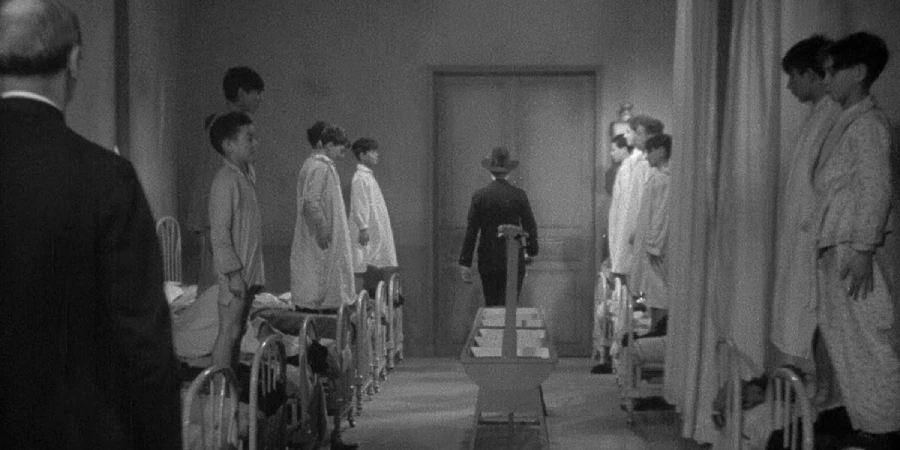
The dormitory sequence is the film’s most celebrated and visually extraordinary passage. Late at night, the boys rise in rebellion, tearing apart their beds and hurling pillows and mattresses with furious, joyous abandon. Feathers fill the air like a blizzard.
Vigo films this sequence in slow motion, transforming a pillow fight into something almost sacred. The boys march in a procession through the feather-filled dormitory, one of them carrying a makeshift flag. It reads like a religious ceremony reimagined as pure, uncontained childhood defiance.
Pète-Sec attempts to restore order and fails completely. Huguet, meanwhile, sleeps through the chaos or simply chooses not to intervene, his loyalty to the boys made quietly clear by his inaction.
The Adults Convene
Following the dormitory revolt, the school’s staff and the headmaster meet to discuss what to do with the ringleaders. Their response is predictably punitive: the boys face confinement and further punishment. In contrast to the boys’ vivid inner world, the adults appear small, bureaucratic, and faintly ridiculous.
Huguet faces pressure from his superiors as well. His sympathy for the students puts him at odds with the institution he technically serves. Notably, Vigo never resolves this tension neatly; Huguet remains a figure of warmth but also of limited power.
Movie Ending
On the day of an official school ceremony attended by local dignitaries and pompous civic figures, the four boys execute their plan. They have secretly gathered stones, garbage, and debris on the school rooftop. As the ceremony proceeds below with all its self-important pageantry, the boys unleash their arsenal from above.
They bombard the assembled adults with the collected junk, raining chaos down on the ceremony. The dignitaries scatter. Authority collapses, at least momentarily, under a shower of rubbish launched by four determined children.
After the bombardment, the boys do not surrender or run away to face consequences. Instead, they climb higher onto the rooftop and then, in a final image of extraordinary symbolic weight, they keep climbing. The film ends with the four silhouetted figures scrambling up over the rooftop and disappearing against the sky.
Vigo offers no resolution about what happens next. There is no punishment scene, no capture, no tidy moral reckoning. The ending is an act of pure cinematic faith in the idea that freedom, once genuinely seized, cannot be taken back. It functions as both a literal escape and a manifesto: the rooftop is the whole world, and the sky above it belongs to the children.
For audiences wondering whether the boys succeed or get caught, that question is precisely what Vigo refuses to answer. The ambiguity is the point. On the other hand, the emotional answer is clear: they have already won by refusing to accept the terms of their captivity.
Are There Post-Credits Scenes?
Zero de Conduite has no post-credits scene. The film ends on its rooftop image, and Vigo lets that final frame carry all the weight. Nothing follows.
Type of Movie
Zero de Conduite occupies a fascinating generic space. It is part poetic realism, part surrealism, and part anarchist comedy. Vigo grounds the film in the recognizable misery of institutional childhood while pushing individual sequences into dreamlike, almost abstract territory.
Its tone shifts constantly and deliberately. Passages of warm, gentle humor give way to genuine pathos, and the dormitory sequence achieves something close to the sublime. Furthermore, the film functions as a political essay disguised as a children’s story.
Cast
- Jean Dasté – Huguet, the sympathetic supervisor
- Louis Lefebvre – Caussat
- Gilbert Pruchon – Colin
- Coco Golstein – Bruel
- Gérard de Bédarieux – Tabard
- Delphin – the Headmaster (Bec-de-Gaz)
- Raphaël Diligent – Pète-Sec
Film Music and Composer
Maurice Jaubert composed the score for Zero de Conduite. Jaubert was one of the most important French film composers of the 1930s, and his collaboration with Vigo extended to L’Atalante as well. His music for this film blends playfulness with an undercurrent of melancholy that perfectly mirrors Vigo’s visual tone.
One of the most striking musical choices involves a funeral march that Jaubert wrote to accompany the dormitory procession sequence. Notably, Vigo instructed that this march be played backwards during the scene, creating an eerie, disorienting sound that heightens the sequence’s surreal quality.


Filming Locations
Vigo shot Zero de Conduite primarily at a real school facility in France. The confined, institutional spaces of the actual school building contributed directly to the film’s sense of claustrophobia and oppression. Using a real environment rather than a constructed set gave the film an authentic texture that a studio recreation could not have matched.
The rooftop setting for the climax carries enormous visual power precisely because it feels like a genuinely precarious, real space. Escaping upward rather than outward carries symbolic resonance: there is nowhere to run in this world except toward the open sky.
Awards and Nominations
Zero de Conduite received no major awards or nominations upon its original release, largely because French censors banned it from public screening almost immediately after its debut. Its recognition came much later, through its lasting influence on world cinema and its place in film history curricula.
Behind the Scenes Insights
- French censors banned Zero de Conduite in 1933, citing its anti-authoritarian content as a threat to public order. The ban remained in place until 1945.
- Jean Vigo drew heavily on his own unhappy experiences at a French boarding school when developing the film’s world and characters.
- Vigo was already seriously ill with tuberculosis during production. He died in 1934 at the age of 29, making Zero de Conduite one of only four films he completed.
- The slow-motion dormitory sequence required careful technical planning with the resources available in early 1930s French cinema, which were extremely limited.
- Many of the boys cast in the film were non-professional actors, and Vigo reportedly encouraged them to improvise and behave naturally rather than perform in a theatrical style.
- The backwards funeral march was a deliberate creative decision by Vigo, not a technical accident, showing his sophisticated approach to the relationship between sound and image.
Inspirations and References
Vigo’s most direct inspiration was his own childhood. His father, the anarchist journalist Miguel Almereyda, died in prison when Vigo was a boy, and Vigo subsequently spent years in boarding schools under an assumed name. That biographical weight saturates every frame of the film’s portrayal of institutional life.
The film also reflects the broader influence of surrealism, which dominated avant-garde French culture in the early 1930s. Vigo absorbed surrealist techniques and applied them to a semi-autobiographical, politically charged subject, producing something that belonged fully to neither camp. In addition, the Charlie Chaplin impression performed by Huguet signals Vigo’s awareness of and debt to silent comedy traditions.
Alternate Endings and Deleted Scenes
No documented alternate ending or significant collection of deleted scenes from Zero de Conduite survives in the historical record. Given the film’s extremely limited budget and the chaotic circumstances of its production and subsequent banning, comprehensive production materials were not carefully preserved.
What survives is essentially the film as Vigo intended it. Scholars generally treat the existing print as the authoritative version of his vision.
Book Adaptations and Differences
Zero de Conduite is not based on a book or any prior literary source. Vigo wrote the original screenplay himself, drawing on personal memory and imagination rather than adapting an existing work. The story belongs entirely to him.


Memorable Scenes and Quotes
Key Scenes
- The opening train compartment scene, in which Caussat, Bruel, and Huguet bond over silliness and Chaplin impressions, establishing the film’s warm, irreverent energy immediately.
- Huguet’s blackboard caricature of Napoleon morphing into the headmaster’s face, one of the film’s most purely comic moments.
- Tabard shouting his profanity at a supervisor, the single most electrifying act of defiance in the film and the emotional turning point for the boys’ collective revolt.
- The slow-motion dormitory sequence, with feathers filling the air and boys marching in procession beneath a makeshift flag, accompanied by Jaubert’s backwards funeral march.
- The rooftop bombardment of the school ceremony, combining slapstick chaos with genuine revolutionary symbolism.
- The final image of four silhouetted boys climbing over the rooftop against the open sky, one of the most enduring closing images in French cinema.
Iconic Quotes
- “Monsieur, je vous dis merde!” (Tabard’s declaration of defiance to a supervisor, roughly translating to: “Sir, I say to hell with you!” A moment of pure, unfiltered rebellion.)
Easter Eggs and Hidden Details
- The headmaster’s extreme short stature is not simply a comic visual gag; it functions as a visual metaphor suggesting that institutional authority, however terrifying it feels to children, is in reality small and absurd.
- Huguet’s Chaplin impression in the train compartment quietly aligns him with the great cinematic figure of the underdog, signaling his true allegiances before the plot makes them explicit.
- The makeshift flag carried during the dormitory procession deliberately echoes imagery of revolutionary and political marches, framing the boys’ revolt as something more than a prank.
- Vigo uses the slow-motion technique in the dormitory sequence to suggest that this moment exists outside normal time, lifting it from the mundane into something mythic and eternal.
- Tabard, the newest and most vulnerable boy, is the one who delivers the film’s most explosive act of defiance, suggesting that those with the least investment in the existing order have the most freedom to challenge it.
Trivia
- French censors banned Zero de Conduite in 1933 for being anti-French and subversive. It remained banned for over a decade.
- Jean Vigo completed only four films before his death at 29. Zero de Conduite and L’Atalante are his most celebrated works.
- Lindsay Anderson’s If…. (1968) is widely acknowledged as a direct spiritual descendant of Zero de Conduite, transplanting its boarding school rebellion to a British public school context.
- At 41 minutes, the film is technically a medium-length feature, yet its influence rivals films many times its length.
- Vigo used the pseudonym Jean Sales (a play on the French word sales, meaning “dirty”) during his early career to protect his identity given his father’s notoriety.
- Maurice Jaubert, the film’s composer, died in 1940 during the French campaign of World War II, cutting short another remarkable artistic career.
- The Jean Vigo Prize, a prestigious French film award given annually to films demonstrating independence of spirit, was named in Vigo’s honor after his death.
Why Watch?
Zero de Conduite is one of cinema’s great acts of defiance, made by a dying young man who had everything to say and almost no time to say it. In just 41 minutes, Vigo created a film that still feels dangerous, tender, and alive. Moreover, its influence on world cinema, from Anderson’s If…. to Truffaut’s The 400 Blows, makes it essential viewing for anyone serious about film history.
Director’s Other Movies
- A propos de Nice (1930)
- Taris, roi de l’eau (1931)
- L’Atalante (1934)
Recommended Films for Fans
- If…. (1968)
- The 400 Blows (1959)
- Au Revoir les Enfants (1987)
- Los Olvidados (1950)
- Melody (1971)
- L’Atalante (1934)