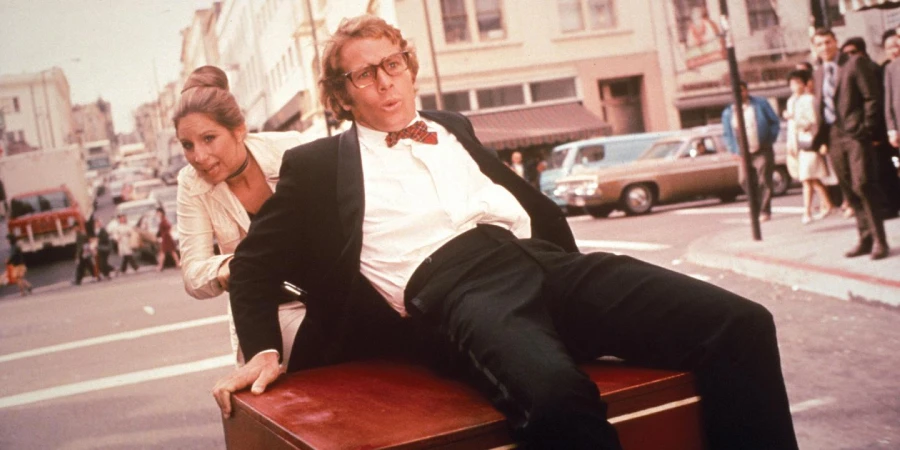
Peter Bogdanovich made a screwball comedy so committed to chaos that it features a fully staged car chase through San Francisco, a climactic courtroom free-for-all, and Ryan O’Neal playing a man so professionally obsessed with prehistoric rocks that he barely notices Barbra Streisand dismantling his entire life.
What’s Up, Doc? (1972) moves at the speed of a runaway shopping cart, piling mistaken identities, stolen government documents, and one very unfortunate hotel room fire into ninety-four minutes of gleeful anarchy. Bogdanovich borrows shamelessly from the Hawks playbook, specifically Bringing Up Baby, and the film is richer for wearing that debt openly.
Table of Contents
Detailed Summary
Howard and Eunice Arrive in San Francisco
Howard Bannister (Ryan O’Neal) is a mild, earnest musicologist from Iowa arriving at a San Francisco hotel with his domineering fiancee, Eunice Burns (Madeline Kahn). Howard carries a plaid overnight bag filled with his prized igneous rocks, which he believes hold evidence of musical tones predating human civilization. Eunice carries a matching plaid bag. This detail will cause every problem that follows.
Howard is in town to compete for a prestigious music grant awarded by the pompous Frederick Larrabee (Austin Pendleton). Two other competitors, the slippery Hugh Simon (Kenneth Mars) and the forgettable Mr. Smith, round out the field. Howard’s career, his grant, and his engagement all hinge on making a good impression at Larrabee’s banquet.
Judy Maxwell Enters the Picture
Judy Maxwell (Barbra Streisand) breezes into the Bristol Hotel like she owns it. She is charming, shameless, and apparently allergic to consequences. Judy spots Howard, decides she likes him, and begins inserting herself into his life with zero invitation and maximum confidence.
Judy also spots that four identical plaid overnight bags have converged on the same hotel. Hers contains her personal belongings. A second bag belongs to Howard and his rocks. A third bag contains classified government documents belonging to a pair of federal agents. A fourth bag contains cash and jewels belonging to a wealthy socialite, Mrs. Van Hoskins (Mabel Albertson). This quadruple-bag confusion is the engine of the entire film, and Bogdanovich keeps all four threads spinning without ever losing the audience.
The Hotel Room Chaos Begins
Judy gets herself assigned to the room directly above Howard, then causes a fire in his room during a botched attempt at room service. She sweet-talks her way into his room while Eunice is absent. Howard tries desperately to resist her, partly because he actually cannot resist her, and partly because Eunice could return at any moment.
The federal agents, Mr. Smith and Mr. Jones, realize their document bag has gone missing. A pair of jewel thieves also circulate through the hotel, hunting Mrs. Van Hoskins’ bag. Every character ends up in or near the same corridor, opening the wrong doors, grabbing the wrong bags, and creating escalating layers of misunderstanding. Kahn’s Eunice becomes increasingly suspicious, increasingly furious, and increasingly hilarious, and this is the point where Madeline Kahn announces herself as the sharpest comedic weapon in the film.
The Banquet Disaster
Howard attends Larrabee’s formal banquet hoping to impress the grant committee. Judy crashes the dinner, masquerades as a music scholar, and proceeds to dazzle Larrabee with invented theories while Howard stands nearby, quietly horrified. She is so convincing that Larrabee finds her more interesting than any legitimate candidate.
Eunice storms in, makes a scene, and Howard’s professional reputation begins its rapid descent. Hugh Simon, who is actively scheming to sabotage Howard’s application, takes careful note of every embarrassing moment. The banquet sequence is a pressure cooker that Bogdanovich lets boil slowly before turning the heat all the way up.
The Bag Swap Accelerates
Back at the hotel, the four bags keep changing hands through a series of misidentifications, break-ins, and accidental switches. Howard briefly has the government documents. The jewel thieves briefly have his rocks. Judy ends up with multiple bags at once. Everyone is convinced everyone else is a criminal.
The federal agents, played with a wonderful deadpan by Michael Murphy and others, pursue all the wrong people with bureaucratic determination. A hotel detective wanders through every scene without ever quite understanding what he is witnessing. Bogdanovich’s direction keeps the physical geography crystal clear even as the comedy logic spirals into beautiful absurdity.
The Antique Shop Break-In
Several characters converge on an antique shop after hours, each convinced a bag containing something valuable to them is inside. What follows is a cramped, beautifully choreographed sequence in which multiple parties hide from each other in the same small space while burglar alarms threaten to go off. Bodies fold behind counters, feet poke out from under furniture, and everyone tries to grab the wrong bag in the dark.
Streisand carries most of this sequence on pure physical comedy instinct, and it is the best stretch of purely visual gag work in the film. O’Neal has genuinely good reactive timing here, registering everything with wide-eyed bafflement rather than exaggerated mugging.
The San Francisco Car Chase
Judy steals a delivery cart to escape the hotel, which somehow escalates into a full car chase down the steep hills of San Francisco. A growing convoy of vehicles pursues Judy and Howard through streets, alleys, and a construction site. A slowly moving parade of Chinese New Year celebrants complicates things magnificently. A plate glass window gets destroyed. A wedding photographer loses his shot. Concrete gets poured in all the wrong places.
Bogdanovich shoots the chase with genuine location work on real San Francisco streets, and the sequence has a physical credibility that pure studio work could never replicate. It is genuinely thrilling in addition to being funny, which is harder to pull off than it looks. The chase ends with everyone and everything crashing into San Francisco Bay.

Movie Ending
Everyone ends up soaking wet and under arrest, dragged before a frazzled judge in a courtroom sequence that functions as a grand finale. All four bag owners present their cases simultaneously, each accusing the others of theft, espionage, and various other crimes. The federal agents argue about classified documents. Mrs. Van Hoskins demands her jewels. Eunice demands justice. Howard stands in the middle of all of it, looking like a man who genuinely cannot explain his own life.
Judy, characteristically, talks her way out of everything. She presents a version of events so charming and so logically scrambled that the judge simply gives up. All charges dissolve. Larrabee, won over by Judy’s performance at the banquet, awards Howard the music grant despite everything that has happened. Hugh Simon’s scheming comes to nothing.
Eunice, to her immense credit, sees the writing on the wall. She reads the situation clearly, delivers one last magnificently indignant look, and exits Howard’s life with her dignity nominally intact. Kahn plays this beat perfectly, making Eunice sympathetic even as the film cheerfully disposes of her.
Howard and Judy walk out together. He asks her why she keeps pursuing him. She quotes Casablanca back at him: “You’re not very bright, are you? I like that in a man.” The film closes on their walking away together, Howard still faintly bewildered, Judy still completely delighted with herself. It is a genuinely warm ending that earns its sentiment because Streisand and O’Neal have built real chemistry across all the chaos preceding it.
Are There Post-Credits Scenes?
No. What’s Up, Doc? has no post-credits scene. When the film ends, it ends. Walk away happy.
Type of Movie
What’s Up, Doc? is a screwball comedy with strong farce elements. Its tone is broadly affectionate and anarchic, indebted to the classic Hollywood comedies of the 1930s and 1940s without pretending to be anything other than a 1970s film wearing that influence proudly.
Pacing is relentless, character work is cartoonish in the best sense, and the film never pauses long enough for any single joke to overstay its welcome. It is warm but never saccharine, silly but never stupid.
Cast
- Barbra Streisand – Judy Maxwell
- Ryan O’Neal – Howard Bannister
- Madeline Kahn – Eunice Burns
- Austin Pendleton – Frederick Larrabee
- Kenneth Mars – Hugh Simon
- Michael Murphy – Mr. Smith
- Mabel Albertson – Mrs. Van Hoskins
- Liam Dunn – Judge Maxwell
- John Hillerman – Mr. Kaltenborn
- M. Emmet Walsh – Arresting Officer
Film Music and Composer
Artie Butler composed the score. Butler was a prolific arranger and composer who worked extensively in pop and film throughout the 1970s. His work here complements the film’s retro screwball aesthetic without becoming parody.
Streisand performs a memorable version of “You’re the Top” (the Cole Porter standard) over the opening credits, which immediately signals the film’s affection for classic Hollywood wit. The choice of a Porter number sets the tone before a single scene plays. It is a smart opening move from Bogdanovich, putting Streisand’s voice to work as a mood-setter rather than a showstopper.

Filming Locations
Principal photography took place in San Francisco, California. The city is not just a backdrop; it is an active participant in the comedy. San Francisco’s notoriously steep hills make the car chase sequence physically possible in a way that no other American city could replicate.
Specific locations include the real streets of Chinatown and the waterfront area near the bay, where the chase concludes. Interior scenes were filmed on studio sets designed to match the visual style of the Bristol Hotel. Bogdanovich’s use of real locations grounds the increasingly unreal comedy in physical space.
Awards and Nominations
What’s Up, Doc? was a massive commercial success but did not receive significant awards attention from the major bodies. Madeline Kahn’s performance is widely considered one of the finest comic supporting turns of the decade by critics, yet it went unrecognized at the time.
Behind the Scenes Insights
- Bogdanovich was deeply influenced by Howard Hawks and Bringing Up Baby (1938); he conceived the film as a conscious homage to that specific Hawks tradition.
- Streisand was reportedly skeptical of the screwball format initially, having built her career on dramatic and musical performances rather than physical comedy.
- Ryan O’Neal and Streisand had recently worked together on Love Story (1970); Bogdanovich cast O’Neal partly because he wanted someone audiences associated with sincerity, not comedy, which made Howard’s bewilderment more believable.
- The car chase sequence required extensive coordination with San Francisco city authorities and took multiple days to film on real streets.
- Madeline Kahn was making her feature film debut; Bogdanovich recognized her stage comedy background and designed Eunice to give her maximum room to perform.
- The four identical plaid bags were a deliberate structural device; Bogdanovich kept a diagram of who held which bag during each scene to avoid logical inconsistencies.
- Buck Henry co-wrote the screenplay, contributing sharp dialogue that balanced physical farce with verbal wit.
Inspirations and References
Bogdanovich has always been open about his primary inspiration: Bringing Up Baby (1938), directed by Howard Hawks and starring Cary Grant and Katharine Hepburn. That film’s structure of a mild man with a professional obsession being upended by a chaotic woman maps directly onto Howard and Judy.
Broader influences include the screwball comedies of Preston Sturges and the Marx Brothers’ talent for layering physical gags with machine-gun dialogue. The courtroom finale owes something to the classic farce tradition of gathering every character in one space to resolve all threads simultaneously.
Bogdanovich also drew from his own deep knowledge of classical Hollywood, having written film criticism and interviews with directors like Hawks before he became a director himself.
Alternate Endings and Deleted Scenes
No widely documented alternate endings or significant deleted scenes have entered the public record for What’s Up, Doc? Bogdanovich ran a tight production, and the theatrical cut reflects his original intentions closely. No substantial alternate version appears to have circulated.
Book Adaptations and Differences
What’s Up, Doc? is not based on a book. The screenplay was written directly for the screen by Buck Henry, David Newman, and Robert Benton. Its story is wholly original, constructed around the screwball comedy traditions Bogdanovich wanted to revive.

Memorable Scenes and Quotes
Key Scenes
- Judy’s first appearance at the hotel pharmacy, shoplifting groceries with cheerful impunity while Howard watches in disbelief.
- The hotel corridor sequence, with every character opening and slamming doors in rapid succession, choreographed like a piece of music.
- The antique shop break-in, with multiple parties hiding from each other in total darkness and grabbing the wrong bags.
- The San Francisco car chase, specifically the moment the convoy plows through the Chinese New Year parade.
- Judy impersonating a music scholar at Larrabee’s banquet, spinning elaborate nonsense while Howard stands frozen beside her.
- Eunice’s final courtroom scene, where Madeline Kahn delivers indignant fury as high comedy without once becoming unsympathetic.
- The Casablanca quote in the final scene, Judy grinning at Howard as they walk away together.
Iconic Quotes
- “You’re not very bright, are you? I like that in a man.” (Judy to Howard, quoting Casablanca)
- “I’m not a ‘thing.’ I’m a person.” (Eunice, defending her dignity with great feeling)
- “Love means never having to say you’re sorry.” (Howard, quoting Love Story; Judy responds: “That’s the dumbest thing I ever heard.”)
- “What IS up, Doc?” (Judy’s payoff line, a direct nod to Bugs Bunny)
Easter Eggs and Hidden Details
- Judy’s reply dismissing the “love means never having to say you’re sorry” line is a direct joke about Love Story, the film O’Neal made just before this one, in which he starred opposite Ali MacGraw and spoke that famous line.
- The film’s title is a direct reference to Bugs Bunny’s catchphrase, fitting the cartoon-logic energy of the comedy’s structure.
- Bogdanovich frames several shots to recall specific compositions from Hawks’s films, particularly the over-the-shoulder two-shots that Hawks used in his comedies to keep both performers equally alive in the frame.
- Frederick Larrabee’s pomposity is a gentle parody of academic grant culture; his name and manner reference the tradition of useless authority figures in classic screwball comedy.
- Four matching plaid bags appear in a single hotel at the same time, a logistical absurdity that the film never bothers to explain because explanation would kill the joke.
Trivia
- What’s Up, Doc? was a huge box office hit upon release, becoming one of the top-grossing films of 1972.
- Madeline Kahn’s film debut here launched one of the most beloved comic careers in American cinema; Mel Brooks cast her repeatedly in the years that followed.
- Bogdanovich reportedly screened Bringing Up Baby for his cast and crew before production began, using it explicitly as a template.
- Ryan O’Neal learned to do much of his own stunt work for the chase sequence, contributing to its physical believability.
- Streisand’s vocal performance over the opening credits marked a deliberate shift in her public image, steering away from dramatic gravity toward something lighter and more playful.
- Buck Henry, who co-wrote the script, was also the screenwriter behind The Graduate (1967), demonstrating his range across very different comic registers.
- The four-bag premise reportedly required extensive script continuity work to ensure that audiences could always track which bag was which at any moment.
Why Watch?
Watch it for Madeline Kahn alone. Her Eunice is the most underrated performance in the film, a woman written as an obstacle who becomes, in Kahn’s hands, a fully realized comic creation. Streisand and O’Neal deliver exactly what the material needs, but Kahn steals every scene she enters without appearing to try.
Director’s Other Movies
- Targets (1968)
- The Last Picture Show (1971)
- Paper Moon (1973)
- Daisy Miller (1974)
- At Long Last Love (1975)
- Nickelodeon (1976)
- Saint Jack (1979)
- They All Laughed (1981)
- Mask (1985)
- The Thing Called Love (1993)
- Texasville (1990)
- Noises Off (1992)
- Illegally Yours (1988)
Recommended Films for Fans
- Bringing Up Baby (1938)
- His Girl Friday (1940)
- The Palm Beach Story (1942)
- Singin’ in the Rain (1952)
- Some Like It Hot (1959)
- The Producers (1967)
- Blazing Saddles (1974)
- Silver Streak (1976)
- Clue (1985)
- Flirting with Disaster (1996)