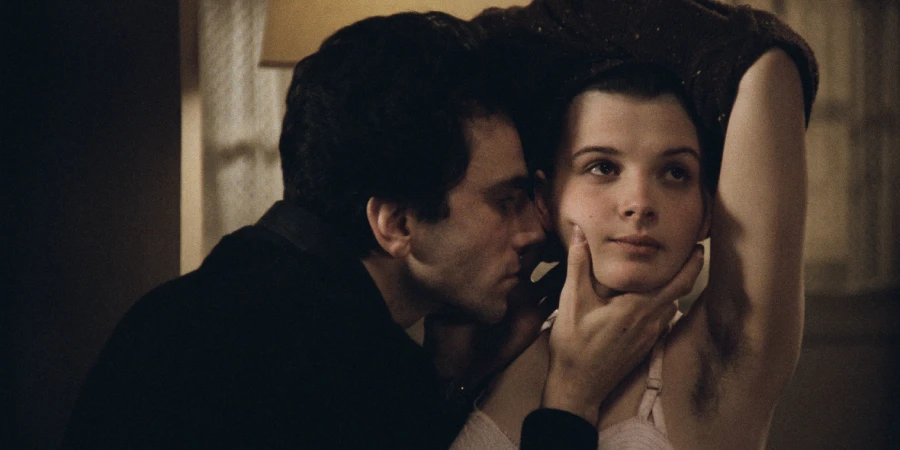
Philip Kaufman’s 1988 film asks a deceptively simple question: what happens to a man who treats love as weightless, and to the women who refuse to let it stay that way? Daniel Day-Lewis plays Tomas, a Czech surgeon in 1968 Prague whose serial womanizing collides with the Soviet invasion and, more devastatingly, with a small-town waitress named Tereza. Kaufman shoots the whole thing in lush, unhurried detail, mixing black-and-white documentary footage of the actual Prague Spring with gorgeous color cinematography.
Detailed Summary
Tomas and His Theory of Lightness
We meet Tomas in Prague, charming and utterly self-possessed. He sleeps with a rotating cast of women, including his long-term lover Sabina, a painter who matches his emotional detachment with her own. Their arrangement suits them both: no jealousy, no obligations, just pleasure and mutual understanding.
Tomas has a philosophy. Commitments weigh him down; freedom feels like his natural state. He calls this “lightness,” and he has organized his entire life around protecting it.
Tereza Arrives
Everything shifts when Tomas visits a small spa town and meets Tereza, a waitress played by Juliette Binoche. She is carrying a copy of Tolstoy, which Tomas uses as an excuse to talk to her. He sleeps with her that same night.
Days later, she turns up at his Prague apartment with a heavy suitcase. He lets her in. That decision, quiet and almost casual on screen, undoes the entire architecture of his carefree life, and Kaufman lets you feel the weight of it settling onto his shoulders in real time.
Sabina Watches
Sabina, played by Lena Olin, remains in the picture. She and Tomas continue their affair even after Tereza moves in, and remarkably, Sabina befriends Tereza. She helps Tereza become a photographer, teaches her to see.
Olin’s Sabina is the most interesting character in the film by a considerable distance. She performs a kind of deliberate lightness, yet her face in quiet moments betrays something she refuses to name.
Prague Spring and Soviet Invasion
1968 lands on the film like a stone. Soviet tanks roll into Prague, and Tereza photographs the chaos in the streets, risking her life to document the invasion. Kaufman cuts her footage against actual archival footage, and the seam is almost invisible.
Tomas eventually agrees to leave Prague for Geneva with Tereza. Sabina is already there, having emigrated earlier. The city should feel like escape, but Tereza cannot settle.
Geneva and the Unraveling
In Geneva, Tomas resumes sleeping with other women. Tereza, unable to bear the weight of his freedom, returns alone to Prague. Her departure forces something out of Tomas: he follows her back.
Going back to Soviet-occupied Czechoslovakia is not a neutral act. It costs him his surgical career. He refuses to retract a political essay the authorities demand he disavow, and they strip him of his hospital position. He ends up washing windows.
Sabina’s Exile
Sabina drifts further west, eventually landing in America. A Geneva acquaintance named Franz falls deeply in love with her. She lets him, for a while. Then she vanishes without explanation, the way she vanishes from everything she values before it can trap her.
Sabina learns of Tomas and Tereza’s deaths by letter, long after the fact. She is painting in California, geographically and emotionally removed from what she has lost.
Tomas and Tereza Settle in the Country
Back in Prague, then later in a rural village, Tomas and Tereza build something quieter. He works as a truck driver. She tends to her dog, Karenin. Their life shrinks, but it becomes, for the first time, genuinely theirs.
Karenin falls ill with cancer. Tereza nurses the dog with the same desperate tenderness she has always directed at Tomas. When Karenin dies, it is one of the film’s most quietly devastating passages.
Movie Ending
Tomas and Tereza spend one last evening dancing at a rural inn with other villagers. Kaufman films it with warmth, the light golden, the music loose and folk-inflected. They are laughing. Tereza tells Tomas she is happy, and for once neither of them is pulling away from the other.
They drive home that night along dark country roads. We do not see the crash. Kaufman cuts away before impact, and a title card tells us they died in a road accident. That choice, refusing to show the moment, is one of the film’s most controlled and correct directorial decisions. Showing the crash would have made it dramatic. Cutting away makes it feel like what it is: a small, random death on an ordinary road.
What the ending argues is that Tomas finally found weight, and that the weight was not a burden. He chose Tereza, chose the country, chose the shrinking life. He was happy when he died, which is more than his earlier, freer self was capable of. Lightness, the film suggests, is actually the harder thing to survive.
Sabina survives. She is free, mobile, unclaimed. Kaufman frames her survival as its own kind of loss, quieter than a crash but no less final.
Are There Post-Credits Scenes?
No. There are no post-credits scenes. The Unbearable Lightness of Being ends on its title card and lets the silence do the work. Stay if you want, but the film has already said everything it intends to say.
Type of Movie
This is a romantic drama with strong political undercurrents. It carries the weight of a literary adaptation, slow and interior, more interested in texture than plot momentum. Calling it purely a romance undersells the historical specificity of the Prague Spring sequences.
The tone shifts register across its runtime. Early sections feel almost playful in their eroticism. Later sections are sober, elegiac, and occasionally devastating. Kaufman earns those late tonal shifts because he spent so long establishing the characters as real people rather than symbols.
Cast
- Daniel Day-Lewis – Tomas
- Juliette Binoche – Tereza
- Lena Olin – Sabina
- Derek de Lint – Franz
- Erland Josephson – The Ambassador
- Pavel Landovský – Pavel
- Donald Moffat – Chief Surgeon
- Daniel Olbrychski – Interior Ministry Official
Film Music and Composer
Mark Adler served as music supervisor, with the film drawing heavily on Czech folk music, Leos Janacek’s compositions, and period-appropriate pieces that root the story in its specific cultural geography. Janacek’s music in particular carries enormous emotional weight in the film’s quieter scenes.
The music never announces itself. It arrives under dialogue and lingers after scenes close. That restraint suits Kaufman’s approach across the entire production: nothing is underlined twice.

Filming Locations
Kaufman could not film in Czechoslovakia, which was still under Communist rule in the mid-1980s when production began. Lyon, France doubled for much of Prague, with its older districts providing the architectural texture of a Central European city. Geneva sequences were shot in Geneva itself.
The production also used San Francisco for some of Sabina’s later American scenes. Kaufman was based in San Francisco and knew the city’s light intimately, and that familiarity shows in how Sabina’s California scenes are photographed, wide and slightly melancholy.
Using French streets to stand in for Czech ones is a significant practical compromise, and it mostly works. Cinematographer Sven Nykvist kept his palette muted enough that Lyon rarely betrays itself as Lyon.
Awards and Nominations
Sven Nykvist received an Academy Award nomination for Best Cinematography. Jean-Claude Carrière and Philip Kaufman received a nomination for Best Adapted Screenplay. Neither won on the night.
Lena Olin received significant critical praise and award attention for her performance, particularly from American critics’ circles. The film’s commercial and critical reception was strong enough to cement its reputation without a major trophy haul.
Behind the Scenes Insights
- Philip Kaufman and screenwriter Jean-Claude Carrière worked closely together on translating Milan Kundera’s notoriously interior novel into dramatic scenes with physical, visible action.
- Kundera himself was famously unhappy with the adaptation and has distanced himself from it publicly, though the film went ahead without his creative involvement.
- Sven Nykvist, best known for his long collaboration with Ingmar Bergman, brought a Northern European austerity to the color photography that keeps the film from ever feeling merely pretty.
- Daniel Day-Lewis learned enough Czech to handle some of his dialogue and reportedly immersed himself in the historical context of the Prague Spring period.
- The film runs at roughly two hours and forty-five minutes, which Kaufman defended as necessary to honor the novel’s scope and the three principal characters equally.
- Kaufman cast Lena Olin after seeing her work in Swedish films, and her casting as Sabina was widely praised as one of the production’s smartest decisions.
Inspirations and References
The film adapts Milan Kundera’s 1984 novel of the same name. Kundera, a Czech exile living in France, wrote the book in Czech but it was first published in French translation. The novel is as much philosophical essay as narrative fiction, which made it one of the more challenging adaptation projects of its decade.
The Prague Spring of 1968, the brief period of political liberalization under Alexander Dubcek before the Soviet-led Warsaw Pact invasion in August 1968, provides the historical spine. Kaufman researched the period extensively and integrated genuine archival footage to anchor the film in documented reality.
Kundera drew on Friedrich Nietzsche’s concept of eternal recurrence as a philosophical foil for his lightness-versus-weight theme, and traces of that framework survive in the film even if the explicit philosophical narration of the novel is largely absent from the screenplay.
Alternate Endings and Deleted Scenes
No widely documented alternate endings or significant deleted scenes have entered the public record for this film. Kaufman’s cut, at its substantial final runtime, appears to be the version he intended without major studio interference forcing a different conclusion.
Given how faithfully the film follows the novel’s structure and ending, it is unlikely Kaufman ever seriously considered a different fate for Tomas and Tereza. The offscreen death was always the point.
Book Adaptations and Differences
Kundera’s novel is structured around philosophical digressions that a screenplay cannot accommodate. Large sections of the book consist of the narrator directly addressing the reader about ideas: lightness, weight, kitsch, and the impossibility of knowing whether our choices are right. All of that inner commentary disappears in the film.
Screenwriter Jean-Claude Carrière found visual and dramatic equivalents for much of the philosophy. Sabina’s bowler hat, which recurs throughout the film as a sexual and symbolic object, survives from the novel and does considerable thematic work without requiring any dialogue to explain it.
Franz’s storyline is substantially condensed compared to the novel, where his own idealism and political naivety receive extended treatment. The film keeps him present but never quite gives Derek de Lint enough screen time to make Franz feel as complete as Tomas, Tereza, or Sabina.
Memorable Scenes and Quotes
Key Scenes
- Tomas and Sabina’s first scene together in her studio, where she puts on the bowler hat and they improvise a game of erotic role-play while her paintings watch from every wall.
- Tereza photographing Soviet tanks in the streets of Prague, pushing forward into crowds while soldiers raise their weapons, her camera up like a shield.
- Tomas following Tereza back to Soviet-occupied Prague from Geneva, arriving at her door without explanation, just presence.
- Karenin’s death, handled with more emotional generosity than almost any other scene in the film, Tereza lying beside the dog on the floor.
- The final dance at the country inn, golden and unguarded, Tomas and Tereza moving together without any of their old tension.
- Sabina standing alone in a bare American room, surrounded by a few paintings, having shed every country and every person she ever loved.
Iconic Quotes
- “Anyone whose goal is something higher must expect some day to suffer vertigo.”
- “We can never know what to want, because, living only one life, we can neither compare it with our previous lives nor perfect it in our lives to come.”
- “Tereza came to him as a dream. She had come to him to escape her mother’s world. But if that world repelled her, why was she so attached to Tomas?”
Easter Eggs and Hidden Details
- The archival footage of Soviet tanks entering Prague in 1968 is genuine documentary material, not recreated for the film, and Kaufman matched his own cinematography to its grain and contrast so the cuts between real and staged footage are difficult to spot.
- Sabina’s bowler hat appears in nearly every scene she shares with either Tomas or Franz, always slightly out of place, always a signal that she is performing a version of herself for an audience.
- Nykvist uses noticeably warmer light in the film’s rural final act compared to the cooler, more clinical light of Prague, a deliberate shift that signals Tomas and Tereza have moved into a different emotional register.
- Tereza’s Tolstoy novel, which she carries when she first meets Tomas, is a quiet signal about her romantic idealism long before the script makes it explicit.
- When Tomas washes windows in Prague after losing his surgical position, Kaufman frames him through the glass, visually separating him from the world he used to inhabit.
Trivia
- Milan Kundera sold the film rights but later expressed regret about the decision and has since refused to allow further adaptations of his work.
- Lena Olin was relatively unknown to international audiences before this film. Her performance as Sabina launched her international career almost immediately.
- Sven Nykvist won two Academy Awards for cinematography during his career, both for his collaborations with Ingmar Bergman, making his nomination for this film notable as recognition of his work outside the Bergman context.
- Jean-Claude Carrière is one of the most prolific literary adapters in European cinema, with credits including collaborations with Luis Buñuel across multiple films.
- Philip Kaufman fought to keep the film’s length intact against pressure to cut it shorter for commercial release.
- The production dressed Lyon streets with Czech-language signage, period vehicles, and Czechoslovak architectural details to complete the illusion of Prague.
- Day-Lewis’s performance here came before his Oscar-winning role in My Left Foot, which he made the same year and which is the film most people associate with his breakthrough.
Why Watch?
Day-Lewis plays Tomas with a specific kind of charm that never tips into likability, and watching Binoche and Olin systematically dismantle his self-satisfaction across nearly three hours is a genuinely uncommon experience. Nykvist’s cinematography alone repays attention, particularly his handling of the Prague street sequences where color and documentary grain sit in the same frame. This film argues that freedom and happiness are not the same thing, and it does so through bodies and rooms and light rather than speeches.
Director’s Other Movies
- The Right Stuff (1983)
- The Wanderers (1979)
- Henry and June (1990)
- Rising Sun (1993)
- Quills (2000)
Recommended Films for Fans
- The English Patient (1996)
- Betty Blue (1986)
- Damage (1992)
- The Reader (2008)
- Reds (1981)
- My Left Foot (1989)
- Kolya (1996)