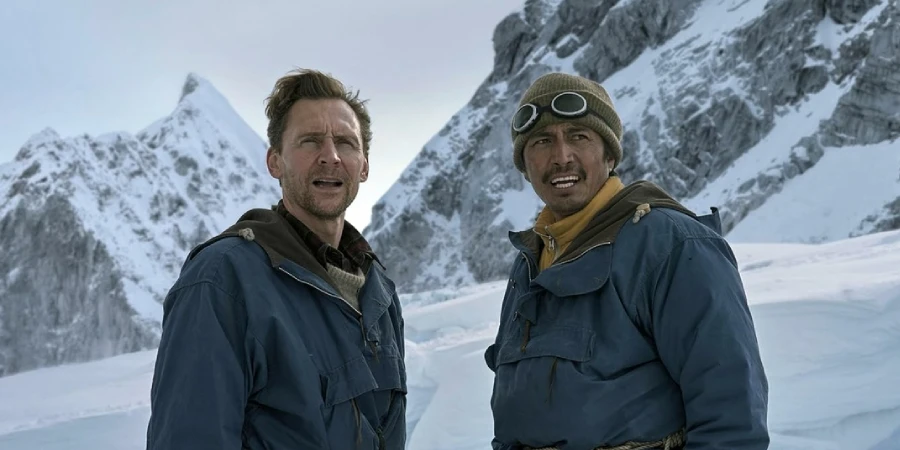
The first photograph of a human being standing on top of Mount Everest shows Tenzing Norgay. Yet for seven decades, history mostly treated him as Edmund Hillary’s sidekick. Tenzing flips the frame, turning the Sherpa from a footnote into the beating heart of the 1953 ascent. Fair warning: we spoil the whole climb below, from the first step to the summit.
Table of Contents
Detailed Summary
Two Timelines, One Mountain
Director Jennifer Peedom tells the story along two alternating tracks. One follows the 1953 British Everest expedition, while the other traces Tenzing’s life from boyhood onward.
For clarity, we walk through the events in chronological order. On screen, however, the film cuts between past and present throughout.
A Boy Meets George Mallory
In 1924, a young Tenzing lives on the Tibetan side of the mountain he calls Chomolungma, the Mother Goddess of the World. One day, British climber George Mallory passes through on his way to attempt the summit.
Tenzing boldly asks to tag along. Mallory never returns from that expedition, but the boy’s dream of reaching the top takes root.
Exile, Illness, and a Monastery
Disaster soon strikes the family. A plague kills their yak herd, and they lose their home as a result.
Together, they trek over the Himalayas from Tibet into Nepal. Along the way, Tenzing falls gravely ill, so his parents leave him at a Buddhist monastery to recover.
Dawa and the Road to Darjeeling
Years later, Tenzing works for a wealthy man whose daughter, Dawa, falls for him. His Everest dreams attract her rather than scare her off.
When word spreads that a British team is heading back to Everest, Dawa pushes him to try his luck. Consequently, the couple moves to Darjeeling, the hub for expedition hiring.
Talking His Way Onto a Team
Getting hired proves comically difficult. Tenzing buys a smart jacket and learns a phrase in English from a Sherpani teacher.
Then he bursts into the home of Jill Henderson, an Englishwoman who helps recruit for Everest expeditions. He mangles the phrase completely, but the visiting expedition leader finds it so charming that he hires Tenzing on the spot.
Love, Loss, and a Funeral Pyre
Expeditions come and go, and Tenzing and Dawa raise two daughters. Their marriage is warm, tender, and full of mutual belief.
Tragedy arrives quietly. Dawa clutches her side in pain in one scene, and soon afterward Tenzing lights her funeral pyre.
So Close With the Swiss
In 1952, Tenzing joins the Swiss expedition as a full climbing member. Alongside his friend Raymond Lambert, he reaches about 28,210 feet, higher than anyone before.
Brutal winds and dwindling oxygen force a retreat. After nearly dying, Tenzing promises his daughters he will never attempt Everest again.
The British Come Calling
In 1953, Jill Henderson sends word that the British want him as head Sherpa. Expedition leader John Hunt holds the permit, and he treats failure as unthinkable, partly because Britain is about to crown a new queen.
Initially, Tenzing hesitates. Henderson persuades Hunt to make him a full climber, and Tenzing’s daughters give him their blessing.
An Outsider Among Outsiders
Trouble starts before anyone touches the mountain. In Kathmandu, the British put the Sherpas in a barn without toilets, so the Sherpas protest by urinating on the lawn.
Translating the scolding that follows, Tenzing quietly tells his men to simply pretend to be sorry. Meanwhile, many Sherpas resent him because he was born in Tibet, and a climber named Pasang stirs up open conflict.
Tenzing finds an ally in Edmund Hillary, a New Zealander who feels equally out of place among the British. Their friendship grows from mutual respect rather than rank.
A Rope, a Crevasse, and a Snub
Ice suddenly gives way beneath Hillary, and he plunges into a crevasse. Fortunately, he is roped to Tenzing, whose quick reaction saves his life.
Even so, Hunt hands the first summit attempt to two British climbers, Charles Evans and Tom Bourdillon. Hillary grumbles that nationality, not skill, decided the matter.
Movie Ending
Evans and Bourdillon push for the top and come back defeated, stopped short of the summit. Camped on the South Col, Tenzing notices the wind dropping and senses an opening.
He and Hillary convince Hunt to back a second attempt. Soon after, the pair begins the final push into thin, killing air.
Near the top, Tenzing struggles badly. Hillary fixes his failing oxygen supply, returning the favor from the crevasse days earlier.
Oxygen-starved and fading, Tenzing then sees a vision of Dawa through the clouds. In his mind, she urges him onward, and he keeps climbing.
Next comes the vertical rock wall later named the Hillary Step. Together, they haul themselves over it and reach the summit of Everest.
Who Reached the Top First?
Peedom deliberately refuses to answer that famous question. Instead, each man gestures for the other to go first, and they step onto the summit side by side.
Overcome, they cry and embrace. In interviews, Peedom has explained that the “who was first” debate never made sense to the two climbers, since neither could have made it alone.
Why the Ending Matters
Above all, the climax completes Tenzing’s spiritual journey. To the British, Everest is a prize; to Tenzing, it is a goddess who has finally allowed him in.
Dawa’s vision ties his two timelines together, too. The woman who launched his dream helps him finish it.
As the credits roll, real archival footage shows the two men’s lifelong friendship. In other words, the film ends not on a flag, but on a bond.
Are There Post-Credits Scenes?
No, Tenzing has no post-credits scene. Still, stay for the credits themselves, since they feature real footage of Tenzing Norgay and Edmund Hillary’s friendship in the years after the climb.
Type of Movie
Tenzing is a PG-rated biographical drama with a strong survival adventure streak. It runs about 125 minutes.
Tonally, the film is earnest, reverent, and deeply spiritual. Critics have described it as old-fashioned in the best sense.
On the other hand, the climbing scenes deliver genuine vertigo and peril. Think classic sweeping epic, with a tender love story tucked inside.
Cast
Three actors share the title role across different ages, backed by a mix of Hollywood stars and Tibetan and Nepali talent.
- Genden Phuntsok – Tenzing Norgay
- Tom Hiddleston – Sir Edmund Hillary
- Willem Dafoe – John Hunt
- Caitríona Balfe – Jill Henderson
- Thinley Lhamo – Dawa
- Tenzin Dalha – Young Tenzing
- Samdrup Dorje Lama – Boy Tenzing
- Choeden Sherpa – Girl Dawa
- Johnny Flynn – George Mallory
- Tenzin Jigmey – Pasang
- Tsering Dorjee – Rinpoche
- Lhakpa Tsamchoe – Kinzom
- Jampa Kalsang Tamang – Mingma
- Kyipu Bhuti – Pem Pem
- Pasang Bhuti – Nima
Film Music and Composer
Norwegian composer Rebekka Karijord wrote the score. Her earlier credits include I Am Greta, All the Old Knives, Explorer, and Songs of Earth.
Karijord has described dividing the music into three worlds: childhood, the love story, and the climb. Notably, she recorded three Tibetan singers to give the score its human, devotional voice.
She has also spoken about building sounds from yak bells, rooting the music in Tenzing’s herding childhood. As a result, the mountain feels less like scenery and more like a living character.
Milan Records released the soundtrack album, which runs about 54 minutes. Rather than chasing one standout single, the score works best as a whole, swelling from intimate to enormous as the climbers rise.


Filming Locations
Principal photography began in Nepal in May 2025. The crew shot in Kathmandu and the Everest region, capturing real trails, villages, and monasteries.
Crucially, the production did not film on Everest itself. Everything below base camp came from Nepal, while everything above it was shot in New Zealand.
Specifically, New Zealand’s Malte Brun Pass and Hochstetter Icefall stand in for Everest Base Camp and the Hillary Step. Some summit-day peaks also come from the Southern Alps.
That choice carries quiet symbolism. Hillary honed his climbing skills in those same New Zealand mountains, so his on-screen ascent unfolds on his home turf.
Filming wrapped in New Zealand on August 7, 2025. Afterward, Spectrum Films handled post-production in Australia.
Awards and Nominations
Tenzing won the Overall Audience Award at the 49th Mill Valley Film Festival in October 2026. Separately, it opened the 2026 Zurich Film Festival as its gala film.
Behind the Scenes Insights
- A long road to the screen. The project first took shape in 2021 at Netflix with the Obamas’ Higher Ground Productions. Later, Apple won worldwide rights in a bidding war at the Cannes market in May 2024.
- A family blessing. Tenzing’s eldest son, Norbu Tenzing, served as an executive producer alongside David Michôd.
- A documentary maker goes narrative. Tenzing is Peedom’s first scripted feature, following acclaimed mountain documentaries like Sherpa.
- Finding Tenzing. A friend pointed Peedom toward films by the late Tibetan director Pema Tseden. She has said she knew from the first Phuntsok film she watched that he was her Tenzing.
- Acting in a new language. Phuntsok had never acted in English before and learned the language for the role.
- Living the part. To prepare, Phuntsok spent ten days with Phurba Tashi Sherpa, the subject of Peedom’s documentary Sherpa.
- A shared first glimpse. Hiddleston and Phuntsok trekked toward Everest Base Camp together before filming. Both saw the mountain with their own eyes for the first time on that trip.
- Real climbing. According to Peedom, the two leads did their own climbing, with doubles used only for the widest shots.
- A crew of summiteers. Cast and crew collectively counted more than 60 Everest summits.
- Picked for adventure. Peedom offered Hiddleston the role partly because of his sense of adventure.
- A festival climb. The film premiered at Telluride on September 4, 2026, then screened at TIFF and opened Zurich before a home premiere in Kathmandu.
Inspirations and References
Primarily, the screenplay by Luke Davies and Peedom draws on Tenzing: Hero of Everest, the biography by mountaineering journalist Ed Douglas. Douglas’s book was reissued in paperback alongside the film.
Peedom’s own history shaped the film, too. Her documentary Sherpa covered the deadly 2014 Everest avalanche and the Sherpas’ fight for respect.
Additionally, much of what we know about Tenzing’s early life comes from his own account, Tiger of the Snows. The film fills in the gaps with considerable imagination.
Alternate Endings and Deleted Scenes
So far, Apple has not released an alternate ending or deleted scenes for Tenzing. No cut material has surfaced publicly either.
What we do know is that the ending reflects a deliberate creative choice. Peedom chose emotion over the endless “who stepped on top first” debate.
Book Adaptations and Differences
Tenzing draws on a book, but it takes real liberties. Mountaineering historian Mark Horrell, who admired the film overall, has flagged several departures from the record.
- Mallory meeting: No evidence suggests Tenzing ever met George Mallory.
- Birthplace view: Tenzing grew up in the Kama Valley, which would have shown him Everest’s east face, not the north face.
- Getting hired: The jacket-and-English-phrase scene is invented. In reality, his landlord, the famed sirdar Angtharkay, helped him in, and Eric Shipton reportedly picked him out for his cheerful grin.
- Jill Henderson’s role: Henderson ran the Himalayan Club in Darjeeling from 1951 to 1955. She may have influenced Hunt in 1953, but not Shipton in 1935.
- Dawa’s death: The real Dawa died during World War II in Chitral, in present-day Pakistan, and was buried there. By contrast, the film shows Tenzing lighting her pyre.
- Ang Lahmu: Tenzing’s second wife, a major source of support in real life, gets only a small role.
- The crevasse rescue: Tenzing saved Hillary in the Khumbu Icefall, not in the location the film depicts.
- Hunt’s summit plan: The biggest change. In reality, Hunt planned Hillary and Tenzing’s attempt from the start, announcing it alongside the Evans and Bourdillon bid.
- The summit step: Tenzing later admitted Hillary was ahead of him on the rope. Nobody stepped onto the top side by side.
- The aftermath: The film skips the tense return to Kathmandu, where locals celebrated Tenzing and snubbed the British.
Memorable Scenes and Quotes
Key Scenes
- The Mallory encounter: A wide-eyed boy asks a famous climber to take him along.
- The jacket gamble: Tenzing bursts into Jill Henderson’s home and butchers his rehearsed English, landing a job anyway.
- Dawa’s funeral pyre: A short, devastating turn in the love story.
- The barn protest: The Sherpas answer British snobbery with a very pointed lawn-watering.
- The crevasse fall: Tenzing’s rope stands between Hillary and death.
- Dawa in the clouds: A hypoxic vision pushes Tenzing up the final ridge.
- The summit embrace: Two outsiders weep together on the roof of the world.
Iconic Quotes
Tenzing lets its mountains do much of the talking. Here are its most resonant moments of dialogue, paraphrased rather than quoted word for word:
- Tenzing on Everest: On the mountain, he can feel his late wife’s spirit beside him.
- Tenzing to the Sherpas: Ignore the British scolding and simply pretend to be sorry.
- Hunt on the mission: Failure is not an option for this expedition.
- Hillary on the summit snub: They were passed over because they are not British.
- Climbers to a collapsed comrade: Fall asleep here, and he will never wake up.
- Tenzing’s daughters: Go and finish the dream their mother believed in.
Easter Eggs and Hidden Details
- Real family names: Tenzing’s parents, Kinzom and Mingma, carry the names of his real mother and father. Similarly, his daughters Pem Pem and Nima share the names of his real daughters.
- A nod to Ang Lahmu: The Sherpani who teaches Tenzing English appears to be his future second wife.
- The Phurba Tashi connection: Phuntsok’s preparation links the film directly to Peedom’s documentary Sherpa.
- Hillary’s home mountains: The New Zealand summit scenes put Hillary on the same peaks where he learned to climb.
- A vanished landmark: The film recreates the Hillary Step as it stood in 1953. The real feature collapsed during the 2015 earthquake.
- Chomolungma throughout: Tenzing almost never calls the mountain “Everest,” underlining whose perspective drives the story.
Trivia
- Tenzing is the first feature-length film about Tenzing Norgay’s life.
- Genden Phuntsok is a Chinese actor of Tibetan descent, and Tenzing marks his first Hollywood film.
- Phuntsok has said that villagers in Tenzing’s home region still see Tenzing as their hero.
- Willem Dafoe previously narrated two of Peedom’s documentaries.
- Classification boards in Australia and the UK both rated the film PG.
- It opened in select US theaters on October 9, 2026, then arrived on Apple TV worldwide on October 16.
- Hiddleston has said he would not gamble on climbing Everest himself. In contrast, Phuntsok hopes to climb higher than base camp one day.
- In 2026, Peedom received the International Alliance for Mountain Film’s Grand Prize for her contribution to mountain cinema.
Why Watch?
Tenzing gives a long-overlooked hero the spotlight he always deserved. Breathtaking real-mountain photography makes every icy step feel dangerous. Genden Phuntsok anchors it with quiet, soulful power. Ultimately, this is a moving story about friendship, faith, and love that climbs far beyond the summit.
Jennifer Peedom’s Other Movies
- Solo (2008)
- Sherpa (2015)
- Mountain (2017)
- River (2021)
Recommended Films for Fans
- Everest (2015)
- Touching the Void (2003)
- Seven Years in Tibet (1997)
- Meru (2015)
- Free Solo (2018)
- Nanga Parbat (2010)
- The Wildest Dream (2010)
- Pasang: In the Shadow of Everest (2022)
- 14 Peaks: Nothing Is Impossible (2021)