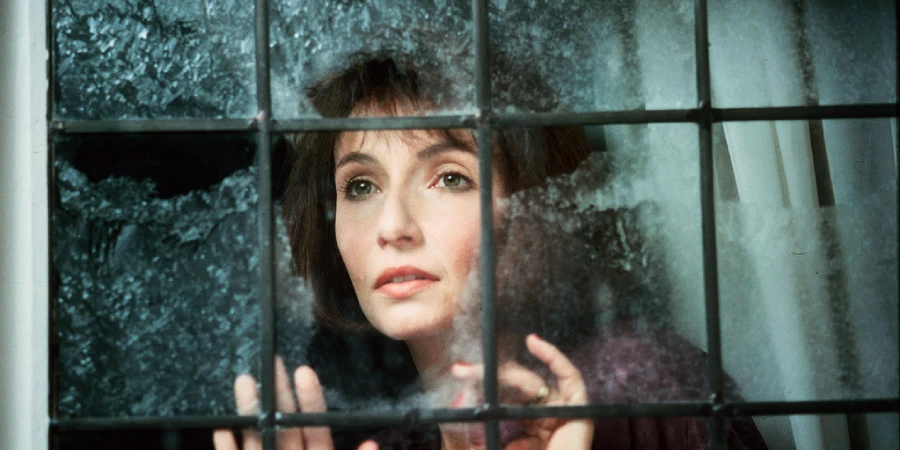
Mary Steenburgen plays three distinct characters in this film, and she commits to each one so fully that you forget you are watching the same actress. Dead of Winter (1987) is a slow-burn thriller directed by Arthur Penn, the man behind Bonnie and Clyde, and it earns every minute of its tension through performance rather than spectacle. It borrows its basic bones from Cornell Woolrich’s pulp tradition and wears that debt proudly. Penn stages the whole thing in a snowbound manor house, and the isolation never stops feeling genuinely suffocating.
Table of Contents
Detailed Summary
Katie McGovern Gets the Audition of a Lifetime
Katie McGovern is a struggling actress in New York City. She gets approached by a man named Rob Sweeney, who tells her a film production urgently needs a replacement actress for a role she would be perfect for.
Rob takes her upstate to a remote, snow-covered estate. There she meets Dr. Joseph Lewis, a wheelchair-bound man with a polished, unsettling charm. He says the part requires her to resemble an actress named Lisa, who had a breakdown during production.
The Trap Closes
Dr. Lewis photographs Katie extensively and takes a cast of her hand. She starts to feel uneasy almost immediately. Small things feel wrong: no phone access, constant surveillance from Rob, and Lewis watching her with an intensity that goes well past professional interest.
Katie discovers a severed finger preserved in a jar in the house. It becomes clear that Lisa did not simply have a breakdown. Something violent happened to her, and now Katie has been brought in as a replacement, not for a film role but for something far more sinister.
Who Is Lisa, and Why Does She Matter?
Katie learns that Lisa Murray was apparently involved in a blackmail scheme. Lewis and Rob are using Katie, who bears a strong resemblance to Lisa, to extract something from Lisa’s contacts. They want Katie to impersonate Lisa on film to obtain leverage or money.
Katie is forced to watch footage of Lisa and mimic her voice, mannerisms, and appearance. Steenburgen plays this layering brilliantly, letting you see Katie consciously building a performance within a performance. It is the best acting showcase in the film by a wide margin.
Attempts to Escape
Katie makes several attempts to signal the outside world or physically escape the estate. Each effort gets thwarted, usually by Rob, who functions as Lewis’s enforcer. Penn keeps the geography of the house deliberately confusing so that Katie, and the audience, never feel fully oriented.
She eventually discovers Lisa’s body hidden on the property. Any remaining ambiguity about Lewis’s intentions evaporates at that point. Katie understands she will be killed once she is no longer useful.
Katie Fights Back
Rather than waiting to be killed, Katie starts using her acting skills as a weapon. She pretends to cooperate, plays docile, and exploits the men’s assumption that she is helpless. Penn shoots these sequences with a quieter energy than most thriller directors would choose, and it works.
Her boyfriend, Murray, eventually becomes suspicious of her absence and starts investigating. His efforts to find her run parallel to Katie’s internal escape plan, though the film keeps the two threads mostly separate until the finale.
Movie Ending
Katie uses her impersonation skills one final time, this time turning them against Lewis himself. She convinces Rob that Lewis plans to betray him once the scheme is complete. Rob, paranoid and volatile, turns on Lewis. The two men’s mutual distrust, carefully stoked by Katie, collapses into violence.
Rob shoots Lewis. Murray arrives at the estate and the confrontation with Rob becomes the film’s final physical showdown. Rob is killed. Katie survives, shaken but intact, walking out of the house into the snow and cold daylight.
What makes the ending satisfying is not the action itself but what it confirms about Katie. She did not survive because someone rescued her. She survived because she outthought two men who underestimated her intelligence entirely. Penn keeps the final shots understated, no triumphant swell, just Katie breathing cold air and her boyfriend reaching her at last.
Lewis’s death carries a particular weight because Penn frames it as almost anticlimactic. This mannered, silver-tongued predator gets shot by his own lackey because a frightened actress read both men correctly. That irony feels intentional and satisfying.
Are There Post-Credits Scenes?
Dead of Winter has no post-credits scene. Once the film ends, it ends. Nothing waits for you after the credits roll.
Type of Movie
Dead of Winter is a psychological thriller with strong Gothic horror undertones. Its tone sits closer to Hitchcock’s domestic suspense than to slasher horror, though it is not squeamish about violence when the moment calls for it.
The pacing is deliberate rather than breathless. Penn trusts atmosphere and performance to generate dread, and the film rewards that patience more often than not.
Cast
- Mary Steenburgen – Katie McGovern / Lisa / Julie Rose
- Roddy McDowall – Rob Sweeney
- Jan Rubes – Dr. Joseph Lewis
- William Russ – Murray
- Ken Pogue – Officer Mullavy
- Wayne Robson – Roland
Film Music and Composer
Richard Einhorn composed the score for Dead of Winter. His work on the film leans into strings and low, creeping tones that suit the snowbound setting. He avoids the kind of bombastic horror scoring that would have undercut Penn’s restrained approach.
Einhorn was already known for his work on low-budget genre films before this project, and his sensibility fits the material well. The score never announces danger before the film earns it, which is exactly the right choice.
Filming Locations
Principal photography took place in Ontario, Canada. The estate used for Lewis’s manor house gave the film its most important visual asset: a place that looks grand but feels sealed off from the world.
The winter conditions were not manufactured. Real snow, real cold, and real isolation contributed to the atmosphere in ways that a studio set simply could not replicate. Every exterior shot reinforces that Katie has nowhere to run to even if she gets outside.
Awards and Nominations
Dead of Winter did not receive major award nominations. It arrived and departed theaters without significant awards attention, which is genuinely unfortunate given Steenburgen’s performance.
Behind the Scenes Insights
- Arthur Penn came to the project after a long gap between major directorial efforts, and Dead of Winter represented something of a return to genre work for him.
- Mary Steenburgen prepared extensively for the triple-role challenge, working out distinct physical and vocal signatures for each version of the character so they would read as separate people on screen.
- Roddy McDowall reportedly relished playing Rob as a man whose surface friendliness conceals pure menace, describing the role as a chance to play against his perceived screen persona.
- Penn deliberately kept the house layout ambiguous in staging to replicate the disorientation a real captive would feel in an unfamiliar space.
- The production shot during actual winter months to capture genuine environmental harshness rather than simulating it in post-production.
Inspirations and References
Dead of Winter draws directly from the 1945 film My Name Is Julia Ross, directed by Joseph H. Lewis, which itself drew from the Cornell Woolrich tradition of pulp suspense. Penn and his collaborators updated the premise for a 1980s sensibility while keeping the core trap narrative intact.
Cornell Woolrich’s influence on the screenplay is pervasive even if not explicitly credited. His recurring theme of an ordinary person locked inside a system designed to destroy them runs through the entire film.
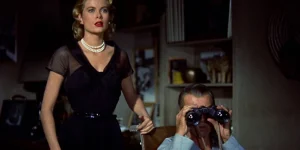
Hitchcock’s work, particularly Rear Window and Dial M for Murder, looms over the genre Penn is working in here. Penn clearly absorbed those films and used their logic of confined spaces and psychological pressure.
Alternate Endings and Deleted Scenes
No widely documented alternate endings or significant deleted scenes from Dead of Winter have entered the public record. Penn’s final cut appears to be the version he intended, and no major studio materials have surfaced suggesting otherwise.
Book Adaptations and Differences
Dead of Winter is not based on a novel. Its primary source is the earlier film My Name Is Julia Ross rather than any prose source material. No novelization of the 1987 film appears to exist.
Memorable Scenes and Quotes
Key Scenes
- Katie first discovers the severed finger in the jar: Steenburgen holds the container up to the light, says nothing for several seconds, and sets it back down with extreme care. Her silence communicates more than any line of dialogue could.
- Dr. Lewis photographs Katie at length in an early scene, adjusting her posture and head position with thin-gloved hands. Penn shoots Lewis’s face in shallow focus during this sequence, and Jan Rubes makes every smile land as a quiet threat.
- Katie impersonates Lisa on camera for Lewis: she starts with a deliberate, slightly stiff delivery and then slowly warms into the character until you briefly forget she is performing under duress. It is a scene within a scene within a scene, and Steenburgen handles all three layers.
- Rob’s paranoia breaking point: McDowall shifts in a single conversation from obsequious to dangerous, his voice dropping and his body going very still. The stillness is more frightening than any outburst would have been.
- The final walk out of the house into the snow: Penn holds on Steenburgen’s face rather than cutting to a wide shot, and you watch relief and exhaustion arrive simultaneously.
Iconic Quotes
- “You have a very expressive face. That is both an asset and a liability.” Dr. Lewis to Katie, early in the film.
- “I’m an actress. I can be anyone you want me to be.” Katie, not yet understanding how literally those words will be tested.
Easter Eggs and Hidden Details
- The name of Jan Rubes’s character, Dr. Joseph Lewis, echoes the name of the director of My Name Is Julia Ross, Joseph H. Lewis. This reads as a deliberate wink at the film’s primary source.
- Several of the framed photographs visible in Lewis’s manor house appear to depict women, a visual shorthand for the idea that Katie is one victim in a longer pattern.
- Rob’s wardrobe stays muted and functional throughout, while Lewis always appears in formal, elegant clothing. Penn uses costuming to signal who holds real power in their partnership long before the betrayal becomes explicit.
- Katie’s apartment in the opening scenes is decorated with theater memorabilia, establishing her identity as a performer before the film demands that identity become a survival tool.
Trivia
- Arthur Penn is best known for Bonnie and Clyde (1967), and Dead of Winter is a reminder that he could operate just as effectively in intimate, small-scale suspense.
- Mary Steenburgen won her Academy Award for Melvin and Howard (1980), and her performance in this film shows a different register of skill: internal rather than expressive.
- Roddy McDowall was already famous for genre work going back to Planet of the Apes, and he brought that history of playing creatures behind masks to a role that requires a very human kind of concealment.
- Jan Rubes, the Czech-Canadian bass-baritone opera singer, brought genuine theatrical weight to Dr. Lewis. His operatic background shows in the measured, precise way he delivers every line.
- The film runs under 100 minutes, which is part of why it does not overstay its welcome. Penn cuts it lean.
- MGM released the film in February 1987, a release window that matched the film’s wintry subject matter, whether that was intentional scheduling or happy coincidence.
Why Watch?
Mary Steenburgen carries this film on sheer technical range, playing three women with enough specificity that swapping between them feels like a magic trick pulled off in plain sight. Penn’s direction trusts Steenburgen and the confined setting to generate all the dread the film needs. If you want to see a thriller that earns its tension through acting rather than editing tricks, this is the one.
Director’s Other Movies
- The Left Handed Gun (1958)
- The Miracle Worker (1962)
- Bonnie and Clyde (1967)
- Alice’s Restaurant (1969)
- Little Big Man (1970)
- Night Moves (1975)
- Four Friends (1981)
Recommended Films for Fans
- My Name Is Julia Ross (1945)
- Misery (1990)
- Dial M for Murder (1954)
- Rear Window (1954)
- Wait Until Dark (1967)
- The Watcher in the Woods (1980)
- Hider in the House (1989)