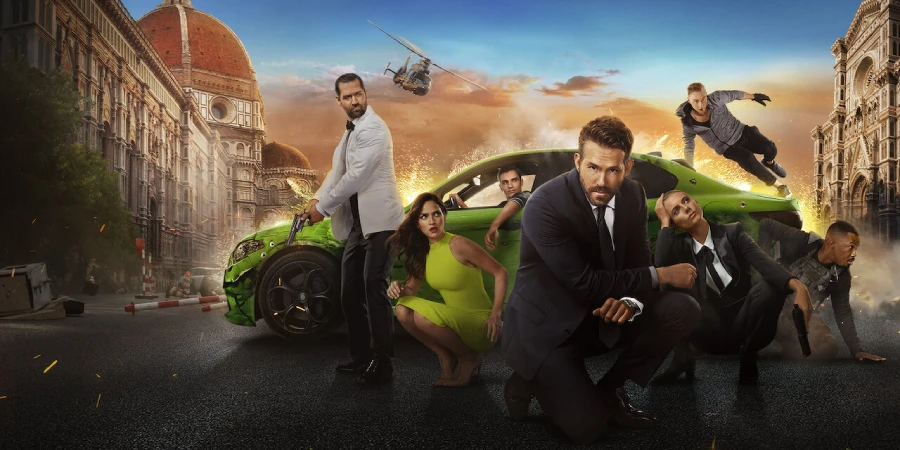
Six dead people walk into a bar, except the bar is a global shadow operation, and the punchline is a brutal coup in a fictional Middle Eastern dictatorship. Michael Bay’s 6 Underground arrives on Netflix with the subtlety of a grenade launcher and the ambition of a franchise starter, packing wall-to-wall carnage, a surprisingly coherent revenge plot, and Ryan Reynolds doing his best deadpan billionaire vigilante impression. It is loud, it is excessive, and it is absolutely committed to every single one of those qualities.
Detailed Summary
The Opening Fireball in Florence
6 Underground opens with one of the most relentlessly chaotic car chases in recent blockbuster memory, set across the streets of Florence, Italy. One, a tech billionaire played by Ryan Reynolds, leads his team of operatives through a city that quickly becomes a demolition derby of supercars, motorcycles, and tourist-scattering carnage.
During this sequence, we lose Three, the team’s parkour specialist, to a gruesomely fatal accident. Her death is quick, jarring, and deliberate; it signals immediately that this film will not protect its characters simply because they are protagonists.
Meanwhile, One narrates in flashback, explaining the premise: he faked his own death to become a ghost, free from legal accountability, and recruited five others to do the same. Each member surrendered their identity to join a private vigilante unit with zero ties to any government.
Who Are the Ghosts?
One by one, the film reveals how each team member “died” and why they joined. Two is a CIA operative who burned her identity after a disillusionment with institutional limits. Four is a hitman haunted by his past kills, seeking a form of penance.
Five is a doctor who witnessed atrocities she could not stop through legitimate means. Six is a former military man with raw combat skills and a straightforward moral compass. In contrast, Seven, who replaces Three mid-film, is a skilled sniper whose recruitment anchors a key act-two sequence.
One himself was a tech billionaire who watched humanitarian crises unfold and decided that money and anonymity were more powerful than any official institution. His motivation is personal, idealistic, and just self-righteous enough to be interesting.
The Mission: Toppling a Dictator
Rovach Alimov is the film’s villain, a ruthless dictator ruling the fictional Central Asian nation of Turgistan. He deploys chemical weapons against his own people, making him the kind of target One’s team specifically exists to eliminate. However, One’s plan is not simply assassination; it is regime change through strategic manipulation.
One has been protecting and grooming Murat Alimov, Rovach’s exiled brother, as a replacement leader. Murat is decent, principled, and deeply reluctant. His arc runs quietly beneath the explosions, grounding the film’s political stakes in something resembling human consequence.
The Magnet Heist and the Yacht
One of the film’s most visually inventive sequences involves a magnetic crane system used to intercept and redirect a convoy. The team uses a massive industrial magnet suspended from a helicopter to flip vehicles and extract a target with mechanical precision.
Later, a confrontation aboard a superyacht raises the tension further. The ghosts infiltrate Rovach’s vessel, trade bullets in tight corridors, and work toward securing leverage for their final operation. Consequently, the yacht scene also delivers some of the film’s sharpest character interplay, particularly between Two and Six.
Seven Joins the Team
To replace Three, One recruits Seven, a Delta Force sniper named Javier, played by Ben Hardy. His introduction involves a long-range sniper sequence that doubles as a job interview. One watches from a distance, evaluating his precision and nerve.
Seven’s arrival reshapes the team dynamic. He brings skepticism toward One’s leadership and genuine emotional investment in the mission’s humanitarian dimension. His presence adds a fresh lens through which the audience can question the ethics of vigilante justice.
The Coup in Turgistan
The final act plants the team inside Turgistan for the coup itself. Rovach’s forces prepare to massacre civilian protesters, and the ghosts move to disable key military assets and protect the crowd. Each team member takes a different position across the city, and the film cross-cuts between them with genuine momentum.
One confronts Rovach directly in a brutal close-quarters fight. Six leads a ground assault with ferocious physicality. Meanwhile, Five works to counteract the threat of chemical deployment, operating under pressure in a way that finally gives her character room to breathe.
Rovach falls. Murat steps into public view, appearing before his people as a symbol of a new beginning. The regime crumbles not through a single dramatic kill shot but through a coordinated collapse of its infrastructure and authority.
Movie Ending
One nearly dies during his confrontation with Rovach, and the team pulls him out with injuries severe enough to force a reckoning. He survives, but the experience cracks his carefully constructed emotional detachment. For the first time, he allows himself to acknowledge that these people are not just assets; they are the closest thing to a family he has left.
Murat addresses the people of Turgistan in a public broadcast, and the film frames this moment as a genuine victory, not a cynical one. The ghosts watch from a distance, anonymous as always. Their work succeeds precisely because nobody knows they did it.
One disbands the team officially and offers each member the chance to reclaim their identity. Some take it. Others choose to remain ghosts. The film presents this not as tragedy but as a form of freedom, hard-won and self-defined.
In the final moments, One sets up a new mission, signaling that 6 Underground was always intended as a franchise opener. A coda hints at the next target. Ultimately, the ending is optimistic in a bruised way, suggesting that doing good outside the system carries a permanent personal cost, and that the team has accepted that cost willingly.
Are There Post-Credits Scenes?
6 Underground does not include a post-credits scene. Given its Netflix release format, there is no theatrical incentive to keep audiences seated past the final frame. However, the film’s closing moments already function as a franchise tease, so a formal post-credits sequence would feel redundant.
Type of Movie
6 Underground is a action thriller with heavy doses of dark comedy. Its tone sits somewhere between a traditional spy film and a Michael Bay spectacle, with self-aware humor keeping the carnage from becoming completely nihilistic.
It leans into excess deliberately. Long action sequences, rapid-fire editing, and a willingness to be genuinely silly in one moment and shockingly violent in the next define its register. In contrast to Bay’s more ponderous franchise work, this one moves with a breezy ruthlessness.
Cast
- Ryan Reynolds – One
- Manuel Garcia-Rulfo – Two
- Ben Hardy – Seven (Javier)
- Adria Arjona – Five
- Melanie Laurent – Four
- Dave Franco – Three
- Corey Hawkins – Six
- Payman Maadi – Murat Alimov
- Lior Raz – Rovach Alimov
Film Music and Composer
Lorne Balfe composed the score for 6 Underground. Balfe is a prolific film composer with credits spanning action blockbusters and prestige productions alike, and his work here favors relentless momentum over subtlety. Percussion-heavy cues drive the action sequences forward with mechanical intensity.
The film also integrates licensed tracks aggressively throughout. Songs appear in the Florence chase and other key sequences, layering pop energy over the orchestral foundation. Balfe’s score is less about emotional depth than about sustaining kinetic pressure, which suits the film’s priorities perfectly.
Filming Locations
Florence, Italy provides the stunning backdrop for the opening car chase. Using real Florentine streets, piazzas, and architecture amplifies the chaos; watching a supercar shred through a Renaissance city creates an almost absurdist contrast that the film exploits fully.
Production also took place in Budapest, Hungary, which served as a stand-in for various international settings. Budapest has become a popular choice for large-scale action productions due to its versatile architecture and competitive filming infrastructure.
Additional sequences were filmed in Abu Dhabi and other international locations. The variety of settings reinforces the team’s stateless, borderless identity, always somewhere new, always operating in the margins of someone else’s world.
Awards and Nominations
6 Underground did not receive significant awards recognition from major industry bodies. Its Netflix release and critical reception positioned it outside the typical awards conversation entirely.
Behind the Scenes Insights
- Michael Bay directed the film as his first Netflix original, marking a shift from traditional studio theatrical releases.
- Ryan Reynolds was involved in the project’s development and helped shape the tone of One’s narration and humor.
- The Florence car chase sequence reportedly took several weeks to film and involved significant coordination with Italian local authorities.
- Dozens of cars were destroyed during production, consistent with Bay’s well-documented appetite for practical vehicular destruction.
- Screenwriters Rhett Reese and Paul Wernick, the team behind the Deadpool films, wrote the script, which explains the tonal overlap with Reynolds’ most famous role.
- Bay designed the film from the start as a potential franchise rather than a standalone story.
Inspirations and References
6 Underground draws loosely from the tradition of vigilante ensemble thrillers popularized in the 1960s and 1970s. Films like The Dirty Dozen and various cold-war-era spy productions established the template of morally complex operatives working outside official sanction.
The film’s political dimension, specifically the idea of a private citizen funding regime change, echoes real debates about private military contractors and billionaire interventionism. Reese and Wernick channel these anxieties into a framework that is action-forward but not entirely without commentary.
Furthermore, the ghost identity concept shares DNA with spy fiction’s long obsession with erasure, from classic James Bond tradecraft to more contemporary works exploring stateless operatives and deniable assets.
Alternate Endings and Deleted Scenes
No officially confirmed deleted scenes or alternate endings for 6 Underground have surfaced in verifiable public sources. Given Netflix’s limited transparency around post-production materials, the full extent of cut content remains unknown.
Bay’s production style typically generates significant footage beyond what appears in the final cut, so additional material almost certainly exists. However, nothing specific has been publicly confirmed or released.
Book Adaptations and Differences
6 Underground is not based on a book, comic series, or any previously published source material. It is an original screenplay written specifically for the screen by Reese and Wernick. Accordingly, no book-to-film comparison applies here.

Memorable Scenes and Quotes
Key Scenes
- The Florence car chase opening, a relentless sequence that establishes the film’s tone, raises the body count, and kills a main character within the first fifteen minutes.
- The magnetic crane heist, in which a helicopter-mounted industrial magnet flips an armored convoy with balletic, absurd precision.
- Three’s death scene, sudden and unglamorous, which signals that the film operates with genuine stakes beneath its action-movie surface.
- The superyacht infiltration, a tight, propulsive sequence that combines close-quarters combat with darkly comic character moments.
- Murat’s public address to the people of Turgistan, which provides the film’s emotional payoff and justifies its humanitarian framing.
- Seven’s long-range sniper audition, which doubles as a character introduction and a demonstration of the film’s flair for staging.
Iconic Quotes
- “In this life, we have a choice. We can be ghosts, or we can be heroes. I choose to be a ghost who gets things done.” (One, establishing the film’s central thesis early in the runtime)
- “Dead men don’t have rules.” (One, on the operational advantage of official non-existence)
- “You don’t need a name to make a difference.” (One, to Seven during his recruitment)
Easter Eggs and Hidden Details
- Ryan Reynolds’ character One shares several personality traits with Deadpool, including the fourth-wall-adjacent narration and the self-deprecating humor; this feels intentional given the shared writing team.
- Several vehicles in the Florence chase sequence bear Italian brand markings that serve as subtle product placement, a Bay trademark running throughout his filmography.
- The number system for naming characters visually mirrors classic spy fiction conventions, notably the numbered agents of John le Carre’s world and similar tradecraft literature.
- Turgistan’s flag and visual design draw from Central Asian aesthetic conventions without directly mirroring any specific real nation, a deliberate choice to avoid direct political identification.
- Bay includes a brief visual nod to Italian Renaissance architecture during the Florence chase that frames destruction against beauty in a way that echoes his previous work in The Rock.
Trivia
- 6 Underground was one of the most expensive films Netflix had produced at the time of its release, with a reported budget of approximately 150 million dollars.
- Ryan Reynolds and the Deadpool screenwriters reuniting on this project was a key selling point for Netflix when acquiring the film.
- Michael Bay worked without a traditional studio development process, giving him significantly more creative autonomy than on his previous franchise work.
- The film’s Florence production required extraordinary logistical coordination, as the city strictly limits large-scale commercial filming in its historic center.
- Dave Franco’s character Three dies in the opening sequence, making him one of the most briefly seen “main cast” members in recent action film history despite prominent billing.
- Melanie Laurent, the acclaimed French actress and director, joined an English-language action blockbuster partly because of the script’s more substantive character writing relative to typical films in the genre.
Why Watch?
6 Underground delivers exactly what it promises: a turbocharged, globe-trotting action spectacle with genuine wit and an ensemble cast firing on all cylinders. Reynolds and his co-stars bring enough personality to make you care between the explosions. For fans of kinetic, self-aware action cinema, this one earns its runtime.
Director’s Other Movies
- Bad Boys (1995)
- The Rock (1996)
- Armageddon (1998)
- Pearl Harbor (2001)
- Bad Boys II (2003)
- The Island (2005)
- Transformers (2007)
- Pain and Gain (2013)
- 13 Hours: The Secret Soldiers of Benghazi (2016)
- Ambulance (2022)
Recommended Films for Fans
- Deadpool (2016)
- The Losers (2010)
- The A-Team (2010)
- Smokin’ Aces (2006)
- Bad Boys II (2003)
- John Wick (2014)
- The Expendables (2010)
- Extraction (2020)
- Mission: Impossible – Fallout (2018)