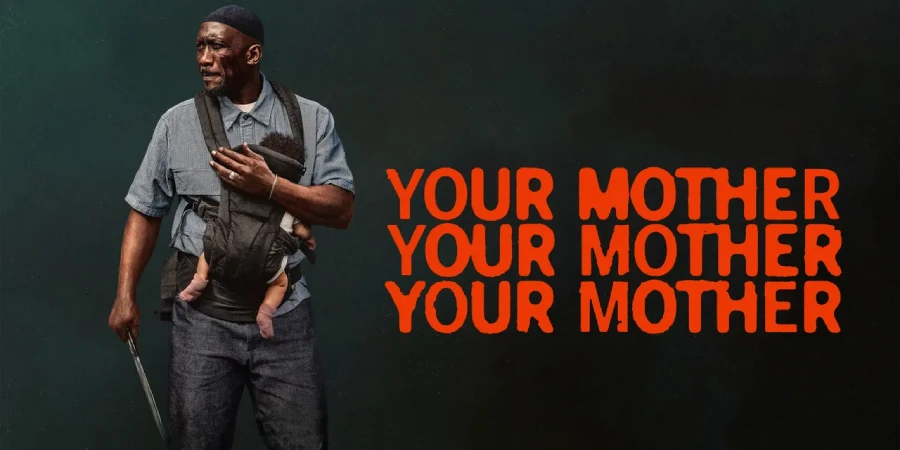
A hitman cleans fresh blood off his blade with baby supplies from a diaper bag. That single image sums up Your Mother Your Mother Your Mother better than any trailer could. Mahershala Ali plays Latif, a devout Muslim assassin whose wife dies without warning. From there, writer-director Bassam Tariq builds a thriller where the scariest assignment is single fatherhood.
Table of Contents
Detailed Summary
A Hadith, a Restroom Kill, and a Devastating Phone Call
Latif’s teenage daughter, Fatiha (Adia), opens the film by reciting a famous hadith. In it, a man asks the Prophet Muhammad who deserves the best of him. Three times, the Prophet answers: your mother.
Next, we meet Latif mid-job, killing a man in a cramped Houston public restroom. His phone rings during the cleanup. Fatiha is calling with crushing news: her mother, Khadija, has died suddenly.
Latif freezes beside the corpse, hands covered in evidence. In a darkly funny touch, he wipes his blade with baby supplies and slips away. He then heads home in a daze to oversee the traditional funeral rites.
Grief, Formula Troubles, and a Desperate Hunt for Breast Milk
Khadija leaves behind three children: Fatiha, eight-year-old Qadir (Jahleel Kamara), and infant Aziza. Aziza cannot digest formula, and the freezer’s stash of banked breast milk keeps shrinking. As a result, a trained killer now faces a ticking clock measured in feedings.
Latif swallows his pride and asks his mosque for help, but the community can only do so much. A WIC office demands a doctor’s note to prove he is not a creep. By the time he returns with paperwork, the office has closed.
These scenes play like gritty social realism rather than action cinema. Ali portrays each humiliation like a man running on fumes; he is fasting and barely sleeping.
Old Debts: Mike Mahmoudi, Hatty, and Pastor Hwan Yoon
Latif wants out of the murder business, yet his longtime handler Mike Mahmoudi (Laith Nakli) keeps pulling him back. Mike’s nephew, Hatty (Abubakr Ali), produces adult videos that he markets as halal. That hustle puts Hatty in the crosshairs of Pastor Hwan Yoon (John Cho).
Hwan is a gun-loving Christian nationalist preacher with a big online following. An Iraq War veteran and born-again Christian, he once survived an IED blast. Now he wages a holy war on porn, converting strip clubs and adult bookstores into makeshift churches.
Mike offers Latif a deal: kill Hwan and keep Hatty alive. In return, Mike will overlook Latif’s recently botched hit. Even better, Hatty knows a former performer who is lactating and could feed Aziza.
Fugazi and the Strip Club Turned Church
That performer is Fugazi (Tiffany Boone), a sex worker with a generous, motherly streak. She helps feed Aziza, and the baby finally eats. However, Fugazi has recently joined Hwan’s church.
She picks a strip club for the meeting, and Hwan has just turned it into a house of worship. Hatty rides along, tied up in the back of Latif’s van. Hwan’s armed congregation quickly closes in.
Latif and Hatty manage to escape. Within hours, though, the zealots track them down. This time, Latif chooses his children over his principles and lets Hwan’s men take Hatty.
Mike’s Revenge and a Father Exposed
Handing over Hatty brings Mike and his goons straight to Latif’s door. Consequently, Latif must hack his way through attackers while racing to get his kids out of Houston. Bodies pile up in his wake.
Fatiha and Qadir witness the violence their father spent years hiding. For Fatiha, who has already drifted from his strict faith, he becomes a monster overnight.
Even in calmer days, father and daughter clashed constantly. Latif once caught her browsing adult content online and confiscated her laptop. She also breaks her fast with junk food and nurses a crush on a young Mormon elder (John Henry Ward).
Meanwhile, Qadir clings to ritual. At one point, he begs to stop and pray mid-escape, and Latif insists they keep moving.
Latif’s estranged younger brother, Talib (Tramell Tillman), offers a different kind of pushback. Talib has left the faith for a comfortable suburban life and seems exhausted by years of his brother’s lectures.
The Murder of Imam Abdul Malik
Latif’s spiritual anchor is Abdul Malik (Giancarlo Esposito), the local imam who knows about his secret career. In one tense exchange, the imam reminds Latif of his promise, made with Khadija, to stop killing for hire. Latif defends his latest hit by insisting the target murdered another imam and escaped justice.
Abdul Malik isn’t buying it and asks whether the money played any role. Later, Hwan’s vengeful followers murder the imam. His death breaks something in Latif, and running no longer feels like an option.
He drops his children at Talib’s house and prepares to end the war himself. Before leaving, he pauses to fix Fatiha’s hair in a quiet, tender goodbye.
Movie Ending
Latif walks into Hatty’s mansion armed with only his blade. Inside, Hwan’s congregation is holding an impromptu worship service. Hatty sits strapped to a chair, bound in plastic wrap.
Hwan greets Latif with an offer of forgiveness for all his sins. Instead of soothing him, it lands like an insult. As Tariq explains it, Latif wants to know his children still love him; he wants no pardon from this man.
Latif unleashes his pent-up fury on Hwan’s armed henchmen. Ultimately, a sword cannot beat a room full of guns. Hwan shoots Latif several times in the back.
Latif drops to his knees and prays in earnest for the first time in the film. Moments later, he appears to breathe his last. For a beat, Hwan and his church seem to have won.
The Miracle That Brings Latif Back
With his face pressed to the floor, Latif somehow sees Fatiha praying for him. She begs Allah to bring her Baba home. In contrast to Hwan’s hollow pardon, her plea means everything.
Latif rises. Hwan stares in shock, recognizing the moment. Decades earlier, Hwan nearly died in Iraq, and he credits his mother’s prayers for his survival.
Watching Latif receive the same kind of miracle humbles him instantly. Amid the chaos, Hatty escapes with his life.
Hwan spares Latif and follows him outside, asking who is praying for him. Latif tells him about his daughter.
Two Former Enemies Walking the Same Way
The two men leave the mansion shoulder to shoulder. Notably, John Cho says the team originally staged this moment face to face. They switched to a side-by-side walk to show both men heading in the same direction.
Latif makes it home and embraces his children, his faith restored. Hwan’s future stays open, though the encounter clearly shakes his certainty.
Did Latif Die at the End?
Tariq happily leaves room for two readings. Some viewers believe Latif dies on that floor and the rest of the film unfolds in the afterlife. In fact, Tariq does not reject that theory; he questions why a happy ending must happen in this life at all.
His own first intention, shared with Ali, was more literal. Latif witnesses his daughter’s prayer through some kind of veil and chooses to get back up.
What the Ending Really Means
Both men justify bloodshed through faith, and both owe their lives to praying women. That parallel ties the finale straight back to the title’s hadith about mothers.
Furthermore, the miracle comes through Fatiha, the family’s most doubtful believer. Her faith, not Latif’s, saves him. In other words, the film rewards love over doctrine.
Why Critics Split on the Climax
Not everyone embraced the finale. Some reviewers argued the film reaches a perfect stopping point, only to push into another round of violence. On the other hand, others praised the final shot as one of the year’s best.
Are There Post-Credits Scenes?
We found no reports of a mid-credits or post-credits scene. The story closes with Latif back among his children, and it leaves nothing dangling for a sequel. In short, feel free to stretch your legs once the credits roll.
Type of Movie
At its core, this is an action thriller wrapped around a family drama about grief. It doubles as a meditation on faith and a sly satire of American religious extremism.
Admittedly, fans expecting nonstop carnage should adjust their expectations. Long stretches play like a slow-burn character study, with short, brutal bursts of bladework in between. Tonally, the film swings from grief to gallows humor, sometimes within a single scene.
Critics often compare it to samurai cinema, particularly stories about hitmen who live by a code. It carries an R rating for violence, bloody images, language, and some sexual content. Runtime lands just under two hours.
Cast
Tariq surrounds Ali with a surprisingly stacked ensemble of veterans and newcomers.
- Mahershala Ali – Latif
- Adia – Fatiha
- Jahleel Kamara – Qadir
- John Cho – Pastor Hwan Yoon
- Giancarlo Esposito – Abdul Malik
- Tramell Tillman – Talib
- Abubakr Ali – Hatty
- Laith Nakli – Mike Mahmoudi
- Tiffany Boone – Fugazi
- Shakirah DeMesier – Khadija
- John Henry Ward – Mormon Elder
Film Music and Composer
Son Lux, the experimental trio, composed the score. The band confirmed its involvement in May 2025, during the shoot.
Ryan Lott, Rafiq Bhatia, and Ian Chang make up the group. Their score for Everything Everywhere All at Once earned an Academy Award nomination. Moreover, they scored Marvel’s Thunderbolts*, a fun link given Tariq and Ali’s history with Blade.
CGMagazine’s TIFF review called the film a treat for the eyes and ears, crediting the score alongside Katelin Arizmendi‘s cinematography. Her warm, grainy images give Houston a lived-in texture.
We could not confirm an official soundtrack track list, so we are not naming individual cues here.
Off screen, one album shaped Latif’s rhythm. At TIFF, Ali said the late rapper Ka‘s 2016 album Honor Killed the Samurai set the right tone for the character.
Ka built that record around samurai-film samples and a strict code of honor. Ali found its deliberate, methodical mood perfect for Latif.

Filming Locations
Principal photography began in Atlanta, Georgia, in March 2025 and wrapped on May 29, 2025. The story takes place in Houston, Texas, and the crew shot part of the film there as well.
Houston matters because Tariq grew up there. Naturally, his camera knows where to look, from check-cashing shops to mosques to strip clubs reborn as churches.
Each location carries its own menace, whether it’s a neon-lit club, a cramped apartment, or a gaudy mansion. Fittingly, the film opened the 2026 Houston Cinema Arts Festival on October 1.
Awards and Nominations
So far, the film has earned three nominations at the 2026 Gotham Awards, which hand out trophies on November 30.
- Best Feature
- Outstanding Lead Performance (Mahershala Ali)
- Breakthrough Performer (Adia)
Behind the Scenes Insights
- A Marvel detour: Tariq and Ali first teamed up on Marvel’s Blade reboot, which never reached theaters. This original film grew out of that disappointment.
- Marvel’s accidental investment: Ali trained for more than a year for Blade. As he tells it, Marvel effectively helped pay for this movie by funding those skills.
- A father’s real crisis: Tariq’s wife developed an infection after the birth of their first son. He spent that stretch caring for a newborn who refused formula and hunting for breast milk.
- A silent audition: Shakirah DeMesier won her role through an unusual silent audition built on improvisation and raw emotion.
- An improvised goodbye: Tariq came up with the hair-fixing farewell during production. Ali saw it as a simple, loving gesture of fatherhood.
- A mentor’s lesson: Tariq credits editor Jonathan Oppenheim with teaching him that a film’s first five minutes show viewers how to watch it. That lesson, in turn, shaped the hadith opening.
- Festival mischief: At the film’s Beyond Fest screening in Los Angeles, Tariq gleefully yelled Allahu Akbar and fired the festival’s T-shirt cannon into the crowd.
- Producers: Lucan Toh, Babak Anvari, and Tariq produced the film through Two & Two Pictures, with Orion Pictures and Amazon MGM Studios releasing it.
Inspirations and References
The title comes straight from a well-known hadith. A man asks the Prophet Muhammad who most deserves his devotion. “Your mother” comes back three times, and the father only arrives fourth.
Tariq’s own life supplied the plot’s engine. His frantic search for breast milk as a new father became Latif’s quest, minus the swords.
Critics repeatedly compare Latif to Forest Whitaker‘s hitman in Ghost Dog: The Way of the Samurai. Others point to Lone Wolf and Cub and Yojimbo, classic tales of swordsmen bound by codes.
Similarly, Ali drew on Ka’s Honor Killed the Samurai, an album steeped in discipline and honor. He has even called for a documentary about the late rapper’s life.
In addition, Hwan’s crusade riffs on real-world Christian nationalism. One critic read his anti-trafficking rhetoric as a jab at conspiracy-driven moral panics.
Alternate Endings and Deleted Scenes
No alternate cut or deleted scenes have surfaced publicly so far. That said, the closest thing to an alternate version involves the final Latif and Hwan scene.
Cho says the filmmakers first blocked it as a face-to-face confrontation before reshaping it into a shared walk. Tariq’s comments add an unofficial second ending, too: the afterlife reading, where Latif never truly survives Hwan’s bullets.
Book Adaptations and Differences
No. Tariq wrote an original screenplay, and no novel, comic, or true-crime account sits behind it. Instead, the story draws on his personal experience and on Islamic teaching about mothers.
Memorable Scenes and Quotes
Key Scenes
- Restroom kill: Latif’s brutal opening fight ends with the phone call that upends his life.
- WIC runaround: A sleep-deprived assassin battles bureaucracy for a doctor’s note and loses to closing time.
- Strip club sanctuary: Latif meets Fugazi inside a former strip club that now hosts Hwan’s flock.
- No time to pray: Qadir begs to stop for prayer mid-escape, and Latif insists they keep going.
- Fixing Fatiha’s hair: Latif pauses ahead of his final fight to tend to his daughter’s hair.
- Mirrored prayers: Father and daughter pray in separate places, their bodies echoing each other without a word.
- Rising again: Riddled with bullets, Latif lifts himself off the floor as Hwan watches in shock.
Iconic Quotes
- “Who deserves the best of me?” (A man questioning the Prophet in the opening hadith, which answers “Your mother” three times)
- “I taught you better than this.” (Abdul Malik, scolding Latif)
- “He killed a holy man. Jail would’ve been a mercy.” (Latif, defending his latest hit)
- “Bring Baba home.” (Fatiha, praying for her father)
Easter Eggs and Hidden Details
- Diaper bag, deadly blade: Latif’s very first kill pairs baby gear with a weapon, previewing his entire double life.
- Three mothers in one title: Tariq repeats the phrase three times to mirror the hadith, where the Prophet names the mother ahead of the father.
- Crucifix couture: Hwan struts around in custom outfits dotted with tiny crucifixes, plus a flashy grill.
- Two praying women: Latif’s daughter and Hwan’s mother both pray a man back from death, quietly linking hero and villain.
- Churches in strip clubs: Hwan’s converted venues make a sly visual joke about claiming sinful spaces as holy territory.
- Tolerant missionaries: Interestingly, the Mormon characters come across as the calmest believers on screen, a wry touch in a film packed with zealots.
- A code of steel: Latif refuses guns and fights only with a blade, a rule that echoes samurai codes of honor.
- Houston homecoming: Tariq’s earlier short documentary, Ghosts of Sugar Land, explored Muslim American life in suburban Houston. This film feels like a return to that turf.
Trivia
- Mahershala Ali was born Mahershalalhashbaz Gilmore, which makes his shared surname with co-star Abubakr Ali pure coincidence.
- Ali became the first Muslim to win an acting Oscar, thanks to Moonlight.
- Having converted to Islam, Ali counts the film’s opening hadith among the teachings that moved him most.
- John Cho, beloved for the Harold & Kumar comedies, plays hard against type as a gun-worshipping preacher.
- Tramell Tillman, famous as Seth Milchick on Severance, plays Latif’s estranged brother.
- After its September 12 world premiere at the 2026 Toronto International Film Festival, the film screened at the BFI London Film Festival.
- Amazon MGM opened it in New York and Los Angeles on September 25, 2026, and expanded it nationwide by mid-October.
- Giancarlo Esposito, best known for menace in Breaking Bad, plays a gentle, principled imam here.
- Ali has publicly said he is done with Marvel’s Blade and has moved on for good.
Why Watch?
Few action movies dare to make breast milk the MacGuffin, and fewer pull it off this gracefully. Mahershala Ali delivers one of his finest performances as a killer learning tenderness. Come for the swordplay, and stay for a finale that turns a revenge thriller into a genuine miracle.
Bassam Tariq’s Other Movies
- These Birds Walk (2013)
- Ghosts of Sugar Land (2019)
- Mogul Mowgli (2020)
Recommended Films for Fans
- Ghost Dog: The Way of the Samurai (1999)
- Lone Wolf and Cub: Sword of Vengeance (1972)
- Yojimbo (1961)
- Léon: The Professional (1994)
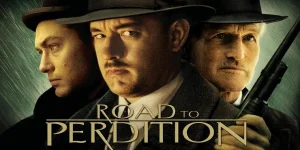
- Road to Perdition (2002)
- First Reformed (2017)
- Logan (2017)
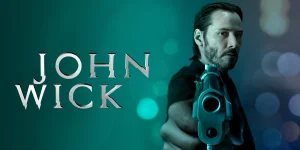
- John Wick (2014)