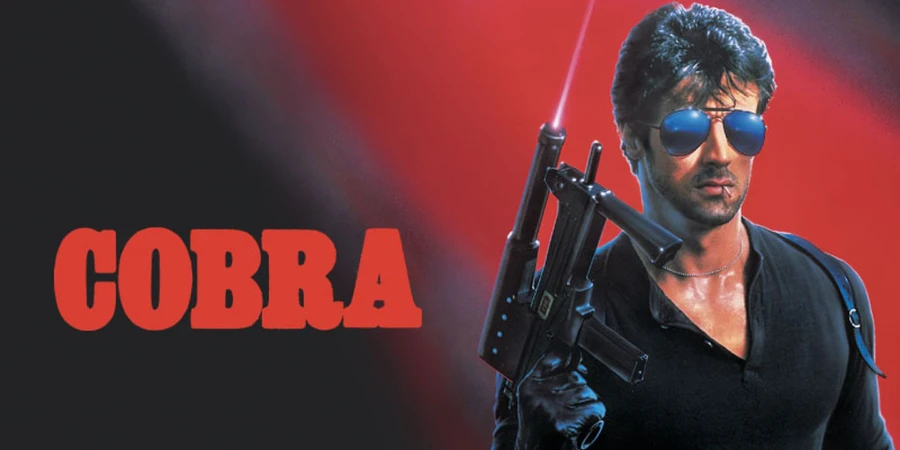

Sylvester Stallone chews a wooden matchstick for almost the entire runtime of Cobra, and that single prop tells you everything about the movie’s priorities. This is a film that cares more about sunglasses, leather gloves, and one-liners than about plot logic, and it never apologizes for it. Released in 1986, Cobra turns a moody crime novel into a neon-lit shooting gallery, and somehow that trade works in its favor more often than critics at the time wanted to admit.
Detailed Summary
A Supermarket Siege Introduces Cobretti
Lieutenant Marion Cobretti, known to everyone as Cobra, gets called into a Los Angeles supermarket where a lone gunman holds hostages at knifepoint. He walks in wearing mirrored shades at night, orders a candy bar, and calmly provokes the killer into a shootout.
Before pulling the trigger, he delivers the line that defines his whole persona: “You’re the disease, and I’m the cure.” It is a ridiculous thing to say to a man holding hostages, and Stallone sells it with total sincerity, which somehow makes it funnier and more effective at once.
The New Order and Ingrid’s Narrow Escape
Across town, a cult calling itself the New Order carries out ritualistic murders with axes and machetes, worshipping violence as a kind of social cleansing. Fashion model Ingrid Knudsen witnesses one of these killings at a car dealership and barely escapes with her life.
She becomes the only person willing to identify the killers, which makes her the top target for an organization with dozens of members hiding in plain sight across the city.
Assigned to Protect a Witness
Cobretti and his partner Tony Gonzales get pulled onto the case once it becomes clear the New Order intends to silence Ingrid before trial. The police department, worried about bad press, wants her hidden away quietly rather than protected aggressively.
Cobretti ignores that instinct completely. He treats every assignment like a personal war, and his supervisors clearly find him more dangerous to manage than the killers he chases.
A Mole in the Department
Officer Nancy Stalk, assigned to help guard Ingrid, turns out to be feeding information straight to the Night Slasher, the cult’s leader. This betrayal drives the back half of the plot, since every safe house Cobretti picks gets compromised almost immediately.
The reveal lands well because Garlington plays Stalk as quietly competent rather than twitchy or suspicious, which makes her betrayal land as a genuine gut punch instead of a predictable twist.
The Farmhouse Attack
Cobretti relocates Ingrid to a remote farmhouse, hoping distance and isolation will keep her alive. The New Order arrives anyway, swarming the property on motorcycles and in trucks, armed with axes and chains.
Cobretti and Ingrid barely escape on his customized car, kicking off a night chase through empty highways and industrial back roads that eats up most of the film’s back stretch.
Flight to the Steel Mill
The chase eventually funnels everyone into an abandoned steel mill, all rusted catwalks, hanging chains, and sparks. Gonzales and backup officers converge on the location while Cobretti squares off against the Night Slasher directly.
This location choice works because it gives the finale vertical space and dangerous machinery to play with, rather than just another parking garage shootout.

Movie Ending
Cobretti and the Night Slasher end up fighting hand to hand among the mill’s machinery, knives drawn, both men covered in sweat and grime. Thompson plays the villain as almost feral here, snarling through his lines instead of delivering them, which makes the fight feel more like an animal confrontation than a standard action duel.
Cobretti gets the upper hand by using the mill’s own equipment against his opponent, impaling the Night Slasher on a piece of industrial machinery before finishing him off for good. The kill is brutal and quick, denying the villain any last speech or redemption moment, which fits a movie that has no interest in giving its monsters dignity.
Gonzales and the other officers mop up the remaining cult members outside while Ingrid watches the confrontation from a distance. Stalk’s betrayal gets addressed off to the side rather than through a dramatic confrontation, which is arguably the one place the script shortchanges its own setup.
Cobretti and Ingrid walk away together as the sun comes up, and the film ends on the two of them driving off rather than any tidy epilogue about the cult’s remaining members. Nobody explains how many New Order followers are still out there, and the movie clearly does not care, because this was never really about tidy resolution.
Are There Post-Credits Scenes?
Cobra has no post-credits scene. The credits roll over the theme music and that is it, which matches the straightforward, no-frills structure of the whole picture.
Type of Movie
Cobra is an action crime thriller with a heavy vigilante-cop streak, closer in spirit to Dirty Harry than to any procedural mystery. Tonally, it leans hard into 1980s excess: synth score, leather jackets, one-liners, and a body count that rarely pauses for reflection.
Cast
- Sylvester Stallone – Lieutenant Marion Cobretti
- Brigitte Nielsen – Ingrid Knudsen
- Reni Santoni – Detective Tony Gonzales
- Andrew Robinson – Detective Monte
- Brian Thompson – The Night Slasher
- Val Avery – Captain Sean Cronin
- Lee Garlington – Officer Nancy Stalk
Film Music and Composer
Sylvester Levay handles the score, layering synths and pounding percussion in a style that fits right alongside his other 1980s action work. The soundtrack also features “Angel of the City,” performed by Robert Tepper, whose gravelly rock delivery matches Cobretti’s own energy note for note.
None of it is subtle, and none of it needs to be. The score exists to push adrenaline, not to underline character, and it does that job efficiently every time a chase or fight kicks off.

Filming Locations
Production shot primarily around Los Angeles, using real city streets, freeways, and the San Fernando Valley to give the film its sun-bleached, sprawling look. The supermarket siege and much of the urban chase footage benefit from that authentic LA texture, grounding the movie’s more cartoonish violence in a recognizable, everyday setting.
The finale takes place inside a real steel mill in the Los Angeles area, and that choice matters. Industrial decay gives the last fight a genuine sense of danger that a soundstage set could never fully replicate.
Awards and Nominations
Cobra did not attract attention from major awards bodies and picked up no notable nominations worth detailing here. It remains a box office and pop culture footnote rather than an awards contender, which frankly suits its personality just fine.
Behind the Scenes Insights
- Stallone wrote the screenplay himself, reshaping Paula Gosling’s source novel into a much more violent, cult-driven story.
- Stallone reportedly worked on an early draft connected to a different cop-comedy project before that project went a different direction entirely, and elements of his rejected take fed into Cobra.
- Brigitte Nielsen and Stallone were married during production, and their off-screen relationship added extra tabloid attention to the film’s release.
- Director George P. Cosmatos worked with Stallone the same year on Rambo: First Blood Part II, giving the two a shorthand that shows in how confidently the action sequences move.
- Real law enforcement consultants worked with the production on weapons handling and tactical movement for the shootout scenes.
Inspirations and References
Cobra draws loosely from Fair Game, a novel by Paula Gosling, though the film discards most of the book’s restrained thriller tone in favor of cult violence and vigilante justice. Stallone’s script also owes a clear debt to Dirty Harry-style cop cinema, right down to Cobretti’s disdain for procedure and paperwork.
Alternate Endings and Deleted Scenes
The film went through significant trims to avoid an X rating, and several scenes of graphic violence, particularly around the New Order’s killings and the supermarket opening, were shortened or removed entirely. A longer, considerably bloodier cut reportedly exists in various forms, though it has never received a proper wide home video release.
Fans who track down alternate versions online often note that the trimmed footage adds brutality without adding much story, which suggests the theatrical cut, choppy as it sometimes feels, was probably the right call for pacing.
Book Adaptations and Differences
Cobra is based on Paula Gosling’s novel Fair Game, but the differences are massive. The book follows a more grounded police investigation without any cult of killers, favoring a single stalker antagonist over an organized group of murderers.
Stallone’s version amplifies everything: one villain becomes dozens, a quiet manhunt becomes a citywide war, and the tone shifts from suspense thriller to full-throttle action spectacle. Interestingly, a separate and more faithful adaptation of the novel arrived in the 1990s under the same title, proving just how far Stallone’s version strayed from its source.

Memorable Scenes and Quotes
Key Scenes
- The supermarket siege, where Cobretti calmly orders a candy bar before taking down an armed hostage-taker.
- Ingrid’s car dealership escape from the New Order, shot with quick, disorienting cuts that sell her panic.
- The farmhouse assault, with cult bikers converging under headlights and axe blades catching the light.
- The steel mill finale, all sparks, chains, and shadows, ending in Cobretti’s brutal one-on-one with the Night Slasher.
Iconic Quotes
- “You’re the disease, and I’m the cure.”
- “This is where the law stops and I start, sucker.”
- “Crime is a disease. Meet the cure.”
Easter Eggs and Hidden Details
- Cobretti’s matchstick habit replaces the cigarette Stallone’s earlier action characters often used, a small nod to changing screen conventions around smoking.
- His customized car carries small cobra emblem details, reinforcing the character’s nickname without a single line of dialogue.
- Several New Order members wear all black with minimal dialogue, giving the cult a uniform, almost faceless menace rather than individual personality.
Trivia
- Stallone reportedly wanted a much darker, more overtly horror-tinged version of the New Order before studio notes pushed the film toward straighter action.
- Brigitte Nielsen’s casting came directly from her real-life relationship with Stallone at the time.
- The film’s violence and rating battle with the MPAA became almost as newsworthy on release as the movie itself.
- Cosmatos and Stallone reportedly clashed creatively at points, a dynamic that also colored their collaboration on Rambo: First Blood Part II.
Why Watch?
Watch it for Brian Thompson’s unhinged villain work and for a supermarket standoff that turns a candy bar into a punchline before the bullets fly. Cobra moves fast, commits fully to its own silliness, and never once pretends to be smarter than it is.
Director’s Other Movies
- The Cassandra Crossing (1976)
- Escape to Athena (1979)
- Rambo: First Blood Part II (1985)
- Leviathan (1989)
- Tombstone (1993)
Recommended Films for Fans
- Dirty Harry (1971)
- Death Wish (1974)
- Commando (1985)
- Lethal Weapon (1987)
- Tango & Cash (1989)