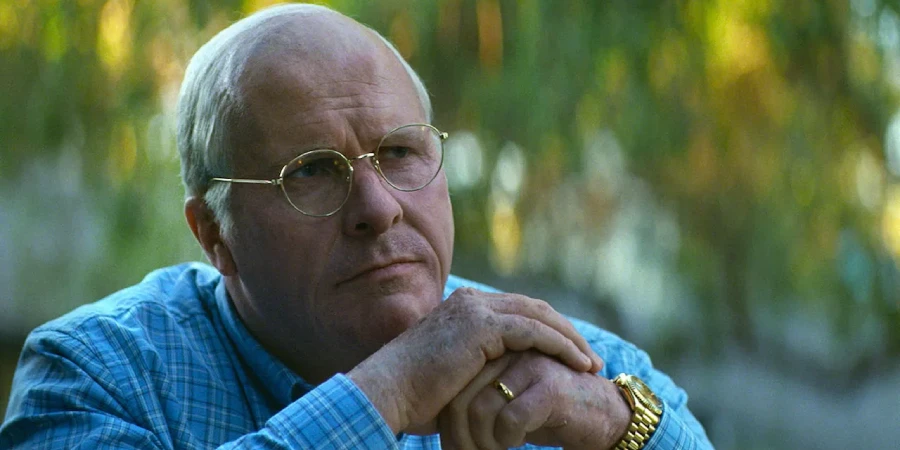

Adam McKay’s Vice is a politically charged biographical drama about former U.S. Vice President Dick Cheney, starring Christian Bale in one of his most transformative performances. With a sharp tone, a satirical style, and McKay’s signature storytelling methods, the film presents power not as an abstract concept, but as a destructive force in the hands of a few.
Detailed Summary
The Rise of an Unlikely Power Player
We first meet Dick Cheney as a troublemaking, aimless young man in Wyoming. After being confronted by his wife Lynne Cheney (Amy Adams), who refuses to be married to a loser, he begins to straighten his life out through a mixture of ambition and opportunistic discipline. This turning point foreshadows how Cheney’s entire political strategy will be defined not by ideology, but by strategic self-interest.
Cheney’s Political Evolution
Working under Republican figures like Donald Rumsfeld, Cheney slowly learns the mechanics of Washington. The film reveals how he discovers a silent but powerful strategy: speak less, move quietly, and avoid public attention. A particularly important moment showcases him defining his future philosophy: power belongs to those who understand that it can be seized without anyone noticing.
The Unitary Executive Theory
The film’s core revelation concerns Cheney’s embrace of the Unitary Executive Theory, arguing that the U.S. President can have almost unlimited authority. This concept fuels Cheneys rise under George W. Bush, allowing him to turn the vice presidency into a hidden seat of power, controlling decisions on torture, foreign policy, surveillance and war.
9/11 and Widespread Changes
After the September 11 attacks, Cheney consolidates power. He promotes the invasion of Iraq using questionable evidence, pushes the expansion of executive authority, and supports controversial methods like waterboarding. The film portrays these moments with stark contrast: while the world suffers, Cheney and his allies continue political maneuvering with cold detachment.

Movie Ending
In the film’s final act, Cheney has already shaped decades of American foreign and domestic policy. Christian Bale delivers a chilling monologue directly to the audience, breaking the fourth wall. Cheney defends his actions, stating that everything he did, he did for safety and for America, leaving viewers questioning whether he is deluded, manipulative, or genuinely convinced of his righteousness.
The film ends by showing the social and political consequences of his decisions: instability in the Middle East, mass surveillance in the U.S., and the normalization of political division. A final scene of Cheney’s supporters arguing with critics in a focus group reminds us that the effects of his legacy still shape modern America. The ending is not subtle. It clearly states that Cheney’s decisions did not end with his term; they transformed the future.
Are There Post-Credits Scenes?
Yes, there is a humorous post-credits segment that breaks the fourth wall again. A focus group turns into a heated argument about politics, mocking how American voters prioritize tribalism over dialogue. The scene reinforces the film’s critique of division and misinformation.
Type of Movie
This film is a political satire and biographical drama, blending factual storytelling with dark comedy to critique power at the highest levels of government.
Cast
- Christian Bale as Dick Cheney
- Amy Adams as Lynne Cheney
- Steve Carell as Donald Rumsfeld
- Sam Rockwell as George W. Bush
- Tyler Perry as Colin Powell
- Alison Pill as Mary Cheney
- Jesse Plemons as the narrator
Film Music and Composer
The score is composed by Nicholas Britell, known for his emotionally layered work in Moonlight and Succession. His music adds tension to quiet political scenes, emphasizing how innocuous decisions create seismic consequences.
Filming Locations
Primarily filmed in California, using sets and production design to recreate Washington offices, war rooms, and political headquarters. The focus is less on spectacle and more on creating authentic, claustrophobic spaces where powerful decisions are made quietly, mirroring Cheney’s style.
Awards and Nominations
- Won Academy Award for Best Makeup and Hairstyling
- Nominated for Best Picture, Best Director, Best Actor (Christian Bale), Best Supporting Actress (Amy Adams) and Best Original Screenplay
Behind the Scenes Insights
- Christian Bale gained over 40 pounds, shaved his head, and… practiced blinking less to mimic Cheney’s mannerisms.
- Bale studied hours of Cheney’s speeches and posture to internalize micro-behaviors rather than imitate.
- The director consulted political analysts to accurately depict the constitutional arguments behind Cheney’s decisions.
- Adam McKay had to explain the Unitary Executive Theory to the studio because executives thought it would be “too boring for audiences.”
Inspirations and References
- Based on real documented political actions and testimonies.
- Uses narrative techniques similar to documentary satire and influences from The Big Short, combining humor with serious analysis.
- Showcases how media manipulation and legal loopholes changed modern democracy.
Alternate Endings and Deleted Scenes
- A longer version of Cheney’s monologue was filmed, but cut to keep the ending sharper and more unsettling.
- Scenes showing further controversial policies after 2008 were removed, rumored to avoid legal complications or excessive runtime.
Book Adaptations and Differences
Not directly adapted from one specific book, but heavily researched using real political memos, interviews, and public records. This allowed the film to present bold claims while grounding them in documented fact.
Memorable Scenes and Quotes
Key Scenes
- Cheney agreeing to be Vice President only if he receives unprecedented control.
- The “dinner table war strategy” scene where combat decisions are shown as casual choices.
- Cheney silently watching 9/11 unfold while preparing policy expansions.
- George W. Bush asking Cheney to be Vice President, shown like a power coup disguised as a friendly invitation.
Iconic Quotes
- “We did our best to protect our country from people who wanted to destroy it.”
- “I can handle the more mundane jobs… bureaucracy, military… energy.”
- “Are we going to do this? Or are we going to sit here like a bunch of… polite amateurs?”
Easter Eggs and Hidden Details
- Cheney’s heart transplant is narrated by Jesse Plemons’ character, later revealed to be the donor.
- The playful mid-film “fake ending” parodies the idea that Cheney could have walked away.
- Visual metaphors (like fishing scenes) mirror Cheney’s hunting style: quiet, patient, deadly.
Trivia
- Christian Bale thanked Satan in his Golden Globes speech for inspiration in playing Cheney.
- Cheney himself has not publicly commented on the film.
- Script drafts dated back to McKay’s research during The Big Short.
Why Watch?
Because it reveals how unspoken decisions, legal loopholes, and quiet ambition shaped a global political landscape. It isn’t just a biography; it’s a warning about how power works when no one is watching.
Director’s Other Movies
- The Big Short (2015)
- Anchorman: The Legend of Ron Burgundy (2004)
- Step Brothers (2008)
- Don’t Look Up (2021)
Recommended Films for Fans
- The Big Short (2015)
- W. (2008)
- Frost/Nixon (2008)
- Look Who’s Back (2015)
- The Report (2019)
- JFK (1991)