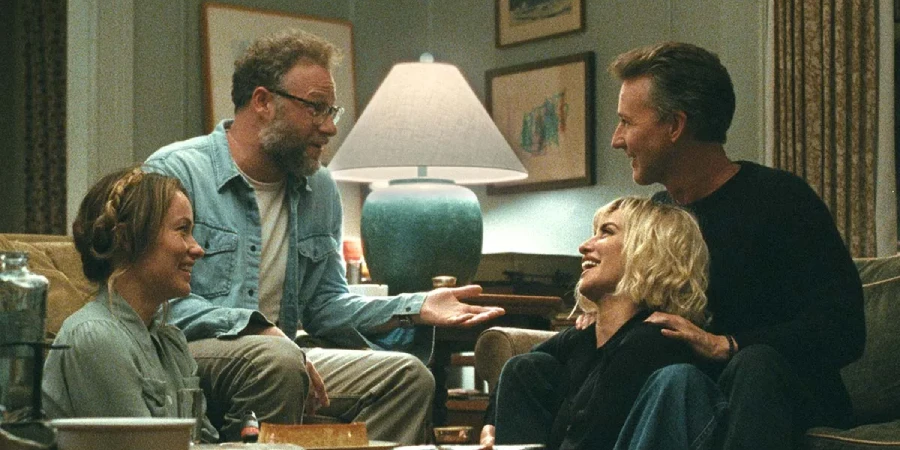

One soufflé, two couples, and an offer nobody expected to hear over dinner: that is the whole setup of The Invite (2026), and it is more than enough. Olivia Wilde‘s third film traps four adults in one apartment for a single night and lets their marriages, egos, and appetites collide. It is funny until it hurts, and then it is funny again.
Detailed Summary
A Marriage Running on Fumes
The film opens in San Francisco, where Joe, a musician who now teaches a jazz band at a conservatory, comes home to find his stay-at-home wife Angela has invited their upstairs neighbors to dinner. He had been told exactly once and forgot. Their marriage is in rough shape, and the two bicker about nearly everything.
A home movie from twenty years earlier frames all of this. Before we see anything, we hear a projector, voices, Seth Rogen’s laugh, and a piano, and then footage of Joe and Angela two decades ago appears. That contrast between then and now sets the stakes before the first guest rings the bell.
The Noise Upstairs
Their most recent fight concerns the neighbors. Joe and Angela keep hearing loud sex from the apartment above, and Joe plans to confront the couple, while Angela, desperate to impress them, orders him to stay calm and quiet. He does not want to host; she needs this to work.
Angela has been functionally trapped at home for years while Joe, once a promising musician, works long hours as a band teacher. Her frustration makes the invitation feel like a coded attack on him. A dinner party is the battlefield she has chosen.
Pina and Hawk Arrive
Pina, a divorcée, and Hawk, a widower, arrive mid-argument. Angela, unprepared to host, makes several awkward mistakes, such as having no wine and failing to check Pina’s dietary restrictions. Nothing about the evening goes as rehearsed.
Joe takes the opposite approach. He openly antagonizes the couple but is surprised to find they admire his brutal honesty. The group eventually warms up, though Joe still resents the noise and becomes troubled when he learns Hawk has seen Angela naked through a window.
Secrets Come Out at the Counter
Small confessions start to pile up. A dark, revealing moment at the kitchen counter has Angela blurting out something bleak about her inner monologue and how she sees herself. Meanwhile, Pina evens the score for her new friend. She reveals that Joe stares at her chest every time they share the elevator.
Hawk also gets his turn. When Joe relentlessly mocks him for choosing a nickname like “Hawk,” Norton delivers a surprisingly moving monologue about where the name came from. Hawk, it turns out, is an ex-firefighter who remade himself into something like a street-corner Henry Miller.
The Actual Invitation
Late in the evening, the neighbors explain the noise. Pina and Hawk apologize and reveal they take part in sex parties, which is why things get loud; Joe and Angela find this exciting rather than offensive. Pina then admits the real reason for the visit: they came hoping to invite Joe and Angela to have group sex with them.
The title does not refer to dinner at all but to this mid-evening offer. The hosts say yes faster than anyone expected. However, Pina hesitates. As a psychotherapist and sexologist, she has watched the couple fight all night and is no longer sure. Instead, the group decides to swap partners.
The Swap Falls Apart
Nothing about the swap works. Angela is too nervous to initiate anything with Hawk, and Joe throws out his back while dancing with Pina. Rogen’s physical comedy as Joe groans, curses, and whines on the floor is one of the film’s highlights.
The mood sours. Another argument erupts between Joe and Angela, and he berates the neighbors. Pina then gets the couple to talk honestly about their relationship, uncovering deep resentment and the fact that they have not had sex in a year.



Movie Ending
Pina stops playing hostess-in-reverse and starts playing therapist. She suggests Joe and Angela should separate rather than stay together for their daughter Maggie, or else find a way to reframe their relationship, because its current form appears to have run its course. It is the first time anyone in the room has said the obvious thing out loud.
Joe and Angela seemingly agree to separate and begin discussing their next moves. When they return from the kitchen, Pina and Hawk have vanished without a word. Given the tone of everything before, it is very strange that the neighbors leave without saying anything, and that oddness has fueled theories about whether the night was quite as real as it looked.
Then the film gets quiet. Joe goes back to his office and plays the piano he had refused to touch, and Angela eventually joins him. The two sit together on the bench and embrace, suggesting their love still exists in some form. No divorce papers appear, and no romantic rekindling gets spelled out either.
So do they stay together? The film refuses to say. Wilde has confirmed that the ambiguity is the point, because it best captures the complexities of a long relationship. She has also explained that the closing song is not meant to signal a sudden happy ending.
The piano is what makes it land. It bookends the opening home movie, where the young couple played together for fun, and it is the one thing Joe has walled off from his wife for years. Opening that door, whatever happens next, is the night’s only real act of change. The final shot gets the story’s larger point across organically and with feeling, and the last half-hour is Wilde’s best work as a director.
Are There Post-Credits Scenes?
No. The Invite ends on the piano bench and goes straight into the credits. No bonus scene or mid-credits tag has been reported, and a chamber comedy of this kind has no reason to tease anything. Once the music fades, the evening is over.
Type of Movie
The Invite is a sex comedy drama, though “comedy of manners” might be the fairest label. It is a farce about an unhappy bourgeois couple hosting the neighbors whose sex noises keep them awake, and the whole thing unfolds in one apartment over one night.
Tone shifts constantly. The first half is heavily stylized, with off-center compositions and a string-driven score that pushes hard; around the halfway point the film calms down and lets the actors carry the storytelling. Critics compared it to Who’s Afraid of Virginia Woolf?, which gives a sense of how sharp the laughs can get.
Cast
- Seth Rogen – Joe
- Olivia Wilde – Angela
- Penélope Cruz – Pina
- Edward Norton – Hawk
- Skip Howland – Doorman
Film Music and Composer
Devonté Hynes composed the score. The first track, “Contentious Environment,” arrived as a digital single on June 15, 2026, and A24 Music released the full soundtrack digitally on June 26. Hynes is better known as Blood Orange, and he previously recorded as Lightspeed Champion.
The music leans on strings. The soundtrack listing includes three “Suite for Cello” sections and short cues titled after plot beats, such as “Sex Parties,” “Hawk’s Story,” and “It’s Over.” Classical pieces also appear, including the Habanera from Bizet’s Carmen and Karl Jenkins’ “Palladio.” Sade’s “By Your Side” (2000) features in the film as well.
Not everyone loved the approach. One critic felt the string-driven score grabbed the dominant feeling of a scene and amplified it until other emotional shades drowned out, with one tense dialogue scene scored like a horror movie. In fairness, that intensity settles down once the film does.

Filming Locations
The apartment scenes were shot in Los Angeles. In April 2025, it was revealed that Wilde would direct the cast, with filming already underway in Los Angeles. The whole film was shot in 23 days, in chronological order, on 35 mm film.
San Francisco provides the exteriors and the sense of place. In May 2025, filming took place at the auditorium of A.P. Giannini Middle School in the Sunset District, on a BART train from Glen Park to Balboa Park, at the Make-Out Room nightclub in the Mission, at the Castro Farmers’ Market, and at Molinari Delicatessen. Those glimpses of Joe’s working life and the city around the couple keep the chamber piece from feeling airless.
Shooting in sequence mattered as much as the addresses. The four actors could track the slow erosion of politeness across the night exactly as the audience experiences it.
Awards and Nominations
At the Astra Midseason Movie Awards on June 30, 2026, Penélope Cruz won Best Supporting Actress and Will McCormack and Rashida Jones won Best Screenplay. The film was runner-up for Best Picture, Edward Norton was runner-up for Best Supporting Actor, and Wilde earned a Best Director nomination.
The screenplay also received a Humanitas Prize nomination for Comedy Feature, and the “Ding Dong” trailer was nominated at the Golden Trailer Awards. The major year-end awards season is still ahead as of this writing, so that list may grow.
Behind the Scenes Insights
- The remake was first announced in March 2021 from producer David Permut. In March 2022, Jonathan Dayton and Valerie Faris signed on to direct, and in May 2023 Amy Adams, Paul Rudd, and Tessa Thompson were cast before the project stalled.
- Hawk’s third-act monologue about the origin of his name was written by Edward Norton himself, and Rogen’s immediate response was improvised.
- The film is dedicated to Diane Keaton, who died on October 11, 2025.
- After the Sundance premiere, studios including A24, Apple TV, Focus Features, Neon, Netflix, Searchlight, and Sony pursued the film, with bids reaching as high as $10 million.
- One buyer offered money for a streaming-only release, which Wilde likened to a bribe, and the team turned it down. The bidding war narrowed to A24 and Focus with offers above $12 million, and despite a late bid from Warner Bros.’ new specialty label, A24 won U.S. rights.
- Wilde has said the ending evolved during production, partly by stripping away well-written but unnecessary dialogue from two characters who had been almost manically combative with chatter.
- Cinematographer Adam Newport-Berra also shot Rogen’s series The Studio for Apple TV.
Inspirations and References
The Invite is an English-language remake of the 2020 Spanish film The People Upstairs (Sentimental) by Cesc Gay, itself an adaptation of Gay’s stage play Els veïns de dalt / The Neighbors Upstairs. The original had also been adapted in France, Italy, Switzerland, and South Korea.
The premise works like a sturdy house with strong bones: it can be completely redone and still be recognizable. McCormack and Jones kept the structure and rebuilt the voices for an American setting.
Critics heard older echoes too. Variety’s Owen Gleiberman compared it to Who’s Afraid of Virginia Woolf?, and TheWrap called it something like that film’s great-great-grandchild. Hawk’s bohemian persona, meanwhile, nods to Henry Miller, and Joe’s bitterness about an abandoned music career gives the film its melancholy undertow.
Alternate Endings and Deleted Scenes
No alternate ending has been released, but the ending was not fixed from the start. Wilde has described how the finale emerged through the process, and she said she could only imagine the battle she would have faced at a studio over that ending.
A significant amount of dialogue was cut because the two leads had become too verbose, which suggests plenty of material hit the floor. A24 has issued special Blu-ray and 4K editions, so any bonus features would live there.
Book Adaptations and Differences
The Invite is not based on a book. Its source is a stage play, and the chain runs from Gay’s play to his own 2020 film to this American version.
The bones stay the same: a downstairs couple, an upstairs couple, one dinner, one indecent proposal. What changes is the texture. Rather than the snickering naughtiness of British and American sitcoms, the film aims for the tone of foreign-language arthouse comedies that can laugh at sex without turning puritanical. Joe’s background as a lapsed musician and the piano bookends are specific to this telling.


Memorable Scenes and Quotes
Key Scenes
- The opening home movie of a young Joe and Angela goofing around at the piano, heard before it is seen.
- Angela scrambling through a dinner she never planned, with no wine and a soufflé on the menu.
- The kitchen-counter confession, where Angela tells Hawk something unexpectedly bleak about how she sees herself.
- Pina exposing Joe’s elevator habit in front of everyone.
- Hawk’s monologue about his name, followed by Joe’s instant deflating remark.
- The reveal that the noise upstairs comes from sex parties, and the invitation that follows.
- Joe throwing out his back mid-dance and spending the rest of the night nearly immobile.
- The final piano scene, with Angela slipping onto the bench beside him.
Iconic Quotes
- Joe’s protest that Angela should have known he was not listening when she told him about the dinner.
- Pina’s blunt question about whether the couple still has sex at all, which the soundtrack even titles as a cue.
- Hawk explaining, with total sincerity, why a grown man chose to call himself Hawk.
- Pina’s closing assessment that the marriage as it stands has run its course.
Easter Eggs and Hidden Details
- The piano frames the entire story: it opens the film in the home movie and closes it in Joe’s office.
- Joe’s studio is off-limits to Angela for most of the running time, so his decision to play with the door open is the night’s real turning point.
- The title refers to the mid-evening offer rather than the dinner invitation, which reframes the whole first act once you know it.
- Several score cues are named after plot beats, which means the soundtrack listing doubles as a spoiler-laden outline of the evening.
- Sharp-eyed viewers have noted the building’s geography seems inconsistent, as though the neighbors live somewhere else entirely, which fits the theory that Pina and Hawk may not be quite what they appear.
- Hawk’s old life as a firefighter quietly explains his attachment to rituals and self-presentation.
Trivia
- The film premiered at the Eccles Theater during the 2026 Sundance Film Festival on January 24.
- A24 released it in limited U.S. theaters on June 26, 2026, then expanded wide on July 10; it reached digital platforms on August 11.
- On a budget of $15 million, it has grossed $55.6 million worldwide, making it the second-highest-grossing summer platform release since the pandemic, behind Wes Anderson’s Asteroid City.
- Its limited opening weekend sold out every screening, with $379,000 in Los Angeles and $54,000 in New York.
- Rotten Tomatoes lists 96% positive reviews from 283 critics, and Metacritic scores it 82 out of 100.
- It also played in competition at the Sydney Film Festival, in the Piazza Grande section at Locarno, and in the Perlak section at San Sebastián.
- The Seattle International Film Festival chose it as the 2026 closing night film.
- A September Deadline piece asked whether Broadway might be the film’s next stop.
Why Watch?
The Invite is a rare adult comedy that trusts its audience with discomfort. Four actors at the top of their game tear into a script that is both filthy and tender. You will laugh, wince, and probably argue about that ending on the way home.
Director’s Other Movies
- Booksmart (2019)
- Don’t Worry Darling (2022)
Recommended Films for Fans
- Who’s Afraid of Virginia Woolf? (1966)
- Bob & Carol & Ted & Alice (1969)
- Husbands and Wives (1992)
- Carnage (2011)
- Force Majeure (2014)
- The Overnight (2015)
- Perfect Strangers (2016)
- Marriage Story (2019)
- The People Upstairs (2020)