
Wim Wenders takes a simple premise, a picture framer with a terminal diagnosis being pulled into organized crime, and turns it into something genuinely strange and sad. The American Friend is a European thriller that doesn’t behave like one. Bruno Ganz plays Jonathan Zimmermann with such quiet dignity that every moral compromise registers like a physical blow. This is a film where the crime mechanics barely matter and the friendship between two men who have no business trusting each other is the whole point.
Detailed Summary
Jonathan’s World and the First Insult
Jonathan Zimmermann lives in Hamburg, restoring picture frames and raising a family with his wife Marianne. He has a blood disease and knows his time may be limited. When he meets Tom Ripley at an auction, he refuses to shake Ripley’s hand, having heard rumors about the American’s shady reputation.
Ripley notices the snub. It stings him, partly because Ripley is a man who craves legitimacy he will never earn. That small social slight plants the seed for everything that follows.
Raoul Minot’s Scheme
Raoul Minot, a French crime figure, approaches Ripley with a proposition: he needs an assassin who cannot be traced back to the usual circles. Ripley, perhaps out of spite, perhaps out of boredom, steers Minot toward Jonathan. He tells Minot that Jonathan is dying and therefore might be motivated by money for his family.
Minot approaches Jonathan with a false story about a medical examination in Paris. The exam gives Jonathan a grimmer prognosis than he may have actually deserved. Frightened and destabilized, Jonathan agrees to carry out a hit on a mob figure in Paris.
The Paris Hit
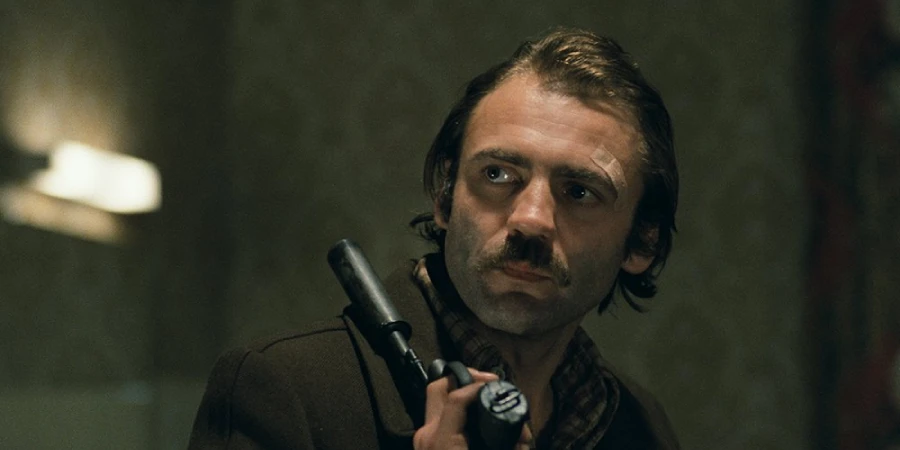
Jonathan travels to Paris. He waits in a metro station, sweating, watching the target descend an escalator. His hands shake. He fires and kills the man.
Wenders shoots this sequence with cold precision. There is no heroic music, no stylish slow motion. Just a sick man doing something he cannot believe he is capable of, and the camera holds on his face long enough for the shame to settle in.
A Second Job and Growing Dread
Minot asks Jonathan to carry out a second killing, this time on a train. Jonathan is in worse shape physically and emotionally. Ripley, feeling guilty and oddly affectionate toward the man he helped destroy, boards the train to assist him.
Together they kill two targets on the train. It is a bizarre scene, two men who are neither friends nor enemies, working together out of necessity and something resembling loyalty. Wenders makes it feel less like an action sequence and more like two people caught in a current they cannot fight.
The Friendship Solidifies
After the train sequence, Ripley and Jonathan spend time together. Ripley visits Jonathan’s home. He genuinely seems to like Marianne and the child. There is something almost domestic about these scenes, which makes them more unsettling than any of the violence.
Jonathan is furious that Ripley set him up, and Ripley never fully apologizes. Yet neither man walks away. Ripley gives Jonathan one of his expensive cowboy hats. It is a ridiculous gesture that somehow works.
The Mob Closes In
The crime organization sends men to tie up loose ends. Jonathan and Ripley find themselves being hunted. They fight back together, disposing of the gangsters in a sequence that plays more like grim necessity than thrilling heroism.
Wenders uses the Hamburg locations brilliantly here. Industrial waterfront spaces and empty night streets make the city feel like a maze. Jonathan, a man who has spent his life in a workshop, now moves through it like a fugitive.

Movie Ending
Jonathan’s body gives out on a beach. After everything he has survived, the disease wins. He collapses near the water, and Marianne watches him die. Ripley drives away alone.
That final image of Ripley in the car, moving through flat coastal landscape, is one of the most quietly devastating shots in the film. Hopper plays it without sentiment. Ripley got what he half-wanted, a companion, a proof that he could matter to someone, and he lost it almost immediately.
Marianne’s grief carries a specific edge. She knows, or suspects, what Ripley’s involvement cost her husband. She does not confront him directly. Her silence is more damning than any accusation could be.
What Wenders refuses to give audiences is catharsis. Nobody is punished in a satisfying way. Ripley survives. Minot’s organization presumably continues. Jonathan, the most innocent person in the story, dies from an illness that was always going to kill him, only now his wife’s last memories of him are tangled up with murder and deception.
Audiences often ask whether Jonathan ever truly forgave Ripley. The film never answers cleanly. Their final interactions have warmth in them, but Wenders is too honest a filmmaker to let that warmth erase what Ripley did. The friendship is real and it is poisoned at the root, and both things are true at once.
Are There Post-Credits Scenes?
The American Friend has no post-credits scene. Wenders ends on his own terms, and the film simply stops. Stay if you want a moment to breathe, but there is nothing additional waiting for you.
Type of Movie
This is a neo-noir thriller with a strong undercurrent of European art-house melancholy. It moves at a contemplative pace that will frustrate viewers expecting genre momentum. Think less Hitchcock, more Antonioni with a gun.
Tonally it sits in a strange place between clinical and tender. Wenders is interested in what crime does to ordinary men, not in crime itself as spectacle.
Cast
- Bruno Ganz – Jonathan Zimmermann
- Dennis Hopper – Tom Ripley
- Lisa Kreuzer – Marianne Zimmermann
- Gérard Blain – Raoul Minot
- Nicholas Ray – Derwatt
- Samuel Fuller – The American Mobster
Film Music and Composer
Jürgen Knieper composed the score. His work here is sparse and unsettling, favoring atmosphere over melody. Long stretches of the film run with minimal scoring, which forces ambient sound and silence to carry the tension.
Knieper would later work with Wenders again on Wings of Desire. His instinct for restraint suits this material perfectly. A more conventionally dramatic score would have undermined the film’s refusal to sensationalize its violence.



Filming Locations
Principal photography took place in Hamburg and Paris, with additional scenes shot in other European locations. Hamburg’s industrial waterfront, with its cranes, container yards, and grey light, gives the film a working-class texture that grounds Jonathan’s ordinary life.
Paris functions almost as an abstract space, a city Jonathan visits to commit murder, clean and anonymous and indifferent. Wenders uses the contrast deliberately. Hamburg feels lived-in; Paris feels like a crime scene waiting to happen.
Ripley’s villa in the film has a sleek, slightly unreal quality. It suggests a man who has constructed a life that looks legitimate from the outside and is hollow all the way through.
Awards and Nominations
The American Friend screened in competition at the 1977 Cannes Film Festival, which gave it significant international exposure at the time of release. It did not win major awards but earned strong critical attention, particularly in Europe and among American cinephiles who sought it out.
Behind the Scenes Insights
- Wenders cast Dennis Hopper at a point when Hopper’s career was in a difficult period. The casting was a genuine risk, and Hopper responded by delivering one of the most controlled performances of his career.
- Nicholas Ray and Samuel Fuller, both legendary American directors, appear as actors in the film. Wenders idolized both men. Having them play criminals in a story about American cultural corruption is a pointed and affectionate joke.
- Wenders and Hopper developed a genuine rapport during production. Hopper’s lived-in quality as Ripley owes something to the trust Wenders extended to him on set.
- Bruno Ganz prepared extensively for the physical symptoms of Jonathan’s illness, researching how the body behaves under the particular kind of fatigue and anxiety his character would experience.
- Patricia Highsmith, who wrote the source novel, reportedly had mixed feelings about the adaptation. She had previously been unhappy with other screen versions of her Ripley character and was protective of how he was portrayed.
Inspirations and References
The film adapts Ripley’s Game, the third novel in Patricia Highsmith’s Tom Ripley series. Highsmith’s Ripley is one of crime fiction’s great amoral protagonists, charming and pitiless in equal measure.
Wenders also drew on his deep love of American cinema, particularly the work of directors like Nicholas Ray and Samuel Fuller. Casting both men as supporting players is less a reference than a direct conversation with the films that shaped him.
The film belongs to a broader 1970s European engagement with American genre forms, alongside works by filmmakers like Claude Chabrol and Bertrand Tavernier, who were similarly interested in what happened when European sensibility collided with American crime fiction.
Alternate Endings and Deleted Scenes
No widely documented alternate endings or significant deleted scenes have entered the public record for The American Friend. Wenders has spoken about the editing process in interviews, but no specific cut material has been detailed in sources this writer can confidently cite.
Book Adaptations and Differences
Wenders adapted Highsmith’s novel Ripley’s Game fairly freely. In the novel, Ripley is more calculating and less emotionally available. Hopper’s Ripley carries a loneliness and a need for connection that feels specific to this film version.
Highsmith’s Jonathan is also somewhat different in psychological texture. The novel leans harder into his passivity and resentment. Ganz brings a warmth to the character that makes his fate more genuinely painful to watch.
Wenders relocated and restructured several plot elements to suit his interest in European-American cultural friction, which is not a central theme of the novel itself. The book is a crime story; the film is a meditation on friendship and mortality that happens to include crime.

Memorable Scenes and Quotes
Key Scenes
- The metro escalator kill: Jonathan stands at the bottom of a Paris escalator, and the camera watches his target descend toward him. Ganz’s face cycles through nausea and resolution in a matter of seconds. No dialogue, no music, just the mechanical hum of the escalator and a man crossing a line he cannot uncross.
- Ripley’s hat gift: Ripley places one of his cowboy hats on Jonathan’s head in a gesture that is part apology, part absurdity. Hopper delivers it with a lopsided sincerity that somehow sells the scene completely.
- The train sequence: Jonathan and Ripley move through train cars dispatching assassins, and Wenders shoots it with almost no glamour. The bodies are heavy, the spaces are cramped, and both men look exhausted rather than triumphant.
- Jonathan’s death on the beach: Flat light, open water, Marianne kneeling. Wenders holds the frame long enough that the landscape itself seems indifferent to the loss.
- The auction house snub: Jonathan refuses Ripley’s handshake in the film’s opening act, and Ripley’s expression shifts from surprise to something colder. It lasts about three seconds and sets every subsequent event in motion.
Iconic Quotes
- “I know less and less about who I am or who anybody else is.” Tom Ripley, spoken into a tape recorder, a line that Hopper delivers to no one in particular with a casualness that makes it hit harder than a speech would.
Easter Eggs and Hidden Details
- The casting of Nicholas Ray as Derwatt, a painter who fakes his own death and produces fraudulent canvases, is layered with meaning. Ray was a director Wenders revered whose later career was troubled. The parallel between a man trading on borrowed legitimacy and Wenders’s feelings about Hollywood mythology is clearly intentional.
- Samuel Fuller’s appearance places two giants of American genre cinema inside a story about the corrupting reach of American crime culture. Wenders is essentially putting his influences on trial.
- Jonathan’s occupation as a picture frame restorer connects to the film’s recurring interest in authenticity and forgery. He spends his life preserving the borders around other people’s art while his own life is being manipulated by forces he cannot see.
- Ripley’s apartment is decorated with American kitsch, cowboy paraphernalia and pop imagery, which reads as a self-aware comment on his own displacement. He is an American abroad who has turned his identity into a costume.
Trivia
- This was not the first screen adaptation of a Highsmith Ripley novel. René Clément’s Purple Noon adapted The Talented Mr. Ripley in 1960, and Highsmith’s complicated relationship with adaptations extended through multiple projects.
- Dennis Hopper was living in Europe during this period of his career, which gave his performance as a displaced American a layer of autobiographical resonance.
- Wenders shot the film with a preference for natural and available light in many scenes, which contributes to the film’s flat, slightly drained visual quality, especially in the Hamburg sequences.
- Ripley’s Game was later adapted again as Ripley’s Game in 2002, with John Malkovich playing Ripley. Comparing the two versions shows how radically a director’s sensibility can reshape identical source material.
- Wenders made the film during his most prolific European period, before his move toward more internationally co-produced work. It shares a texture and pace with his other films from this era.
Why Watch?
Bruno Ganz’s performance is the reason to seek this film out. Watch the escalator scene specifically: his face does everything a monologue cannot. Wenders uses a dying man’s fear not for suspense but to ask what ordinary people are actually capable of, and the answer he arrives at is more unsettling than any conventional thriller would dare to be.
Director’s Other Movies
- Alice in the Cities (1974)
- Kings of the Road (1976)
- Paris, Texas (1984)
- Wings of Desire (1987)
- Buena Vista Social Club (1999)
- The Salt of the Earth (2014)
Recommended Films for Fans
- Purple Noon (1960)
- Le Samourai (1967)
- The Conformist (1970)
- Paris, Texas (1984)
- Ripley’s Game (2002)
- The Talented Mr. Ripley (1999)