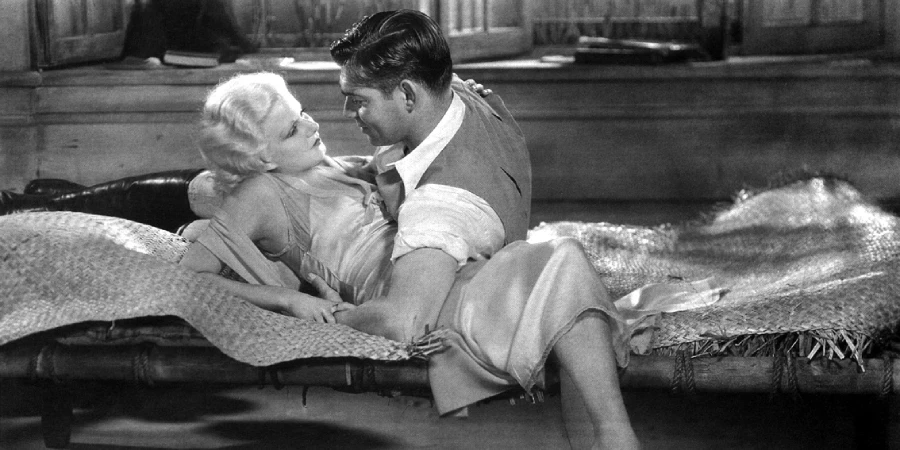

Long before Hollywood had a Code, it had Clark Gable and Jean Harlow. They steamed up the screen in a jungle of lust, betrayal, and monsoon rain. Red Dust is a masterclass in raw, pre-Code chemistry. It remains a shockingly frank film about adult desires.
Detailed Summary
Vantine’s Unexpected Arrival
The story begins on a rubber plantation in French Indochina. Manager Dennis Carson (Clark Gable) is exasperated by the heat and isolation. A boat arrives, unexpectedly leaving behind a woman named Vantine (Jean Harlow).
She is a brash, wise-cracking woman of negotiable virtue, on the run from the authorities in Saigon. Dennis is initially annoyed by her presence. However, he grudgingly allows her to stay until the next boat arrives.
A Steamy, Combative Romance
Dennis and Vantine immediately clash. Their conversations are filled with sharp, witty insults. Yet, an undeniable attraction simmers just beneath the surface.
One sweltering day, Vantine famously takes a bath in a rain barrel to cool off. Dennis playfully teases her, leading to one of the film’s most iconic and flirtatious scenes. Ultimately, their combative energy boils over into a passionate affair.
The Langleys Appear
Their rough-and-tumble romance is interrupted by the arrival of Gary and Barbara Willis (Gene Raymond and Mary Astor). Gary is a naive young engineer hired to work on the plantation. His wife, Barbara, is a refined, elegant lady who seems totally out of place in the jungle.
Dennis finds himself immediately drawn to Barbara’s cool sophistication. She represents a world of class and respectability he secretly craves. Consequently, this attraction creates an immediate and tense love triangle.
Jungle Fever and Betrayal
Gary, unaccustomed to the harsh climate, soon falls ill with a dangerous fever. He requires constant care, leaving Barbara vulnerable and lonely. Meanwhile, Dennis sees his opportunity.
He relentlessly pursues Barbara, who initially resists but eventually succumbs to his advances during a powerful storm. They begin a secret affair while her husband lies near death. Vantine, relegated to the background, watches with growing jealousy and hurt.
Confrontation and Gunshot
Gary eventually recovers from his fever. Dennis, however, callously plans to send Gary away to a remote outpost. This would allow him to continue his affair with Barbara unimpeded.
Vantine overhears the plan and decides she has had enough. She reveals Dennis’s scheme to Barbara, then threatens to tell Gary everything. As a desperate Barbara begs her not to, Dennis enters and arrogantly confirms his intentions, mocking her husband. In a moment of panic, Barbara grabs a gun and shoots Dennis in the shoulder to silence him.

Movie Ending
Chaos erupts in the bungalow after the gunshot. Gary rushes in, demanding to know what happened. Seeing the desperate situation, Vantine makes a selfless decision to save Barbara’s reputation and marriage.
She quickly fabricates a story. Vantine claims that Dennis was making a drunken pass at her, and she shot him in self-defense. Her lie is convincing, especially given her reputation and her known flirtation with Dennis. Gary believes the story completely, his faith in his wife restored.
The lie works perfectly. The Langleys reconcile and prepare to leave the plantation together, their marriage intact. In the final moments, the wounded Dennis realizes Vantine’s true worth and loyalty. He understands that he loves her, not the idealized Barbara. A smiling Vantine stays behind to nurse him back to health, and the film ends with the two of them playfully bickering, their future together secure.
Are There Post-Credits Scenes?
No, there are no post-credits scenes in Red Dust. End-credit scenes were not a common practice in Hollywood filmmaking during the 1930s.
Type of Movie
Red Dust is a pre-Code romantic drama with strong adventure elements. Its tone is remarkably daring for its time, mixing steamy romance, sharp comedic banter, and serious dramatic conflict.
At its core, the film is a character study about passion and class differences in an isolated, high-pressure environment. It notably explores themes of infidelity and sexual frankness that would become forbidden under the Hays Code just two years later.
Cast
- Clark Gable – Dennis Carson
- Jean Harlow – Vantine
- Mary Astor – Barbara Willis
- Gene Raymond – Gary Willis
- Tully Marshall – “Mac” McQuarg, the overseer
- Donald Crisp – Guidon
Film Music and Composer
The film does not have a traditional, contiguous score by a single composer. Like many early sound films from MGM, Red Dust used a combination of music from the studio’s library and cues composed by the in-house music department, which was uncredited.
Most of the film relies on diegetic sound—the sounds of the jungle, rain, and plantation life—to build its intense atmosphere. Music is used sparingly, primarily for the opening and closing credits.

Filming Locations
Despite its convincing setting in French Indochina (modern-day Vietnam), Red Dust was filmed almost entirely on the MGM backlot in Culver City, California. The studio’s art department, led by the legendary Cedric Gibbons, constructed an incredibly detailed jungle set.
Massive soundstages housed the bungalow, and the production team created impressive practical effects for the monsoons. This controlled environment allowed director Victor Fleming to achieve the specific oppressive and steamy atmosphere he wanted for the story.
Awards and Nominations
Interestingly, despite its massive box office success and enduring legacy, Red Dust received no Academy Award nominations. It remains one of the most famous and acclaimed films of its era to be completely overlooked by the Academy.
Behind the Scenes Insights
- The on-screen chemistry between Clark Gable and Jean Harlow was legendary. However, their relationship off-screen was one of close, platonic friendship. Gable was deeply protective of Harlow throughout her tumultuous personal life.
- Tragedy struck during production when Jean Harlow’s husband, producer Paul Bern, died by suicide. The studio wanted to replace her, but Gable and other colleagues insisted she continue, and production was halted for a week to allow her to grieve.
- Red Dust is one of the quintessential pre-Code films. Vantine is unapologetically a prostitute, bathing scenes are risqué, and adultery is a central plot point treated without heavy moral condemnation. The film’s success was a key factor in strengthening the eventual enforcement of the Hays Code in 1934.
Inspirations and References
The film is based on the 1928 play of the same name by Wilson Collison. The play was a moderate success on Broadway, but it was the steamy story and exotic setting that attracted MGM producers.
Alternate Endings and Deleted Scenes
There are no known alternate endings or significant deleted scenes for Red Dust. The finished film is believed to be director Victor Fleming’s intended version and aligns closely with the final script.
Book Adaptations and Differences
While adapted from Wilson Collison’s play, the film makes several key changes. The screenplay, written by John Lee Mahin, significantly punches up the dialogue, especially for Jean Harlow’s character.
The film gives Vantine much of the story’s wit and heart, making her a more sympathetic and central figure than she was in the stage version. Furthermore, the film emphasizes the love-hate chemistry between Dennis and Vantine, which became the story’s defining element.


Memorable Scenes and Quotes
Key Scenes
- The Rain Barrel Bath: A landmark pre-Code scene where Vantine, trying to cool off, bathes in a large wooden barrel. Dennis’s discovery and their subsequent teasing dialogue perfectly encapsulates their relationship.
- The Storm: Dennis and Barbara finally give in to their passion during a violent jungle monsoon, a classic example of pathetic fallacy where the weather mirrors the characters’ emotions.
- The Lie: Vantine’s quick-thinking deception to save Barbara’s marriage after the shooting. It is the moment she reveals her hidden integrity and wins both Dennis’s and the audience’s respect.
Iconic Quotes
- Vantine: “For a dollar, you can have a look at my passport. For two, you can have it.”
- Dennis: “I’m not a gentleman, see? And you’re not a lady.”
- Vantine: (Reading to a bored Dennis) “Came the dawn… How do you like that? For two cents, I’d sock that dame.”
Easter Eggs and Hidden Details
- During the famous rain barrel scene, Jean Harlow was reportedly catching a cold. To keep her healthy, the crew filled the barrel with heated water between takes.
- The film’s title, Red Dust, refers to the distinctive red soil of the region, which kicks up during the dry season, coating everything and contributing to the oppressive atmosphere.
- Mary Astor, who played the refined Barbara, would later become embroiled in her own real-life scandal involving a diary detailing her affairs, making her casting in this role ironically prescient.
Trivia
- Clark Gable would star in a direct remake of Red Dust 21 years later, titled Mogambo (1953). In that version, he reprised his role as the plantation manager, with Ava Gardner in the Jean Harlow role and Grace Kelly in the Mary Astor role.
- Red Dust was the second of six films starring both Clark Gable and Jean Harlow. Their incredible chemistry made them one of the most popular screen pairings of the 1930s.
- The film was shot by cinematographer Harold Rosson, who was briefly married to Jean Harlow a year after the film’s release.
Why Watch?
Watch for the electrifying, unmatched chemistry of Gable and Harlow. This film is a raw, funny, and daring piece of Hollywood history. Its pre-Code frankness remains potent and surprisingly modern. It is an absolute classic.
Director’s Other Movies
- Gone with the Wind (1939)
- The Wizard of Oz (1939)
- Captains Courageous (1937)
- Bombshell (1933)
- Test Pilot (1938)
Recommended Films for Fans
- Mogambo (1953)
- It Happened One Night (1934)
- Dinner at Eight (1933)
- The Public Enemy (1931)
- Baby Face (1933)