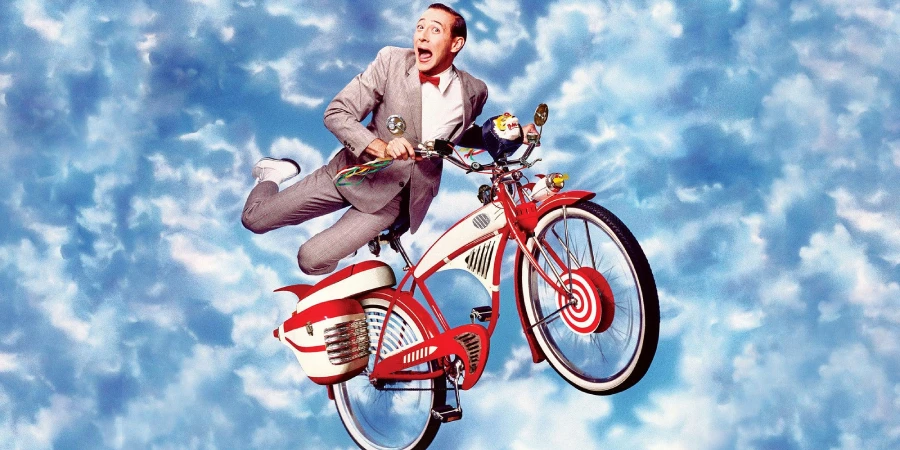
Few films announce a major directorial talent quite as loudly as Pee-wee’s Big Adventure. This 1985 comedy launched Tim Burton into Hollywood and gave the world a hero so gloriously weird that he makes every other road-trip protagonist look painfully normal. Paul Reubens brought his beloved Pee-wee Herman character from stage and television to the big screen, and the result is a fever dream of color, comedy, and surprisingly earnest heart. Buckle up, because no one takes the straight road in this one.
Detailed Summary
Pee-wee and His Beloved Bicycle
We open on Pee-wee Herman’s fantasy: a triumphant Tour de France victory, which tells us everything about his relationship with his cherry-red custom bicycle before a single word of dialogue lands. Back in reality, Pee-wee lives in a whimsical house packed with gadgets and contraptions, and his bicycle sits at the center of his entire universe. He polishes it, talks to it, and guards it with the devotion of a medieval knight protecting sacred armor.
His neighbor Francis, a spoiled rich kid, desperately wants to buy the bike. Pee-wee refuses flatly. Francis, in a fit of entitled pique, secretly hires someone to steal it.
The Theft and the Investigation
Pee-wee discovers his bike missing from a shopping mall bike rack and immediately spirals into a full public breakdown. He interrogates neighbors, hires a psychic named Madam Ruby, and generally treats the theft as a crime of cosmic proportions. Madam Ruby, sensing easy money, tells him the bike is in the basement of the Alamo.
Meanwhile, Pee-wee confronts Francis, and Francis gleefully admits he arranged the theft. However, without proof, Pee-wee cannot simply call the police and wrap things up neatly. He decides to go find the bike himself.
Hitting the Road
Pee-wee sets off on foot and by hitchhiking, beginning a sprawling cross-country odyssey toward San Antonio, Texas. His first memorable encounter comes with Mickey, a fugitive on the run, who picks him up in a stolen car. Pee-wee rides along blissfully unaware of Mickey’s situation, which plays as a perfect joke on Pee-wee’s magnificent self-absorption.
He then meets Simone, a waitress with big dreams of visiting Paris who works at a roadside diner shaped like a dinosaur. Their conversation under the stars is one of the film’s most genuinely tender moments. Simone’s jealous boyfriend Andy eventually chases Pee-wee out of the diner before dawn.
Large Marge and the Open Road
Pee-wee catches a ride with a truck driver who introduces herself as Large Marge. She tells him a horrifying story about a terrible accident on “this very stretch of road.” Then, at the moment of maximum horror, her face contorts into a grotesque stop-motion grimace that remains one of cinema’s great jump-scare gags. Pee-wee arrives at a truck stop in a state of shock, only for the staff to reveal that Large Marge died in that accident years ago. He was riding with a ghost.
Further Misadventures Across America
Pee-wee’s journey continues through a series of escalating comic set pieces. He visits a biker bar, accidentally knocks over every motorcycle outside, and saves himself from a brutal beating by performing a spectacular, heel-clacking dance to “Tequila” by The Champs. In addition, he encounters a hobo named Mickey (a different Mickey, briefly), a rodeo clown, and a film lot security guard.
He also discovers, upon finally reaching the Alamo, that there is no basement. Madam Ruby’s vision was entirely false. Consequently, Pee-wee’s quest shifts direction completely.
Hollywood and the Climax
A television news segment reveals that Pee-wee’s bicycle has turned up at the Warner Bros. studio lot in Hollywood, where it was used as a prop. Pee-wee breaks onto the lot and finds his bike on a soundstage. He grabs it and tears through multiple active film sets, crashing a horror film, a beach party picture, and a biblical epic in a single glorious chase sequence. Security finally catches him.
Ironically, studio executives witness the chaos and decide his story would make a great movie. They option it immediately. Furthermore, they cast James Brolin as Pee-wee and Morgan Fairchild as his love interest, which is perhaps the film’s sharpest satirical joke.
Movie Ending
Pee-wee attends the Hollywood premiere of Pee-wee’s Big Adventure, the film-within-a-film that studios produced from his story. He watches a wildly inaccurate action movie version of his life, complete with dramatic explosions and a romantic subplot he never had. Rather than feeling cheated, he shrugs it off with magnificent contentment: “There are some things you just can’t explain.”
His bicycle comes home with him, intact and back where it belongs. He reunites with Dottie, his devoted friend who had feelings for him throughout the entire adventure. In contrast to most Hollywood endings, Pee-wee does not suddenly become romantic; he stays exactly who he is, which is both funny and oddly refreshing.
Back in his neighborhood, Pee-wee hosts a drive-in screening of the film for his friends and neighbors. He and Dottie ride a bicycle built for two, circling the drive-in lot rather than watching the screen. It is a quietly perfect ending: Pee-wee’s world is restored, his relationships are intact, and he has learned absolutely nothing, which is entirely the point. His unchangeable nature is not a flaw the film wants to correct; it is the joke and the charm simultaneously.
Are There Post-Credits Scenes?
Pee-wee’s Big Adventure contains no post-credits scene. Once the credits roll, the film is over. You can safely leave your seat without missing anything extra.
Type of Movie
This film lands squarely in the comedy adventure genre, blending broad physical comedy with a genuine road-movie structure. Burton layers a distinctly gothic surrealist aesthetic under the bright colors and slapstick, giving the film a texture unlike any straight studio comedy of its era.
Tonally, it operates on a frequency all its own: childlike without being childish, weird without becoming inaccessible, and funny across multiple age groups simultaneously. It works as pure entertainment and, on a second viewing, as a surprisingly clever piece of satirical filmmaking.
Cast
- Paul Reubens – Pee-wee Herman
- Elizabeth Daily – Dottie
- Mark Holton – Francis
- Diane Salinger – Simone
- Judd Omen – Mickey
- Alice Nunn – Large Marge
- Jan Hooks – Tina, the Alamo tour guide
- John Paragon – Jambi (cameo)
- Cassandra Peterson – Barbette (cameo)
Film Music and Composer
Danny Elfman composed the score, marking the beginning of one of cinema’s most celebrated director-composer partnerships. His work here is cartoonish, propulsive, and infectiously energetic, establishing many of the musical signatures he would refine across his later work with Burton. Notably, this was one of Elfman’s earliest major film scores.
Specific cues like the opening theme capture Pee-wee’s manic optimism perfectly. The score draws on circus music, Bernard Herrmann-style strings, and comic brass, blending them into something that feels purpose-built for this particular universe. Elfman’s contribution is impossible to separate from the film’s identity.
Filming Locations
Production filmed across multiple locations in California, including the Warner Bros. backlot in Burbank, which serves as both a real location and a plot destination. Using the actual Warner Bros. lot for the climactic chase sequence adds a layer of meta-comedy: Pee-wee literally crashes through Hollywood’s machinery.
The Alamo sequences filmed on location in San Antonio, Texas, grounding the road-trip fantasy in genuine geography. Various roadside diners, highways, and California exteriors filled out the cross-country illusion. Burton used these real locations to anchor the surrealism; the odder the story gets, the more the real-world settings matter as contrast.
Awards and Nominations
Pee-wee’s Big Adventure did not receive major awards recognition from bodies like the Academy Awards or the Golden Globes. However, the film’s commercial success and cultural footprint far outlasted any trophy cabinet could measure.
Behind the Scenes Insights
- Tim Burton had directed only one prior feature, Frankenweenie (1984), before landing this project. Studios took a significant chance on him based on very limited experience.
- Paul Reubens co-wrote the screenplay alongside Michael Varhol and Phil Hartman, the same Phil Hartman who later became a beloved cast member on Saturday Night Live.
- Reubens insisted on casting Alice Nunn as Large Marge specifically because her face lent itself to the stop-motion distortion effect the filmmakers wanted.
- Burton and Elfman developed their working relationship so quickly on this project that they essentially locked in a creative partnership for decades with a single film.
- Warner Bros. gave the production a modest budget, which pushed the crew toward creative practical solutions rather than expensive effects.
- The biker bar “Tequila” dance sequence required multiple takes and rehearsals, but Reubens committed to the physicality with full enthusiasm, making it feel spontaneous on screen.
Inspirations and References
Reubens developed the Pee-wee Herman character originally as part of a Los Angeles comedy stage show called The Pee-wee Herman Show. That live performance established the character’s world, his voice, and his relationship with absurdity before any camera rolled. The film essentially transported that theatrical universe into a road-movie framework.
Structurally, the film borrows from classic picaresque adventure stories, where a naive protagonist stumbles through a series of misadventures and encounters colorful strangers. In addition, the film nods to Italian neorealist masterpiece Bicycle Thieves (1948) in its basic premise: a man’s bicycle stolen and his obsessive quest to recover it. Burton and Reubens clearly played the homage entirely for comedy rather than tragedy.
Alternate Endings and Deleted Scenes
No widely documented alternate endings or significant deleted scenes from Pee-wee’s Big Adventure have entered the public record with confirmed details. Some minor footage trims occurred during editing, as with any production, but nothing substantial has surfaced in interviews or home video releases to suggest a radically different version of the film exists.
Book Adaptations and Differences
Pee-wee’s Big Adventure is not based on a book. It is an original screenplay written by Paul Reubens, Phil Hartman, and Michael Varhol, built around the pre-existing Pee-wee Herman stage character. No source novel exists to compare it against.
Memorable Scenes and Quotes
Key Scenes
- Pee-wee’s opening Tour de France dream sequence, which establishes his delusional grandeur instantly and economically.
- The Large Marge truck ride, combining deadpan storytelling with a genuinely startling stop-motion face transformation.
- Pee-wee dancing to “Tequila” in the biker bar, complete with platform shoes and escalating crowd enthusiasm.
- Pee-wee and Simone watching the sunrise outside the giant dinosaur diner, the film’s quietest and most human moment.
- The Warner Bros. backlot chase, crashing through multiple film sets in a single breathless sequence.
- Pee-wee watching the Hollywood version of his own story at the drive-in and responding with total equanimity.
Iconic Quotes
- “I know you are, but what am I?” – Pee-wee’s ultimate circular comeback, delivered against Francis.
- “There are some things you just can’t explain.” – Pee-wee’s response to watching his own absurd life on film.
- “Everyone I know has a big ‘but.’ Come on, Simone, let’s talk about your big ‘but’.” – A perfectly delivered double-meaning line.
- “Tell ’em Large Marge sent ya.” – Delivered by Alice Nunn just before her grotesque facial transformation.
- “I’m a loner, Dottie. A rebel.” – Pee-wee’s self-mythologizing at its most gloriously deluded.
Easter Eggs and Hidden Details
- During the Warner Bros. backlot chase, Pee-wee briefly disrupts what appears to be a Godzilla-style monster film set, a nod to classic B-movie creature features.
- The dinosaur roadside attraction where Simone works is a real location in Cabazon, California, and appears largely as it does in real life.
- Pee-wee’s elaborately Rube Goldberg-style breakfast machine in the opening sequence contains dozens of moving parts, and careful viewers can spot slight continuity variations between cuts.
- Cassandra Peterson, famous as horror host Elvira, appears in a cameo on the Warner Bros. lot, a small tribute to the horror-comedy adjacent world Burton was beginning to inhabit.
- The fictional movie-within-a-movie casts James Brolin as a heroic, action-ready Pee-wee, which satirizes Hollywood’s tendency to conventionalize any story it adapts.
Trivia
- Phil Hartman co-wrote the screenplay and also appears briefly on screen in a small role.
- This was Tim Burton’s first major studio feature, and its box-office success gave him the leverage to pursue Beetlejuice (1988).
- Danny Elfman had no formal film-scoring training before composing this score; he came from the rock band Oingo Boingo.
- Paul Reubens performed the character of Pee-wee Herman in full costume and persona during the entire production, reportedly staying in character on set between takes.
- The film grossed over 40 million dollars against a budget of approximately 6 to 8 million dollars, making it a substantial commercial hit for Warner Bros.
- The biker bar that appears in the film is a real California location, though interior scenes were shot on a set.
- Jan Hooks, later of Saturday Night Live fame, appears as the cheerfully unhelpful Alamo tour guide who insists there is no basement.
Why Watch?
Pee-wee’s Big Adventure is a singular piece of American comedy filmmaking that rewards both first-time viewers and longtime fans with equal generosity. It launched two extraordinary careers in Burton and Elfman while showcasing Reubens at the absolute peak of his comic invention. Few films this genuinely strange have also been this genuinely joyful.
Director’s Other Movies
- Beetlejuice (1988)
- Batman (1989)
- Edward Scissorhands (1990)
- Batman Returns (1992)
- Ed Wood (1994)
- Sleepy Hollow (1999)
- Big Fish (2003)
- Charlie and the Chocolate Factory (2005)
- Sweeney Todd: The Demon Barber of Fleet Street (2007)
- Dark Shadows (2012)
- Dumbo (2019)
Recommended Films for Fans
- Beetlejuice (1988)
- Raising Arizona (1987)
- Bottle Rocket (1996)
- Rustlers’ Rhapsody (1985)
- The Wizard (1989)
- UHF (1989)
- Bicycle Thieves (1948)
- Napoleon Dynamite (2004)