
Detailed Summary
Introduction: A Land at War with Itself
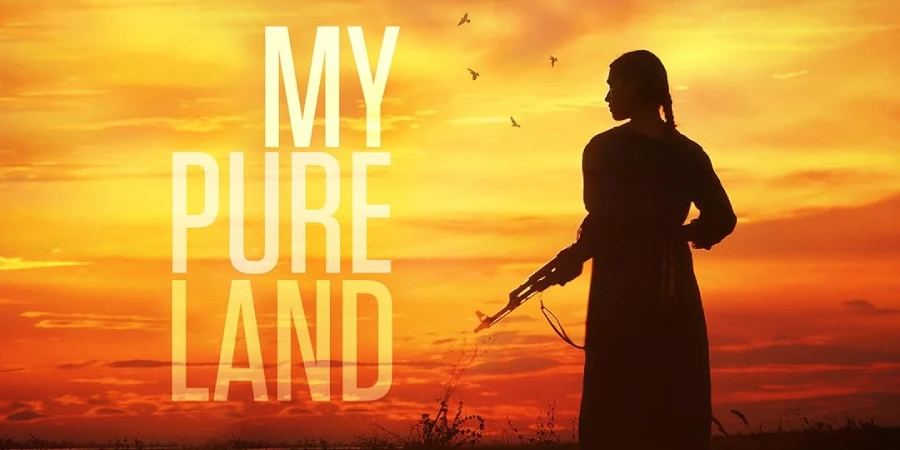
My Pure Land (2017), directed by Sarmad Masud, is a British-Pakistani drama film inspired by a true story. It portrays the courage of a young woman, Nazo Dharejo, who defends her family’s land from armed men in rural Sindh, Pakistan. Set against the backdrop of feudal conflict and patriarchal oppression, the film combines realism, grit, and a quiet but powerful sense of justice.
The Roots of the Conflict
The story begins with Nazo and her family living peacefully in their rural village. Her father, a respected local man, owns a large piece of land — a source of both pride and danger. In Pakistan’s feudal system, land equals power, and those without scruples will do anything to seize it. When her father becomes entangled in a dispute with corrupt relatives and local land grabbers, violence erupts.
The Siege of the Family Home
After her father is imprisoned and her brother killed, Nazo (played by Suhaee Abro) finds herself alone with her sister and mother. Their home — a simple, mud-brick compound surrounded by arid fields — becomes their fortress. Soon, over 200 armed men surround the house, intent on taking their land. But Nazo refuses to surrender. Armed only with rifles, determination, and sheer willpower, the women begin a standoff that lasts for several days.
Strength Amid Desperation
The film’s tension builds slowly and relentlessly. There are long stretches of silence broken by bursts of gunfire and whispered prayers. The cinematography captures the harsh beauty of Sindh’s landscape — vast, sun-baked, and unforgiving, mirroring Nazo’s own endurance. As the siege drags on, we see flashbacks of her childhood and her father’s teachings: that land is not just property but honor — and that a woman’s strength lies in her resolve.
The Turning Point
As food and ammunition run low, Nazo faces an impossible choice: surrender or die defending her family’s legacy. Her sister and mother remain by her side, embodying solidarity in the face of patriarchal violence. When the attackers breach the walls, Nazo fights back with everything she has — and miraculously, her courage and persistence draw the attention of the authorities, who intervene before the attackers can take over completely.
Movie Ending
The police arrive just as Nazo’s last bullets are spent. Her attackers are forced to retreat, and she emerges alive but emotionally scarred, standing over the remains of her shattered home. Her father returns from prison to find that his daughter has become a local legend — a symbol of resistance and courage.
In the closing moments, the film quietly reminds the audience that Nazo Dharejo is a real person, often called “Pakistan’s toughest woman.” The real Nazo continued to fight legal battles to protect her family’s land for years. The final scenes fade with her voice echoing over the fields — a haunting mixture of pride and sorrow.
There are no post-credits scenes in My Pure Land. The story concludes with on-screen text honoring the real Nazo Dharejo, underlining the film’s deep roots in true events.
Type of Movie
A drama and biographical war film, My Pure Land merges feminist themes with a gritty portrayal of rural Pakistan. It’s part Western, part political drama, and part intimate survival story.
Cast
- Suhaee Abro as Nazo Dharejo
- Eman Malik as Sakina
- Tanveer Hussain as Nazo’s Father
- Razia Malik as Nazo’s Mother
- Ahsen Murad as Nazo’s Brother
Film Music and Composer
The haunting score is composed by Tristan Cassel-Delavois, who blends traditional Pakistani instrumentation with atmospheric, minimalist music. The soundtrack deepens the emotional intensity of the siege and gives the film a sense of timeless tragedy.
Filming Locations
The film was shot on location in Sindh, Pakistan, near the actual site of the real Nazo Dharejo’s home. These authentic locations add realism — the dusty plains, crumbling houses, and stark landscapes are not just backdrops but essential parts of the story, symbolizing both isolation and resilience.


Awards and Nominations
My Pure Land received strong critical acclaim and was selected as the UK’s entry for the Best Foreign Language Film category at the 90th Academy Awards — making it the first-ever Urdu-language submission from the UK. It also screened at major film festivals, including Edinburgh International Film Festival and Toronto International Film Festival, where it was praised for its cinematography and feminist message.
Behind the Scenes Insights
- Director Sarmad Masud discovered Nazo Dharejo’s real-life story through a newspaper article and spent years researching before writing the script.
- The film’s all-female leads underwent firearms training to realistically portray the siege.
- Local villagers acted as extras, adding authenticity to the environment.
- The production faced real challenges due to heat, dust storms, and limited resources on location.
- Masud described the film as “a Western told from a woman’s point of view in Pakistan.”
Inspirations and References
The story is directly inspired by the true events of Nazo Dharejo, a real woman who defended her home against 200 armed men in 2003. The film draws on themes of honor, resistance, and the strength of women in patriarchal societies. It also nods to classic Western films like High Noon and The Magnificent Seven, but with a South Asian feminist twist.
Alternate Endings and Deleted Scenes
While no alternate endings were officially released, early cuts reportedly included longer flashbacks of Nazo’s childhood and more detail about her brother’s death. These scenes were removed to maintain the film’s tight pacing and focus on the siege itself.
Book Adaptations and Differences
The film is not based on a book, but it draws inspiration from real-life interviews and court records involving Nazo Dharejo’s case. However, some dramatic elements — such as the exact number of attackers and the duration of the siege — were stylized for cinematic effect.
Memorable Scenes and Quotes
Key Scenes
- Nazo training to shoot under her father’s guidance as a child.
- The moment Nazo takes her brother’s rifle after his death.
- The tense sequence where the women defend their home in silence before the first gunshot.
- The final standoff as Nazo faces down the attackers, dust and blood mixing in the heat.
Iconic Quotes
- Nazo: “This land is my mother. I will not give her away.”
- Nazo’s Father: “A daughter’s courage is stronger than any man’s gun.”
- Nazo (to her sister): “We don’t need saving. We save ourselves.”

Easter Eggs and Hidden Details
- The opening shot of hands planting wheat mirrors the closing shot — symbolizing life continuing after violence.
- Nazo’s rifle is engraved with her father’s initials, a detail shown briefly but symbolically powerful.
- The sound of birds during moments of tension acts as a motif of fleeting peace amid chaos.
Trivia
- The film is in Urdu, though it was submitted by the UK for the Oscars.
- It was the first Urdu-language film to represent the UK at the Academy Awards.
- Real family members of Nazo Dharejo visited the set during production.
- Critics compared Suhaee Abro’s performance to a “Pakistani Joan of Arc.”
Why Watch?
Because My Pure Land is more than a movie — it’s a story of defiance and dignity. It’s a rare, powerful look at the strength of women in a world that often underestimates them. If you’re drawn to true stories, strong female leads, and visually poetic storytelling, this film is a must-watch.
Director’s Other Works
- Adha Cup (2009) – short
- Two Dosas (2014) – short
Recommended Films for Fans
- The Breadwinner (2017)
- Wadjda (2012)
- A Girl Walks Home Alone at Night (2014)
- The Kite Runner (2007)
- Theeb (2014)