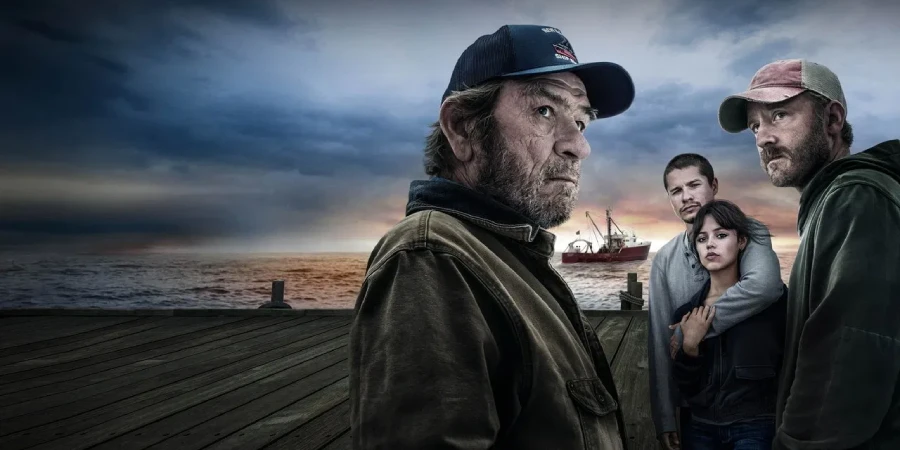

Finestkind (2023) is a gritty American crime drama that blends family conflict, moral collapse, and the harsh realities of working-class life on the New England coast. Directed by Brian Helgeland, the film focuses less on spectacle and more on emotional damage, bad decisions, and consequences that cannot be undone.
Detailed Summary
Two Brothers, Two Worlds
The story centers on Charlie Mayhew and Tommy Mayhew, half-brothers who share a father but grew up in very different circumstances.
Charlie has escaped his coastal hometown and is now a law student with a stable future ahead of him. Tommy, on the other hand, stayed behind, working as a commercial fisherman alongside their father Ray Mayhew, a hardened, emotionally distant man whose life revolves entirely around the sea.
From the beginning, the film establishes a deep emotional divide. Charlie represents escape and possibility, while Tommy represents stagnation and survival.
The Fishing Industry and Financial Pressure
The commercial fishing business is shown as brutal and unforgiving. Ray and Tommy are drowning in debt due to rising fuel prices, damaged equipment, and declining profits. Their boat, the Finestkind, is both their livelihood and their prison.
Ray refuses to accept help, especially from Charlie, whom he views as someone who abandoned the family. This stubborn pride becomes one of the film’s recurring emotional triggers.
When an opportunity arises to make fast money through a drug-smuggling run hidden within a legitimate fishing job, desperation overrides morality.
The Criminal Connection
The brothers are introduced to Adam Delaney, a dangerous drug trafficker who uses fishing boats to transport narcotics. The job seems simple: transport packages at sea without inspection.
Charlie initially resists, but mounting pressure and his desire to reconnect with his family pull him in.
This decision becomes the film’s central turning point.
Once involved, Charlie cannot retreat without consequences.
Mabel’s Influence
Charlie meets Mabel, a sharp, guarded young woman with her own troubled past. Their relationship provides emotional warmth but also draws Charlie deeper into the criminal world.
Mabel understands the dangers better than Charlie does, yet she remains trapped in the same economic reality as everyone else in town.
Her presence reinforces one of the film’s core themes: love does not save you from poverty or violence.
Escalation and Violence
The smuggling operation quickly unravels. Tensions rise between the brothers, Ray grows increasingly unstable, and Delaney’s patience runs thin.
A violent confrontation erupts during a second job at sea, leading to death and betrayal. From this point forward, every character is reacting rather than choosing.
The film abandons any illusion of control.
Everything becomes consequence.


Movie Ending
After the deal goes wrong, Tommy kills Adam Delaney in self-defense during a chaotic struggle on the boat. This act seals his fate. The death cannot be hidden, and the authorities soon begin closing in.
Ray, realizing that his sons’ lives are now permanently damaged because of his choices and pride, attempts to take responsibility. In a desperate act of atonement, he takes the blame for the murder, fully aware that it will cost him the rest of his life.
Charlie, who once believed he could briefly step into this world and then leave, realizes that there is no clean exit. His legal career, future, and identity are irreparably scarred.
In the final moments:
- Ray is taken into custody.
- Tommy is left traumatized, guilt-ridden, and emotionally broken.
- Charlie leaves town again, not as a hopeful young man, but as someone carrying lifelong moral weight.
There is no redemption arc, no triumphant escape, and no justice that feels satisfying.
The ocean remains indifferent.
The boat remains.
Life continues.
The ending makes it clear that some choices do not destroy you immediately, but they follow you forever.
Are There Post-Credits Scenes?
No. Finestkind does not include any mid-credits or post-credits scenes. The film ends definitively with its final emotional note.
Type of Movie
Finestkind is a grounded crime drama that blends family tragedy with maritime noir elements. It focuses heavily on realism, emotional conflict, and the slow erosion of morality under economic pressure.
Cast
- Ben Foster as Tommy Mayhew
- Toby Wallace as Charlie Mayhew
- Tommy Lee Jones as Ray Mayhew
- Jenna Ortega as Mabel
- Clayne Crawford as Adam Delaney
Film Music and Composer
The score was composed by Hildur Guðnadóttir, known for her atmospheric, minimalist approach.
The music avoids dramatic swells and instead relies on low-frequency tones and silence, reinforcing the film’s emotional weight and sense of inevitability.



Filming Locations
The movie was filmed primarily in:
- Massachusetts coastal towns
- New Bedford and surrounding harbor areas
- Practical fishing vessels at sea
These locations are vital because they emphasize:
- The authenticity of the fishing industry
- The isolation of coastal working-class communities
- The feeling of being trapped between land and ocean
The environment functions almost like another character.
Awards and Nominations
As of now, Finestkind has not received major awards recognition, though performances—particularly Ben Foster’s—were widely praised by critics.
Behind the Scenes Insights
- The director spent time with real commercial fishermen before writing the script.
- Many supporting actors were actual fishermen from Massachusetts.
- Ben Foster lived on a fishing vessel during part of filming to understand the physical exhaustion of the job.
- Tommy Lee Jones reportedly rewrote portions of his dialogue to sound more authentic to coastal speech patterns.
- Several storm scenes were filmed in real rough-sea conditions rather than using CGI.
Inspirations and References
- Real-life drug trafficking cases involving fishing boats in New England
- Classic American crime dramas such as The Friends of Eddie Coyle
- Maritime labor documentaries
- Brian Helgeland’s own upbringing in blue-collar communities
Alternate Endings and Deleted Scenes
No alternate ending has been officially released.
However, interviews revealed that:
- A longer ending showing Tommy’s legal outcome was filmed but cut
- Additional scenes between Charlie and Mabel were removed for pacing
- The final cut intentionally avoids showing long-term consequences, emphasizing emotional impact over resolution
Book Adaptations and Differences
The film is not based on a novel or book. It is an original screenplay.


Memorable Scenes and Quotes
Key Scenes
- The first fishing expedition showing the brutal physical labor
- Charlie witnessing illegal cargo being transferred at sea
- The violent confrontation on the boat during the second smuggling run
- Ray’s silent decision to sacrifice himself for his sons
- The final dockside farewell
Iconic Quotes
- “The sea doesn’t care who you are.”
- “You don’t get clean money out here.”
- “Family isn’t who saves you. It’s who sinks with you.”
Easter Eggs and Hidden Details
- The boat name Finestkind is real New England slang meaning “the best of its kind.”
- Ray’s tattoos reference actual maritime memorial symbols.
- The radio chatter heard during storm scenes uses authentic Coast Guard transcripts.
- Charlie’s law school books foreshadow themes of guilt and responsibility.
Trivia
- The film was shot in chronological order to help actors track emotional decay.
- Ben Foster lost weight during filming due to the physical demands.
- Jenna Ortega filmed this movie between major franchise productions.
- The boat used in filming was a functioning commercial fishing vessel.
- Several scenes required only one take due to real weather conditions.
Why Watch?
You should watch Finestkind if you enjoy:
- Emotionally heavy crime dramas
- Stories about family loyalty versus moral responsibility
- Realistic portrayals of working-class struggle
- Films that refuse easy endings or heroic fantasy
This is not a comfort movie.
It is a consequence movie.
Director’s Other Works
- A Knight’s Tale (2001)
- Mystic River (2003) – writer
- Man on Fire (2004) – writer
- 42 (2013)
- Legend (2015)