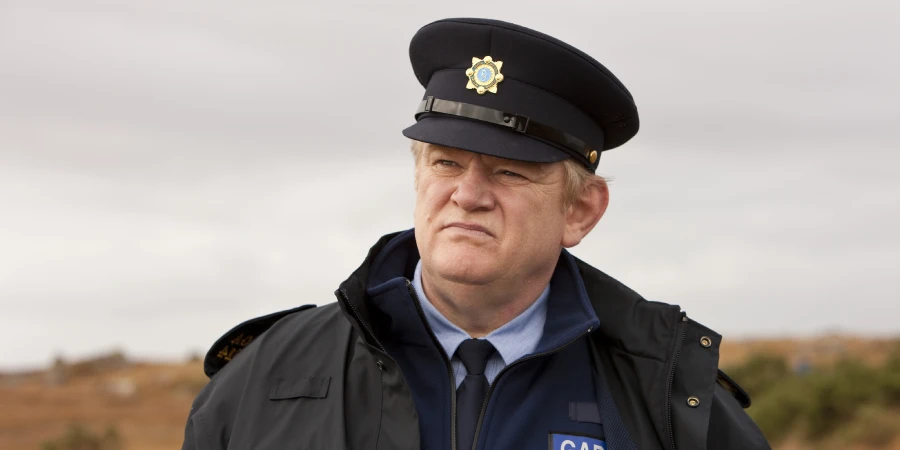
Brendan Gleeson drinking whiskey at seven in the morning, hiring a prostitute on a Wednesday, and somehow being the sharpest cop in the room: that is The Guard in a nutshell. John Michael McDonagh’s debut feature drops an FBI agent into the wet, grey, magnificently strange landscape of Connemara and watches him squirm while Gleeson’s Sergeant Gerry Boyle runs circles around everyone. It is a buddy-cop film that genuinely does not care about being a buddy-cop film.
Detailed Summary
Opening: A Road Crash and a Dead Body
The film opens with a car full of teenagers crashing on a Connemara road at night. Boyle, arriving at the scene, casually pockets some drugs from one of the dead bodies before anyone else shows up. This single act tells you everything about Gerry Boyle before he has spoken a single word.
A separate murder victim turns up in the area shortly after, with ritualistic markings on the body. Boyle treats the discovery with the same cheerful detachment he applies to most things.
Enter Agent Wendell Everett
FBI Special Agent Wendell Everett, played by Don Cheadle, arrives in the west of Ireland to brief local Gardaí about a major international drug smuggling operation. Half a billion dollars’ worth of cocaine is heading toward the Irish coast. Everett is sharp, professional, and almost immediately baffled by Boyle.
Their first meeting is one of the film’s best scenes. Boyle tells Everett he thought only black people were drug dealers, then watches Everett’s face carefully to see what happens. McDonagh writes it as a test, not a slip: Boyle is poking at Everett to figure out whether he has a sense of humour.
The Drug Smuggling Ring Takes Shape
Three villains run the operation: Francis Sheehy-Skeffington, Clive Cornell, and Liam O’Leary. McDonagh gives each of them a distinctive intellectual texture. They quote philosophy, debate ethics, and argue about the finer points of crime while calmly murdering people.
Cornell in particular gets a wonderful scene where he corrects a hitman’s grasp of Nietzsche mid-conversation. It sounds like a gimmick, but it works because the actors commit to it completely.
Boyle’s Mother and His Private Life
Boyle visits his mother, Eileen, regularly at her home. She is ill and clearly dying. These scenes are genuinely tender and reveal a side of Boyle that his professional behaviour keeps thoroughly hidden.
He also hires two escorts for what he describes as a weekend off. McDonagh refuses to moralize about it, and neither do the escorts. The scenes are funny and oddly sweet.
A Fellow Guard Is Murdered
Garda Aidan McBride, a new transfer from Dublin, is the earnest young cop who gets partnered with Boyle early in the film. McBride is straight, naive, and trying to do the right thing. He starts digging into the drug operation and pays for it with his life.
His murder sharpens the film’s tone considerably. Boyle takes it personally, though he expresses grief in his own sideways fashion.
Boyle and Everett Reluctantly Team Up
With McBride dead and local police either corrupt or useless, Boyle and Everett find themselves as the only two people actually pursuing the case. Their partnership never becomes warm exactly, but it develops a genuine mutual respect built on comic friction and shared competence.
Cheadle plays Everett’s growing exasperation with a beautifully timed slow burn. His face during some of Boyle’s more outrageous statements is worth the price of admission alone.
Corruption Inside the Gardaí
Superintendent Liam Stanton is revealed to be on the smugglers’ payroll. His corruption has protected the operation for long enough to let it reach this scale. Boyle has suspected something for a while, which partly explains why he has always kept his own counsel.
Stanton is not a cartoonish villain. His corruption reads as banal and practical rather than menacing, which makes it feel more real.
The Final Confrontation
Boyle goes to the coast alone, armed, to intercept the drug shipment. He tells Everett to stay back and get backup. Everett, who has spent the film being the responsible one, arranges for the cavalry but arrives too late.
Boyle walks into a firefight against the three drug lords and their crew at the harbour. Shots are exchanged. Carnage follows.
Movie Ending
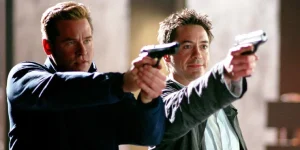
Boyle kills the three main villains, but the final confrontation is chaotic and brutal, not triumphant. By the time Everett and the police arrive, Boyle is gone. There is blood. There is wreckage. There is no body.
McDonagh refuses to confirm whether Boyle survived. Everett walks the scene and finds evidence of a serious struggle but no corpse. He interviews locals, and nobody knows anything, or nobody is saying. He writes a report that describes Boyle as a hero. His face suggests he believes it.
That ambiguity is the point. Boyle has spent the entire film operating by his own code, outside every institutional framework, and his ending reflects that. He does not get a clean death or a clean survival. He gets a story, which suits a man who constructed himself as a character from the ground up.
Eileen, Boyle’s mother, has also died off-screen by this point. Her death and his disappearance arrive close together, and the film lets that weight sit quietly without underlining it. McDonagh trusts the audience to feel what that means about Boyle’s life.
The final image of Everett walking away, slightly smiling, alone on a grey Irish road, is the film’s most eloquent moment. He came to do a professional job and ended up in something stranger and more human than he expected. Gleeson’s absence in that final shot is as loud as any performance.
Are There Post-Credits Scenes?
The Guard has no post-credits scene. When it ends, it ends. McDonagh is not interested in epilogues.
Type of Movie
The Guard is a black comedy crime thriller with strong buddy-cop elements. Its tone sits somewhere between In Bruges and a classic western, though it earns that comparison rather than chasing it.
It is also, quietly, a character study. Genre mechanics serve the character work, not the other way around.
Cast
- Brendan Gleeson – Sergeant Gerry Boyle
- Don Cheadle – FBI Agent Wendell Everett
- Mark Strong – Francis Sheehy-Skeffington
- Liam Cunningham – Clive Cornell
- David Wilmot – Liam O’Leary
- Rúaidhrí Conroy – Aidan McBride
- Fionnula Flanagan – Eileen Boyle
- Dominique McElligott – Sinead McBride
Film Music and Composer
The score was composed by Calexico, the American alt-country and desert-rock band from Tucson, Arizona. Their sound, all muted brass, dusty guitar, and open-road melancholy, gives the film its unexpectedly western quality.
Pairing a Connemara crime story with desert-inflected music was a bold choice, and it pays off. It reinforces the film’s argument that Boyle is a kind of lonesome frontier lawman, displaced in time and geography.
Individual cues carry a mood of quiet desolation that contrasts with the film’s comedy rather than competing with it.
Filming Locations
Principal photography took place in County Galway, specifically in and around the Connemara region of western Ireland. The town of Salthill and surrounding coastal areas feature prominently.
These locations are not just backdrop. The wide, flat, grey Atlantic light and the empty roads make Connemara feel like the edge of the known world, which is precisely what McDonagh needs. Boyle’s eccentricity feels plausible in a landscape this remote.
The physical isolation of the setting also makes the drug operation’s ambition feel more absurd, which the film leans into deliberately.
Awards and Nominations
Brendan Gleeson won the IFTA Award for Best Actor for this performance. The Guard received several Irish Film and Television Award nominations and earned strong recognition on the international festival circuit.
In the United States, the film performed remarkably well for a limited release Irish production, which itself counts as a commercial achievement worth noting.
Behind the Scenes Insights
- John Michael McDonagh wrote the screenplay specifically with Brendan Gleeson in mind. There was no version of this film without Gleeson attached.
- Don Cheadle has spoken about enjoying the role precisely because Everett is reactive rather than dominant, which reversed his usual screen dynamic.
- McDonagh is the brother of playwright and filmmaker Martin McDonagh, who directed In Bruges. Both films share a sensibility but were developed entirely independently.
- Much of the Connemara shooting had to contend with unpredictable Atlantic weather, which is visible on screen and adds to the atmosphere rather than working against it.
- The film was a co-production between Irish and British production companies, with Element Pictures among the producers.
Inspirations and References
McDonagh has cited classic American westerns as a structural and tonal reference point. Boyle as a figure maps loosely onto the morally ambiguous lone lawman of films like High Noon or Shane.
The film also draws on a tradition of Irish literary comedy that uses apparent crudeness to reveal intelligence, a trick writers from Flann O’Brien to Samuel Beckett have deployed. Boyle’s apparent laziness concealing forensic awareness is that tradition in police uniform.
The villain characters quoting philosophy owes something to Tarantino’s pop-culture-literate criminals, though McDonagh’s version is drier and less theatrical.
Alternate Endings and Deleted Scenes
No alternate endings or notable deleted scenes have been officially confirmed or released for The Guard. McDonagh has not publicly discussed significant footage left on the cutting room floor.
Given the film’s tight 96-minute structure, it feels like a screenplay that arrived close to the screen largely intact.
Book Adaptations and Differences
The Guard is not based on a book, novel, or any other prior source material. John Michael McDonagh wrote the original screenplay. No adaptation comparison applies here.
Memorable Scenes and Quotes
Key Scenes
- Boyle pocketing drugs from the crash victim in the opening sequence, establishing his character before he says a word.
- The first meeting between Boyle and Everett, where Boyle makes his pointed comment about drug dealers and watches Everett’s reaction with pure calculation.
- Boyle visiting his dying mother, sitting with her in a small room while she talks frankly about death. Gleeson barely moves and does not need to.
- Cornell correcting the hitman’s interpretation of Nietzsche in a car, delivered by Liam Cunningham with total seriousness.
- Boyle alone on the harbour road, walking toward the confrontation at night, Calexico’s score low in the mix. It plays exactly like a western gunfighter walking into a final duel.
- Everett’s final walk away from the scene, alone, the camera holding on him on a wide grey road with the Atlantic in the background.
Iconic Quotes
- “I’m Irish. Racism is part of my culture.”
- “I thought only black lads were drug dealers. I didn’t know white fellas were at it too.”
- “Maybe I don’t want to be a good cop. Maybe I just want to be left alone.”
- “There’s a rule in the Garda that you’re not supposed to speak ill of the dead. But I never had much time for rules.”
Easter Eggs and Hidden Details
- Boyle’s reading material throughout the film includes philosophy texts, quietly signalling that his apparent stupidity is entirely performative.
- The colour of Boyle’s uniform is notably faded compared to other Gardaí on screen, a subtle costuming choice suggesting how long he has operated outside normal institutional rhythms.
- Calexico’s score briefly echoes a melody associated with Boyle’s mother in the final harbour sequence, linking his last act to his grief rather than to professional duty.
- The three villains’ names include a reference to a prominent figure from Irish revolutionary history, a choice that fits the film’s habit of burying jokes in plain sight.
- Background extras in the pub scenes include several locals from the actual Connemara area, giving those scenes an authentic social texture that a cast of Dublin-based extras would not have provided.
Trivia
- The Guard became one of the highest-grossing Irish independent films ever released in the United States at the time of its release.
- John Michael McDonagh made his feature directorial debut with this film, having previously worked in screenwriting.
- Brendan Gleeson and Don Cheadle had no prior working relationship before this production. Their on-screen chemistry was built entirely during filming.
- Mark Strong, who plays Sheehy-Skeffington, is English and prepared extensively for the Irish accent and the character’s philosophical monologues.
- Fionnula Flanagan, who plays Boyle’s mother, is one of Ireland’s most respected veteran actresses. Her casting brings genuine weight to scenes that could otherwise read as sentimental.
- McDonagh completed the screenplay relatively quickly. The film moved from script to screen faster than many comparable productions.
Why Watch?
Brendan Gleeson gives the kind of performance where you catch yourself watching his hands, his posture, the exact angle of his gaze, because every physical choice is doing work the dialogue is too smart to spell out. Boyle is a genuinely original screen creation: a man who uses apparent boorishness as armour against a world he understands too well. No other film quite gives you that specific feeling.
Director’s Other Movies
- Calvary (2014)
- Grimsby (2016)