Most alien invasion movies give us something to see. The Darkest Hour, however, courageously asks what happens when the enemy is completely invisible. This 2011 sci-fi horror gambles on a novel concept: its antagonists are not creatures of flesh and bone, but deadly waves of energy. Ultimately, its unique setting in Moscow proves to be its most compelling character.
Detailed Summary
The Arrival in Moscow
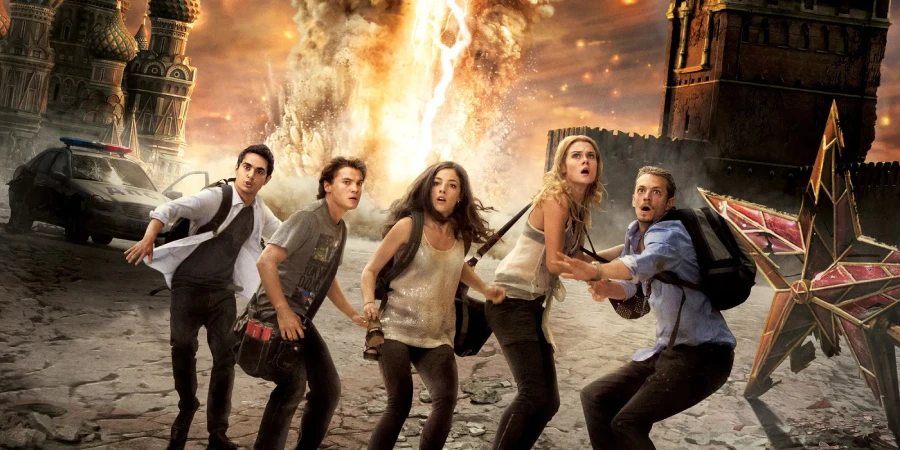
Young American software developers Sean (Emile Hirsch) and Ben (Max Minghella) travel to Moscow to pitch their social networking app. Unfortunately, their shady Swedish partner, Skyler (Joel Kinnaman), steals their idea and beats them to the punch. Dejected, they head to a nightclub to drown their sorrows. There, they meet American tourists Natalie (Olivia Thirlby) and Anne (Rachael Taylor), and the group begins to hit it off. Suddenly, the power across the entire city cuts out, and shimmering orange lights descend slowly from the sky. The lights are beautiful but deadly; consequently, anyone who touches them is instantly disintegrated into ash.
Days of Hiding
Chaos erupts. The five survivors—Sean, Ben, Natalie, Anne, and Skyler—barricade themselves in the nightclub’s storage cellar. After hiding for several days, dwindling supplies force them to venture out. They find a Moscow that is eerily empty, covered in ash and abandoned vehicles. Almost immediately, the group is stalked by an unseen force. Skyler is the first to fall, vaporized in broad daylight. The remaining four discover the aliens are invisible energy beings that emit an electrical field, causing lights to flicker whenever they are near.
Finding New Allies
Seeking refuge in an apartment building, the group finds another survivor, a resourceful young woman named Vika (Veronika Ozerova). She has been tracking the invasion and provides crucial information. In addition, they stumble upon an eccentric, paranoid electrician named Sergei (Dato Bakhtadze). His entire apartment is a giant Faraday cage, shielding them from the aliens’ electrical senses. Sergei explains the aliens are essentially living energy that is consuming Earth’s electrical infrastructure and eradicating all life in the process. More importantly, he has built a prototype microwave gun that might be able to disrupt them.
The Journey to the Submarine
A faint radio broadcast reveals a nuclear submarine is waiting in the Moscow River to take survivors to safety. Therefore, the group formulates a plan: travel to the American Embassy for communication gear and supplies, then make their way to the river. The journey is fraught with peril. During an encounter on the street, Ben sacrifices himself to save the others, getting disintegrated by an alien. His death is a devastating blow, but it hardens the resolve of the remaining survivors.
The Final Confrontation
The group, now consisting of Sean, Natalie, Anne, Vika, and Sergei, makes its way to the GUM department store across from Red Square. Inside a wrecked bus, Anne panics and makes a run for it, only to be killed instantly. Sergei confronts the alien that killed her but is also killed, though not before proving his microwave gun works. Sean, Natalie, and Vika finally reach a patrol boat on the river. As the girls get aboard, Sean uses a flare gun to lure the aliens toward a leaking fuel tank, then fires a rocket launcher to trigger a massive explosion, destroying several of them. He jumps into the river just in time and is pulled aboard the boat by Natalie.



Movie Ending
The film doesn’t end with their escape from the city. Sean, Natalie, and Vika are pulled from their small boat onto the waiting nuclear submarine. There, they discover they are not alone. The submarine is filled with other Russian survivors, all armed and organized into a resistance force. They show Sean a global map illustrating that pockets of resistance are fighting back all over the world. Realizing the fight is far from over, Sean and the others look on with renewed determination. The film concludes on this hopeful yet open-ended note, suggesting the beginning of a global war against the invaders, which was clearly intended to set up a sequel that never materialized.
Are There Post-Credits Scenes?
No, there are no scenes after the credits begin to roll. Once the story concludes with the survivors on the submarine, the film is officially over. Therefore, viewers can leave the theater or turn off the television without missing any additional content.
Type of Movie
The Darkest Hour is primarily a science fiction horror film with strong survival thriller elements. Unlike action-heavy invasion movies, its tone is grounded in suspense and dread. The movie focuses more on the characters’ desperate attempts to understand and evade an incomprehensible threat. Consequently, the horror comes from the unknown, as the invisible nature of the aliens makes every open space a potential death trap. The film’s atmosphere is tense and bleak, punctuated by short, brutal bursts of action.
Cast
- Emile Hirsch – Sean
- Olivia Thirlby – Natalie
- Max Minghella – Ben
- Rachael Taylor – Anne
- Joel Kinnaman – Skyler
- Dato Bakhtadze – Sergei
- Veronika Ozerova – Vika
Film Music and Composer
The score for The Darkest Hour was composed by Tyler Bates. Known for his work on action-heavy blockbusters like 300, Watchmen, and the John Wick series, Bates brought a distinct electronic and industrial edge to the film. His music effectively enhances the movie’s tension. For instance, dissonant synth sounds and pulsing electronic beats are often used to signal the aliens’ presence, acting as an auditory warning system for the audience. The score avoids traditional orchestral swells, instead favoring a modern, gritty texture that complements the alien’s technological nature.

Filming Locations
One of the film’s most distinctive features is its setting. The Darkest Hour was shot almost entirely on location in Moscow, Russia. This choice provides a refreshing and visually striking backdrop for an alien invasion, a genre typically dominated by American and British cities. Key sequences were filmed in iconic locations like Red Square, the GUM department store, and the Cathedral of Christ the Saviour. As a result, the desolate, ash-covered landmarks of Moscow create a powerful and unique post-apocalyptic aesthetic that sets the film apart.
Awards and Nominations
The Darkest Hour was not a major awards contender. Its sole notable nomination was from the Motion Picture Sound Editors, USA. It received a Golden Reel Award nomination for Best Sound Editing – Sound Effects and Foley in a Feature Film in 2012. However, the film did not win the award.
Behind the Scenes Insights
- The film was produced by Timur Bekmambetov, the Russian director of Night Watch and Wanted. His influence was crucial in securing permission to film in sensitive and iconic Moscow locations.
- Director Chris Gorak has a background as an art director and production designer on films like Fight Club and Minority Report. His visual expertise is evident in the film’s stark, atmospheric look.
- The movie was shot in native 3D, not converted in post-production. The filmmakers believed the technology would enhance the experience of floating ash and the invisible energy of the aliens.
- The cast and crew faced significant challenges filming in Moscow, including navigating the language barrier and dealing with the city’s notoriously difficult traffic.
Inspirations and References
While not a direct adaptation of any single work, The Darkest Hour draws from a long tradition of science fiction tropes. The concept of an invisible, energy-based alien echoes creatures from classic sci-fi stories and shows like Star Trek. Furthermore, its “invasion and survival” narrative shares thematic DNA with H.G. Wells’s The War of the Worlds, focusing on humanity’s initial helplessness against a technologically superior foe. The gritty, on-the-ground survival aspect also feels inspired by a new wave of post-apocalyptic films from the 2000s, such as 28 Days Later.
Alternate Endings and Deleted Scenes
No official alternate ending for The Darkest Hour has been released. The theatrical cut ends with the survivors joining the submarine resistance. However, the Blu-ray and DVD releases include a short film titled Survivors, which expands on the world and shows another group of survivors in Moscow fighting back. In addition, several deleted scenes were included, featuring extended character interactions and a sequence where the survivors navigate Moscow’s canal system.
Book Adaptations and Differences
The Darkest Hour is not based on a book. It is an original story conceived by Leslie Bohem, M. T. Ahern, and Jon Spaihts. Therefore, there are no literary source materials to compare it to. The screenplay was written specifically for the screen, blending classic alien invasion ideas with a modern, international setting.

Memorable Scenes and Quotes
Key Scenes
- The First Attack: In the Moscow nightclub, the shimmering orange lights descend. A policeman curiously touches one, only to be instantly vaporized into a cloud of ash, establishing the terrifying nature of the threat.
- Red Square Crossing: The survivors must cross a completely deserted Red Square in broad daylight. The tension is immense as they use glass bottles to create distractions, knowing an invisible killer could be anywhere.
- The Microwave Gun: Sergei demonstrates his makeshift weapon, firing a beam of microwave energy that makes a nearby alien visible for the first time—a writhing mass of electrical tentacles—before it is destroyed.
- River Finale: Sean single-handedly takes on multiple aliens, using a flare gun and a rocket launcher to create a massive explosion, providing a heroic climax to his character arc.
Iconic Quotes
- “They’re not organisms. They’re composed of lethal microwave energy.” – Sergei, explaining the aliens’ nature.
- “My cage is safe! My cage is clean!” – Sergei, proudly describing his apartment-turned-Faraday cage.
- “They’re not ‘hunting’ us. Okay? They won. This is cleanup.” – Sean, expressing the hopelessness of their situation early on.
- “They can feel our bio-electrical charge. It’s like a neon sign.” – Ben, realizing how the aliens detect them.
Easter Eggs and Hidden Details
The Darkest Hour is a fairly straightforward film that does not contain many hidden Easter eggs or intricate references. The focus remains squarely on the survival narrative. A few notable details include:
- The film’s title is a well-known phrase popularized by Winston Churchill in a 1940 speech about the threat of invasion. Its use here, in a Russian context, is an interesting historical juxtaposition.
- Early in the film, Ben’s travel app is named “Globe Trot,” and Sean’s nightlife app is “Zazhigalka,” which is Russian for “lighter,” fitting the film’s eventual use of flares and fire.
Trivia
- This was one of the first major American productions to be filmed almost exclusively in Moscow, granting audiences a rare look at the city in a Hollywood blockbuster.
- Director Chris Gorak cited the 2010 eruptions of the Eyjafjallajökull volcano in Iceland as a visual inspiration for the ash that covers Moscow.
- The specific “shredding” effect of the aliens disintegrating people was designed to be unique and to avoid a simple “zap” or explosion, making the deaths more visually disturbing.
- Joel Kinnaman, who has a small role as Skyler, would later gain international fame for his roles in The Killing, RoboCop (2014), and as Rick Flag in the Suicide Squad films.
Why Watch?
This film is worth watching for its truly unique alien concept and refreshing change of scenery. Instead of another invasion in New York or Los Angeles, the desolate, ash-covered landmarks of Moscow provide a stunning and eerie post-apocalyptic playground. It’s a tense, fast-paced survival thriller.
Director’s Other Movies
- Right at Your Door (2006)
Recommended Films for Fans
- Skyline (2010)
- Cloverfield (2008)
- Attack the Block (2011)
- Monsters (2010)
- A Quiet Place (2018)