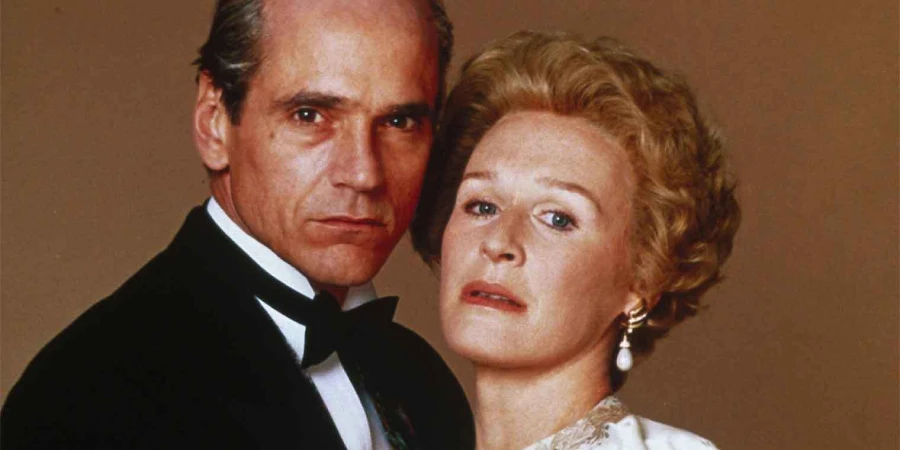

Jeremy Irons delivers one of cinema’s most unsettling performances as a man who may or may not have tried to kill his wife, and he does it while being almost aggressively charming about the whole thing. Reversal of Fortune drops you straight into a moral maze with no exit signs. Based on the real 1980 case of Claus von Bulow, the film refuses to tell you what actually happened, and that refusal is a creative choice, not a cop-out. Ron Silver’s Alan Dershowitz and Glenn Close’s comatose Sunny narrate from opposite ends of a story that never quite resolves.
Table of Contents
Detailed Summary
Sunny Speaks from Her Coma
Glenn Close opens the film as Sunny von Bulow, narrating her own vegetative state from a hospital bed. She tells us she has been in this coma since 1980, and she will never wake up. Right away, the film signals its intent: this is not a thriller about finding the truth, it is something stranger and more unsettling than that.
Claus Hires Dershowitz
Claus von Bulow, freshly convicted of attempted murder, approaches Harvard law professor Alan Dershowitz to handle his appeal. Dershowitz is skeptical and finds Claus personally repellent. He takes the case anyway, partly for the legal challenge and partly, the film implies, because he cannot resist a puzzle.
The Students Take Over
Dershowitz runs much of his case through his law students, who work out of his home. They pore over evidence, argue among themselves, and begin to find cracks in the prosecution’s case. This setup gives the film a procedural energy that cuts against its more gothic, aristocratic atmosphere.
The Black Bag and the Insulin Question
At the center of the original conviction is a black bag belonging to Claus, found to contain a needle encrusted with insulin. The prosecution argued Claus injected Sunny with insulin to induce her coma. Dershowitz’s team focuses on the chain of custody for that bag, questioning whether the von Bulow children’s private investigators handled it improperly before handing it over to police.
Who Was Sunny Von Bulow?
Flashback scenes, presented as possibilities rather than facts, sketch out the von Bulow marriage. Sunny was fabulously wealthy and unhappy, prone to drinking and allegedly self-medicating. Claus appears cold and calculating in these reconstructions, but the film keeps nudging you to remember that reconstructions lie.
The Children’s Testimony
Sunny’s children from her first marriage, particularly Alexander, despise Claus and believe he murdered their mother. Their involvement in hiring private investigators to search the Newport mansion becomes a key point on appeal. Dershowitz argues the search was illegal and tainted the evidence.
Claus and Dershowitz Face Off
Irons and Silver share several long, dialogue-driven scenes where Claus essentially taunts Dershowitz with ambiguity. In one crucial moment, Claus smiles and says something like: you tell me what happened, professor. He never confesses and never fully denies. Irons plays these scenes with a kind of aristocratic amusement that makes your skin crawl in the best possible way.
The Appeal Succeeds
Dershowitz wins the appeal, getting the conviction overturned on the basis that the private search violated Claus’s Fourth Amendment rights. A retrial is ordered. At the retrial, Claus is acquitted. Sunny remains in her coma, and no one is ever held legally responsible for her condition.
Movie Ending
Claus walks free. That is the legal outcome, delivered with minimal fanfare by the film. Dershowitz has won his case, his students have learned something about the machinery of the law, and Claus von Bulow returns to his life.
Sunny’s voiceover returns at the end. She reminds us she is still in the coma, still watching, still unknowable. Close delivers these final lines with a flat, eerie calm that lands harder than any dramatic climax would. She tells the audience that what really happened is something only she and Claus know.
Director Barbet Schroeder refuses to resolve the central question. Did Claus do it? The film presents enough evidence to argue both ways and then steps back. That refusal is not cowardice; it is the entire point. A legal acquittal is not the same as innocence, and the film forces you to sit with that distinction.
What lingers is not the verdict but Irons’s final shot, where Claus looks directly at the camera with that thin, unreadable smile. It is a moment that implicates the audience for spending two hours trying to read him.
Are There Post-Credits Scenes?
Reversal of Fortune has no post-credits scene. The film ends and it is over. No stingers, no codas, no epilogue cards beyond what appears before the credits roll.
Type of Movie
This is a legal drama with strong elements of biographical thriller and dark comedy. The tone is unusual: cool and sardonic rather than emotionally heated. Schroeder keeps the film at an ironic distance that unsettles more than conventional courtroom tension would.
Calling it a courtroom drama slightly misrepresents it. Most of the action happens outside the courtroom, in offices, kitchens, and the Gothic Newport mansion. It plays more like a philosophical mystery that knows it cannot solve itself.
Cast
- Jeremy Irons – Claus von Bulow
- Glenn Close – Sunny von Bulow
- Ron Silver – Alan Dershowitz
- Annabella Sciorra – Carol
- Uta Hagen – Maria
- Fisher Stevens – David Marriott
- Christine Baranski – Andrea Reynolds
- Jack Gilpin – Peter MacIntosh
Film Music and Composer
Mark Isham composed the score. Isham favors spare, atmospheric textures, and his work here leans on cool, detached strings and electronic undertones that match the film’s refusal to emotionalize its subject. Nothing swells at a moment when you expect it to swell.
That restraint is itself a statement. A more conventional composer might have pushed the audience toward a verdict through music. Isham’s score keeps you at arm’s length, which is exactly where Schroeder wants you.

Filming Locations
Much of the film was shot in Newport, Rhode Island, where the real von Bulow case unfolded. Clarendon Court, the actual von Bulow Newport mansion, appears in the film. Using the real location gives the flashback sequences a documentary chill that a studio recreation would have flattened.
Harvard and the Boston area provided the backdrop for the Dershowitz scenes. That contrast, between the gilded Newport world and the academic Cambridge world, is part of how the film visually separates its two moral universes.
Awards and Nominations
Jeremy Irons won the Academy Award for Best Actor for his performance, one of the more surprising Oscar wins of its era given the film’s dark, ambiguous tone. The film also received a nomination for Best Director for Barbet Schroeder.
Ron Silver’s performance, in my view the most underrated element of the film, received comparatively little awards attention, which remains a genuine oversight.
Behind the Scenes Insights
- Jeremy Irons spent time with the real Claus von Bulow in preparation for the role, studying his mannerisms and speech patterns.
- Barbet Schroeder reportedly fought to keep the film’s ambiguous ending intact against pressure to deliver a cleaner resolution.
- Glenn Close performed most of her scenes lying perfectly still in a hospital bed, a physically and psychologically demanding constraint that she worked within by focusing entirely on vocal delivery.
- Ron Silver, who had a background in stage work, pushed for longer rehearsal periods to develop the verbal sparring between Dershowitz and Claus.
- The film was based on Alan Dershowitz’s own book, which gave the production direct access to case documents and Dershowitz’s personal recollections.
- Irons reportedly found the role deeply uncomfortable and used that discomfort as fuel for the performance’s strange magnetism.
Inspirations and References
The film draws directly from Alan Dershowitz’s 1986 book of the same name, in which the real Dershowitz detailed his work on the appeal. Dershowitz was involved in the production, which means the film carries his perspective on events even when it tries to maintain neutrality.
The case itself was a cultural flashpoint in 1980s America, touching on wealth, privilege, and a justice system that seemed to operate differently for the very rich. Screenwriter Nicholas Kazan shaped the source material into something that interrogates those class dynamics without becoming a polemic.
Alternate Endings and Deleted Scenes
No widely documented alternate endings or significant deleted scenes have surfaced for Reversal of Fortune. Schroeder’s commitment to ambiguity suggests the open ending was always the plan rather than a compromise reached in editing. No official release has included substantial cut material.
Book Adaptations and Differences
Nicholas Kazan’s screenplay adapts Dershowitz’s book, Reversal of Fortune: Inside the von Bulow Case. Dershowitz’s book is a first-person legal account focused on the appeal strategy and his own reasoning. The film adds the Sunny voiceover, the flashback reconstructions, and the Gothic atmosphere, none of which exist in the book in that form.
Kazan’s smartest addition is structuring the film so that Sunny and Claus never really share the same narrative space. In the book, Dershowitz is always the center. In the film, the competing perspectives of Sunny and Claus create a tension the book cannot replicate.


Memorable Scenes and Quotes
Key Scenes
- Sunny’s opening voiceover, delivered while the camera drifts through the Newport mansion like a ghost, sets the film’s entire tone in under two minutes.
- Claus telling Dershowitz “you have no idea” with a smile so composed it reads as either innocence or contempt, and Irons makes it genuinely impossible to tell which.
- The law students arguing over crime scene photographs around a kitchen table, bringing an oddly domestic energy to the forensic horror of the case.
- Glenn Close lying motionless while her voiceover describes watching her own family from inside the coma, a sequence that is quietly one of the film’s most formally daring choices.
- Claus’s final look at the camera after his acquittal, which lasts just long enough to become deeply uncomfortable.
Iconic Quotes
- “You are a very strange man.” / “You have no idea.” (Dershowitz to Claus, Claus’s reply)
- “I’m Sunny von Bulow. I’ve been in this state for thirteen years. No one knows what I feel, what I know, or if I experience anything at all.” (Sunny’s opening narration)
- “Claus, you’ve got to give me something to work with.” (Dershowitz, expressing the film’s central frustration)
Easter Eggs and Hidden Details
- Clarendon Court, the real Newport mansion, appears in exterior shots, grounding the film’s reconstructions in genuine geography.
- Schroeder frames several shots of Claus against ornate gilded mirrors, visually suggesting a man who exists only as reflection, never as substance.
- Sunny’s narration uses the present tense throughout, a grammatical choice that keeps her simultaneously dead and alive in the story’s logic.
- The law students’ casual domestic setting, eating, laughing, arguing, contrasts deliberately with the frozen grandeur of the Newport scenes, a visual argument about class that never becomes explicit dialogue.
- Irons rarely blinks during close-up scenes, a physical choice that makes Claus feel slightly inhuman without tipping into caricature.
Trivia
- Jeremy Irons reportedly said his Oscar win surprised him more than almost any other event in his career.
- The real Claus von Bulow reportedly enjoyed the film and appreciated Irons’s portrayal.
- Glenn Close had to coordinate with the medical team advising the production to understand how to realistically portray a comatose patient’s appearance during close-ups.
- Nicholas Kazan is the son of director Elia Kazan, making this a second-generation Hollywood family production.
- Barbet Schroeder was born in Iran, raised in Colombia, and educated in France, a biography that gave him an outsider’s eye on American class and legal culture.
- The film was released the same year as several other high-profile legal dramas, but its refusal to moralize set it apart from the pack immediately.
- Ron Silver later said playing Dershowitz required him to constantly resist making the character likable, since Dershowitz’s appeal in the film comes precisely from his uncomfortable moral flexibility.
Why Watch?
Irons’s performance is worth the price of admission alone: he plays a man who may be a killer as though being accused is the mildest inconvenience imaginable, and that specific kind of aristocratic indifference is more frightening than any conventional villain. Reversal of Fortune also asks a genuinely uncomfortable question about what a legal acquittal actually means. It is a film that trusts its audience to hold two contradictory conclusions at once.
Director’s Other Movies
- Barfly (1987)
- Single White Female (1992)
- Kiss of Death (1995)
- Our Lady of the Assassins (2000)
- Terror’s Advocate (2007)
Recommended Films for Fans
- Presumed Innocent (1990)
- The Talented Mr. Ripley (1999)
- Primal Fear (1996)
- A Few Good Men (1992)
- Nuts (1987)
- Compulsion (1959)
- Judgment at Nuremberg (1961)