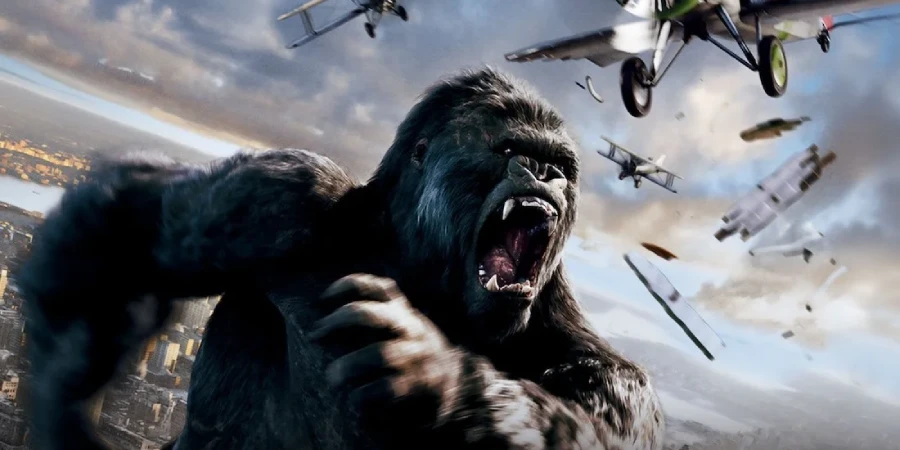

King Kong is director Peter Jackson’s ambitious, emotional, and visually spectacular remake of the 1933 classic. Released in 2005, the film blends epic adventure, tragic romance, survival horror, and blockbuster spectacle into one sweeping cinematic experience. It is loud, long, emotional, and surprisingly tender at its core.
Detailed Summary
The Great Depression and a Desperate Filmmaker
The story is set in 1933 New York during the Great Depression. Struggling actress Ann Darrow (Naomi Watts) is out of work and starving. Enter Carl Denham (Jack Black), an ambitious and morally flexible filmmaker whose latest production is about to collapse due to financial trouble.
Denham secretly plans to shoot his film on the mysterious Skull Island, a place shrouded in rumor and myth. He convinces playwright Jack Driscoll (Adrien Brody) to join the voyage and tricks a reluctant crew into sailing aboard the ship Venture before they realize their true destination.
From the beginning, the film builds tension not through monsters, but through desperation and ambition. Everyone on that ship needs something: fame, money, validation, escape.
Arrival at Skull Island
Skull Island is a nightmare disguised as a jungle paradise. The crew quickly discovers a towering wall built by the island’s indigenous population to keep something out — or perhaps something in.
Ann is kidnapped by the islanders and offered as a sacrifice to Kong, a massive gorilla-like creature who rules the island. Kong takes Ann into the jungle, and what follows is not a simple “beauty and the beast” scenario, but a layered relationship built on fear, curiosity, and empathy.
Meanwhile, the rescue party ventures into the island’s interior and encounters some of the most intense creature sequences in modern cinema:
- A brutal battle with three V-Rex dinosaurs
- A horrifying giant insect ravine sequence
- Swarms of prehistoric predators
These scenes are relentless, visceral, and genuinely disturbing.
Kong and Ann’s Bond
While the humans fight to survive, Ann slowly earns Kong’s trust. She entertains him with vaudeville routines, and Kong begins to see her not as prey, but as companionship.
The film slows down here, emphasizing loneliness. Kong is the last of his kind. Ann is a struggling actress with nothing. Their connection is built on mutual isolation. It’s unexpectedly tender and gives emotional weight to everything that follows.
Capture and Exploitation
Denham, seeing dollar signs instead of danger, captures Kong using chloroform. He abandons the island with Kong restrained in chains, declaring he will bring “The Eighth Wonder of the World” to New York.
This decision shifts the film from adventure to tragedy.


Movie Ending
Back in New York, Denham unveils Kong as a Broadway spectacle. Shackled and humiliated before a wealthy audience, Kong panics when flashing cameras remind him of Skull Island’s chaos. He breaks free in a violent escape that devastates the theater and surrounding streets.
Kong rampages through Manhattan not out of malice, but confusion and fear. He searches for Ann, whom he recognizes as his only source of safety and connection. After finding her, he carries her through snow-covered Central Park in one of the film’s most unexpectedly gentle sequences. They share a quiet, almost peaceful moment as snow falls — perhaps the only time Kong experiences something close to happiness outside Skull Island.
But it cannot last.
The military pursues Kong relentlessly. Kong climbs the Empire State Building, seeking refuge at the highest point he can find — symbolically returning to isolation. Ann tries to protect him, but fighter planes arrive.
Kong fights back desperately, swatting at planes, injured again and again. Eventually, riddled with bullets and exhausted, he looks at Ann one final time. There’s no anger in his expression — only recognition.
He releases her and falls from the Empire State Building to his death.
Denham arrives afterward and utters the iconic line: “It wasn’t the airplanes. It was beauty killed the beast.”
But the film makes it clear: it was greed, exploitation, and fear that killed him.
The ending is tragic, emotional, and deliberately uncomfortable. Kong was never the villain. Humanity was.
Are There Post-Credits Scenes?
No. King Kong does not feature any mid-credit or post-credit scenes. Once the credits begin, the story is complete.
Type of Movie
The film is an epic adventure drama with strong elements of monster horror and tragic romance. It combines large-scale spectacle with surprisingly intimate emotional storytelling.
Cast
- Naomi Watts as Ann Darrow
- Adrien Brody as Jack Driscoll
- Jack Black as Carl Denham
- Thomas Kretschmann as Captain Englehorn
- Colin Hanks as Preston
- Andy Serkis as Kong (motion capture) and also Lumpy
Andy Serkis’ performance as Kong is particularly noteworthy, bringing emotional nuance through motion-capture technology.
Film Music and Composer
The score was composed by James Newton Howard. His music enhances both the bombastic action and the film’s heartbreaking finale, especially during the Empire State Building sequence.
Originally, Howard Shore was attached to score the film, but he was replaced late in production due to creative differences.
Filming Locations and Their Importance
Filming took place primarily in New Zealand, especially in Wellington and at Stone Street Studios. Wellington doubled for 1930s New York using extensive practical sets combined with CGI.
The Empire State Building sequences were heavily CGI-enhanced but based on meticulous recreations. Skull Island environments were largely digital but grounded in real jungle landscapes and soundstage work.
New Zealand’s varied terrain allowed Jackson to create a convincing prehistoric island ecosystem.
Awards and Nominations
The film won three Academy Awards at the Academy Awards:
- Best Visual Effects
- Best Sound Editing
- Best Sound Mixing
It was also nominated for Best Production Design.
Despite mixed critical reactions to its length, its technical achievements were widely praised.
Behind the Scenes Insights
- Peter Jackson loved the original 1933 film as a child and cites it as the reason he became a filmmaker.
- Jackson used early motion capture technology, pushing boundaries beyond what was done in The Lord of the Rings: The Two Towers with Gollum.
- The giant insect sequence was partially inspired by a “lost spider pit scene” from the 1933 version.
- Naomi Watts reportedly screamed so often during filming that she temporarily lost her voice.
- A fully playable video game adaptation was directed by Jackson himself.
Inspirations and References
The film is a remake of the original King Kong directed by Merian C. Cooper and Ernest B. Schoedsack.
It also draws heavily from classic adventure literature like Heart of Darkness and pulp-era jungle stories, emphasizing humanity’s intrusion into the unknown.
Alternate Endings and Deleted Scenes
No alternate ending was officially filmed. However, the Extended Edition includes longer creature battles and additional Skull Island sequences that were cut for pacing.
The infamous spider pit sequence was expanded in the extended cut as a tribute to the lost footage from 1933.
Book Adaptations and Differences
While based on the 1933 film, a novelization was released alongside the 2005 version. The film largely stays faithful to the original story but expands Skull Island significantly and deepens the emotional bond between Ann and Kong.
The 1933 version is faster-paced and less psychologically layered. Jackson’s version emphasizes tragedy and spectacle in equal measure.

Memorable Scenes and Quotes
Key Scenes
- The three V-Rex battle sequence
- The insect ravine massacre
- Kong and Ann on the frozen lake in Central Park
- The Empire State Building finale
Iconic Quotes
- “It wasn’t the airplanes. It was beauty killed the beast.”
- “I’m not scared of you.”
- “The Eighth Wonder of the World!”
Easter Eggs and Hidden Details
- Carl Denham’s filmmaking obsession mirrors Peter Jackson’s own childhood passion for the original film.
- Several crew member names are references to people involved in the 1933 version.
- The “lost spider pit” sequence pays homage to long-rumored missing footage.
- Jackson himself makes a brief cameo as a gunner on a plane.
Trivia
- The film runs 3 hours and 7 minutes.
- Andy Serkis studied real gorillas in Rwanda for the role.
- The production budget exceeded $200 million.
- The snow scene in Central Park was digitally enhanced frame by frame.
Why Watch?
If you want a monster movie with real emotional weight, this is it. It’s not just about destruction. It’s about loneliness, exploitation, and tragic misunderstanding. The visual effects still hold up remarkably well, and the final act remains genuinely heartbreaking.
Director’s Other Works (Peter Jackson)
- The Lord of the Rings: The Fellowship of the Ring (2001)
- The Lord of the Rings: The Two Towers (2002)
- The Lord of the Rings: The Return of the King (2003)
- The Hobbit: An Unexpected Journey (2012)
- Braindead (1992)