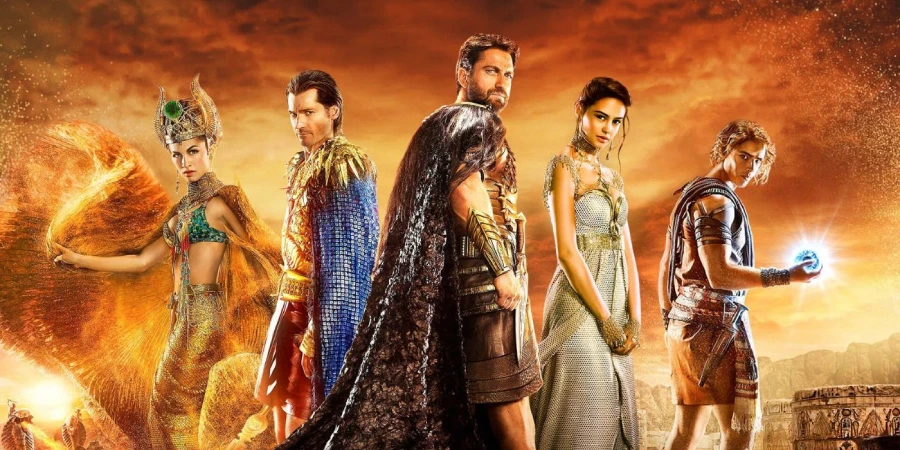

Gods of Egypt is a visually extravagant fantasy epic that blends ancient mythology with blockbuster-style action. Directed by Alex Proyas, the film takes heavy creative liberties with Egyptian myths, delivering a stylized, larger-than-life adventure where gods walk among humans, kingdoms rise and fall, and destiny is decided by courage rather than birthright.
Detailed Summary
The World of Gods and Mortals
The film is set in a mythological version of ancient Egypt where gods live among humans but are physically different: they are taller, stronger, and possess golden blood that grants immortality. Humans serve the gods, hoping for favor in the afterlife, which is ruled by Osiris.
At the center of the story are two brothers: Osiris, the benevolent god-king, and Set, the god of darkness and chaos. Osiris plans to pass the throne to his son Horus, setting the stage for betrayal.
Set’s Coup and the Fall of Horus
During Horus’ coronation ceremony, Set launches a brutal attack, murders Osiris, and seizes the throne. In a pivotal moment, Set tears out Horus’ eyes, robbing him of his powers and forcing him into exile. With Set now ruling Egypt, humanity suffers under tyranny, forced to pay tribute or face annihilation.
This moment establishes the film’s core conflict: a fallen god, a cruel ruler, and a world on the brink of collapse.
Bek the Mortal Hero
Enter Bek, a clever human thief whose personal tragedy ties him to the larger conflict. When Set kills Bek’s lover Zaya, Bek makes a desperate deal with Horus: help overthrow Set in exchange for Zaya’s resurrection in the afterlife.
This unlikely alliance between god and mortal becomes the emotional backbone of the film, emphasizing the theme that true heroism is earned, not inherited.
Trials, Monsters, and Divine Politics
Horus and Bek embark on a perilous journey to recover Horus’ stolen eyes, facing giant serpents, deadly gods, and treacherous deserts. Along the way, they encounter Hathor, goddess of love, and Thoth, god of wisdom, who both play key roles in shaping Horus’ growth.
Meanwhile, Set consolidates power, draining the gods of their abilities and preparing to face the cosmic serpent Apophis, whose arrival threatens to destroy the world. Set believes only he is strong enough to defeat it, further justifying his tyranny in his own mind.

Movie Ending
In the final act, Set’s true motivations are fully revealed. He claims his cruelty is necessary to prepare Egypt for Apophis, but his methods have weakened the gods and brought suffering to humans. Horus, having regained his eyes through sacrifice and teamwork, finally understands what it means to be a true king.
The climactic battle unfolds as Apophis emerges from the underworld, attacking Egypt during the night cycle. Horus confronts Set in a massive showdown that combines physical combat and divine power. Set is ultimately defeated not because Horus is stronger, but because Horus has embraced responsibility, humility, and unity.
Set is stripped of his powers and exiled to the underworld, condemned to push the sun through darkness each night, a mythological punishment rooted in Egyptian lore.
Horus is crowned the rightful king and restores balance between gods and humans. Bek, mortally wounded during the battle, is rewarded for his bravery. Horus honors their deal and brings Zaya back to life, but not as a favor—rather as recognition that human courage rivals divine strength. The film ends with Egypt restored, the gods humbled, and Horus ruling not as a tyrant, but as a guardian.
Are There Post-Credits Scenes?
No, Gods of Egypt does not include any post-credits or mid-credits scenes. Once the story concludes, the narrative is fully wrapped up without teasing a sequel.
Type of Movie
Gods of Egypt is a fantasy action-adventure film heavily inspired by mythology. It combines epic battles, mythological creatures, and heroic quests with a modern blockbuster sensibility.
Cast
- Nikolaj Coster-Waldau as Horus
- Gerard Butler as Set
- Brenton Thwaites as Bek
- Chadwick Boseman as Thoth
- Élodie Yung as Hathor
- Geoffrey Rush as Ra
- Courtney Eaton as Zaya
Film Music and Composer
The score was composed by Marco Beltrami, known for his work in both action and horror genres. The music emphasizes grand orchestral themes, heavy percussion, and dramatic motifs that underscore the gods’ scale and the epic nature of the story.

Filming Locations
The movie was primarily filmed in Australia, using large studio sets combined with extensive CGI. Real-world landscapes were digitally enhanced to create massive temples, deserts, and celestial realms. This approach allowed the filmmakers to craft a mythological Egypt unconstrained by historical realism, reinforcing the film’s fantasy tone.
Awards and Nominations
While not a major awards contender, the film received nominations in visual effects and production design categories at genre-based and technical award shows. Its ambitious CGI work was frequently highlighted, even by critics who were divided on the storytelling.
Behind the Scenes Insights
- Director Alex Proyas aimed for a graphic-novel aesthetic rather than historical accuracy.
- Over 90% of the film relies on CGI, making it one of the most effects-heavy productions of its year.
- Chadwick Boseman described Thoth as “a god of intelligence rather than muscle,” deliberately contrasting other characters.
- Gerard Butler trained extensively to physically embody Set’s brutality and dominance.
Inspirations and References
The film draws loosely from ancient Egyptian mythology, particularly stories involving Horus, Set, Osiris, and Ra. However, it prioritizes spectacle over strict mythological accuracy. The visual style is also influenced by comic books, video games, and classic sword-and-sandal epics.
Alternate Endings and Deleted Scenes
Several deleted scenes reportedly expanded the political dynamics between the gods and provided more background on Set’s upbringing. No alternate ending was filmed, but early drafts portrayed Set as more sympathetic, a direction later abandoned to emphasize his role as a clear antagonist.
Book Adaptations and Differences
Gods of Egypt is not based on a specific book, but rather on mythological sources. As a result, it diverges significantly from traditional Egyptian lore, reimagining gods as humanoid warriors and simplifying complex myth cycles for mainstream audiences.



Memorable Scenes and Quotes
Key Scenes
- Set ripping out Horus’ eyes during the coronation.
- Bek stealing one of Horus’ eyes and discovering divine power.
- The final battle against Apophis under a collapsing night sky.
Iconic Quotes
- Set: “I will remake this world in my image.”
- Horus: “A king protects his people, not himself.”
- Thoth: “Knowledge is the sharpest weapon.”
Easter Eggs and Hidden Details
- Set’s armor subtly incorporates serpent imagery referencing Apophis.
- Ra’s solar barge design mirrors ancient tomb illustrations.
- Hieroglyphs in background scenes reference real Egyptian deities not featured in the film.
Trivia
- The gods’ golden blood was added to visually distinguish them from humans.
- Geoffrey Rush filmed most of his scenes alone against green screens.
- The film sparked widespread discussion about casting choices and mythological representation.
Why Watch?
If you enjoy mythology reimagined as high-budget fantasy, massive CGI battles, and clear-cut heroic journeys, Gods of Egypt offers an unapologetically bold experience. It may not be subtle, but it is ambitious, colorful, and committed to spectacle.