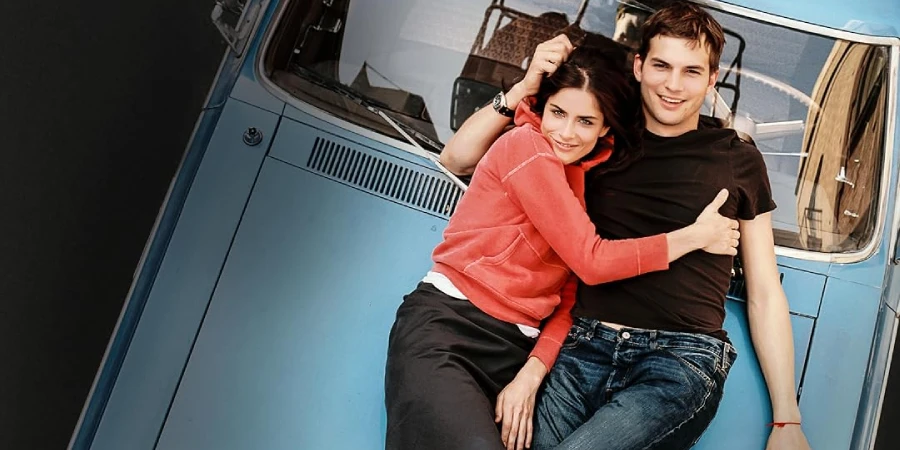

Ashton Kutcher and Amanda Peet spend seven years almost falling in love, and the film has the audacity to make you root for every failed attempt. A Lot Like Love (2005) is a romantic comedy built entirely on bad timing, and director Nigel Cole leans into that premise with more sincerity than the trailers ever suggested. It bombed at the box office, got buried by middling reviews, and somehow aged into a genuinely watchable film about two people who keep choosing the wrong moment. That gap between its reputation and its actual warmth is the most interesting thing about it.
Detailed Summary
The Plane Encounter That Starts Everything
Oliver Martin, a young optimist with a business plan tucked under his arm, boards a flight from Los Angeles to New York. Emily Friehl, impulsive and prickly, drags him into the airplane bathroom on a whim. No names exchanged. No promises made. They go their separate ways at JFK like it never happened.
New York and the First Real Conversation
Oliver spots Emily again in New York. What follows is their first actual conversation, awkward and charged, wandering through the city with a looseness that feels unscripted. Oliver is optimistic about his future; Emily is contemptuous of his cheerfulness, and that friction gives the film its early energy.
Oliver’s Business Dream and the Six-Year Plan
Oliver has a concrete goal: launch an online baby goods delivery company, get financially stable, then pursue a serious relationship. He tells Emily this with complete sincerity. She finds it absurd. He means every word of it.
They Go Their Separate Ways, Again
After their New York time together, they part without committing to anything. Oliver heads back to building his business. Emily drifts back into her own chaotic life, pursuing photography and a string of relationships that never quite stick.
The Reconnection in San Francisco
Years pass. Oliver’s business struggles. Emily reappears in his life, and they fall into each other’s company again with the ease of people who forgot how much they liked each other. This stretch of the film is the warmest section, and it’s where Peet’s performance quietly takes over.
Another Near-Miss and Another Goodbye
Oliver gets close to saying what he actually feels. He pulls back. Emily, unwilling to wait for someone still running a mental checklist, walks away. This pattern repeats across the film, and Cole does not try to hide its repetition; he trusts it as the point.
Oliver’s Business Collapses
Oliver’s company fails. His six-year plan crumbles. He loses the financial stability he spent years prioritizing over every personal relationship, including the one that mattered most. It’s the film’s bluntest structural joke: he sacrificed love for a plan that didn’t work.
Emily Gets Engaged to Someone Else
Emily moves on. She gets engaged to a man who is present, reliable, and available in all the ways Oliver never managed to be. Oliver hears the news and the look on Kutcher’s face does more work than any line of dialogue in the script. It’s a small, honest moment of loss.
Oliver Rebuilds and Reconsiders
Oliver picks himself up, starts fresh professionally, and begins to understand what he kept deprioritizing. His growth here is functional rather than dramatic, but it grounds the final act in something resembling credibility.



Movie Ending
Oliver drives to Emily. He shows up at her door without a plan, without the six-year checklist, without any of the scaffolding he used to hide behind. Emily is still with her fiance at this point, and Oliver does not deliver a grand speech designed to win applause.
What he offers is simpler: honesty, finally uncomplicated by timing. Emily has to decide whether to trust it. The film earns its ending because it never pretends the years of bad timing were romantic detours; they were genuine failures of courage from both sides.
Emily calls off her engagement and goes to Oliver. Their reunion happens quietly, without swelling orchestration demanding you feel something. Two people standing in a doorway, after seven years of almost. That restraint is the best directorial decision in the entire film.
Audiences most often ask whether Emily’s fiance gets a fair shake in the script. He doesn’t, honestly. He exists to be adequate. But the film is not interested in his interiority; it is only interested in what his adequacy reveals about what Emily actually wants.
Are There Post-Credits Scenes?
A Lot Like Love has no post-credits scenes. Once the story wraps, the film is done. You can leave when the credits roll.
Type of Movie
This is a romantic comedy-drama with a heavier lean toward drama than the marketing implied. The tone stays warm without becoming saccharine, and the comedy is situational rather than broad.
It belongs to the early-2000s tradition of adult-skewing rom-coms that trusted their audience to sit with ambiguity for a while before delivering satisfaction. Think less screwball, more wistful.
Cast
- Ashton Kutcher – Oliver Martin
- Amanda Peet – Emily Friehl
- Taryn Manning – Gina
- Kal Penn – Jeeter
- Ali Larter – Ellen
- Kathryn Hahn – Carol
- Ty Giordano – Graham
Film Music and Composer
The score was composed by John Swihart, a television and film composer whose work here stays functional and understated. He keeps the music from overexplaining the emotional beats, which suits the film’s quieter register.
The soundtrack leans heavily on licensed indie and folk-leaning tracks rather than the score itself. Songs do a lot of the emotional heavy lifting in the montage sequences, which is standard practice for the genre but executed with decent taste here.



Filming Locations
Production shot across multiple American cities to reflect the span of Oliver and Emily’s years-long near-relationship. Los Angeles anchors the story on either end, fitting for a film about two people with California restlessness in their blood.
New York City hosts their first real conversation, and the city’s indifferent enormity suits a scene about two people talking around what they actually mean. San Francisco appears during their warmest reconnection, and there is something fitting about using a city famous for hills you have to work to climb.
Awards and Nominations
A Lot Like Love did not receive significant awards attention. It was not a film the awards circuit paid much notice to in 2005, and its reputation since has been built by audiences rather than critics or academies.
Behind the Scenes Insights
- Director Nigel Cole was best known for Calendar Girls before taking this project, an unusual choice that may have contributed to the film’s more grounded emotional register compared to typical studio rom-coms of the period.
- Amanda Peet reportedly pushed for Emily to feel genuinely flawed rather than quirky-in-a-cute-way, and that pressure shows in the performance; Emily is prickly in ways the script does not always reward or explain.
- Kutcher was coming off his That ’70s Show peak and had box office momentum from Just Married and Cheaper by the Dozen; the studio was betting on his likeability to carry the film’s slower stretches.
- The non-linear structure, jumping forward in years repeatedly, was a deliberate choice to prevent the story from feeling like a conventional will-they-won’t-they countdown.
- Several scenes were shot with a loose, partly improvised quality, particularly the New York walking sequence, which gives early scenes an energy the more structured later acts lose slightly.
Inspirations and References
The film does not adapt a book or draw from a documented real-life source. Its central architecture, two people repeatedly meeting and missing each other across years, owes a clear debt to films like When Harry Met Sally (1989).
The screenplay by Colin Patrick Lynch also borrows the long-form timeline structure that Annie Hall made viable for romantic stories. Neither debt is hidden; the film wears its influences openly without pretending otherwise.
Alternate Endings and Deleted Scenes
No alternate ending or significant deleted scenes from A Lot Like Love have been widely documented or released publicly. The DVD release included some additional material, but nothing that meaningfully reframes the theatrical cut.
Book Adaptations and Differences
A Lot Like Love is an original screenplay, not an adaptation of any novel or pre-existing source material. There is no book version to compare it against.


Memorable Scenes and Quotes
Key Scenes
- The opening airplane bathroom encounter, shot tight and fast, establishes the film’s willingness to skip the slow romantic build and start in the middle of something already happening.
- Oliver and Emily walking through New York for the first time, trading observations about strangers, is the film’s most charming sequence and the scene where their chemistry actually convinces.
- Oliver learning Emily is engaged: Kutcher sits with that news without a speech or a dramatic exit, and the camera stays on his face long enough for the disappointment to register as genuinely felt rather than performed.
- The final doorstep scene, quiet and unhurried, where Oliver shows up without a prepared argument and Emily looks at him like she’s making a real decision rather than fulfilling a genre requirement.
- Emily’s photography work appearing throughout the film as a visual thread, her pictures reflecting where she is emotionally at different points, is one of the script’s more understated structural choices.
Iconic Quotes
- “You know what I figured out? Life’s too short to be afraid of what you want.” Oliver’s line late in the film, after his plan has failed, lands harder than it would have in act one.
- Emily’s early dismissal of Oliver’s optimism, something along the lines of his certainty being either inspiring or deeply irritating, sets up the film’s central tension without overexplaining it.
Easter Eggs and Hidden Details
- Emily’s photography evolves across the timeline; early shots are chaotic and spontaneous, later ones more composed, a quiet visual marker of her emotional state that most viewers miss on first watch.
- Oliver’s clothing choices shift from low-key and casual early on to more businesslike during his startup years, then back to simpler clothes after his company fails; it’s a costume-department shortcut to character arc.
- Background extras in the New York walking scene appear to be genuinely unaware of the filming, giving the city scenes an authenticity that the more staged California sequences lack.
- The airports bookending the story use similar visual framing, arrivals and departures mirroring the film’s central metaphor without underlining it with music or dialogue.
Trivia
- A Lot Like Love was released in April 2005 and opened to modest numbers before fading quickly from theaters.
- The film’s title comes from the idea that what Oliver and Emily share for most of the story is not quite love, not quite not-love; the title is a description of the film’s entire premise.
- Kal Penn, playing Oliver’s friend Jeeter, was in the middle of his rise to wider recognition through the Harold and Kumar films and brings a natural comic looseness to a role the script does not give him much to work with.
- Kathryn Hahn appears in a supporting role years before her profile grew significantly; watching the film now, she is visibly more interesting than the material asks her to be.
- The film’s marketing leaned heavily on the Just Married and Dude, Where’s My Car? version of Kutcher, which likely misled audiences expecting broader comedy and contributed to the lukewarm reception.
- Nigel Cole directing a Kutcher vehicle was an unusual pairing by studio standards, and the mismatch between Cole’s quieter instincts and the studio’s commercial expectations is visible in the film’s uneven tonal shifts.
Why Watch?
Amanda Peet delivers a performance that this film did not earn enough attention for; she plays Emily as genuinely difficult without making her unlikeable, which is a harder needle to thread than it looks. Kutcher, often dismissed in this period, shows real restraint in the scenes where Oliver has nothing clever to say. If you want a rom-com that earns its ending by actually showing the work, this one pays off.
Director’s Other Movies
- Calendar Girls (2003)
- Saving Grace (2000)
Recommended Films for Fans
- When Harry Met Sally (1989)
- Serendipity (2001)
- The Wedding Date (2005)
- Just Like Heaven (2005)
- Hitch (2005)
- 13 Going on 30 (2004)
- My Best Friend’s Wedding (1997)