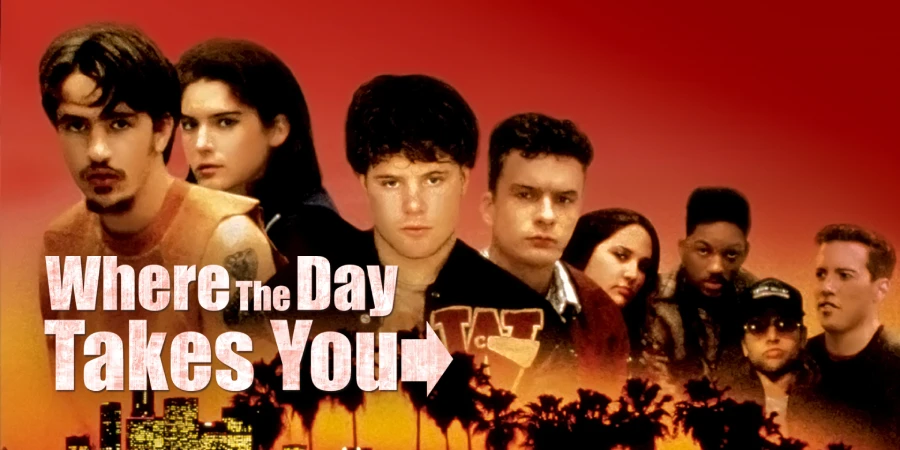

Where the Day Takes You drops you onto the streets of Los Angeles with no safety net and no apologies. This 1992 film follows a tight-knit group of teenage runaways surviving by any means necessary, and it never once flinches from the ugliness of that reality. It is raw, compassionate, and criminally underseen. Consider this your formal introduction to one of the most honest portraits of youth homelessness that Hollywood ever produced.
Detailed Summary
King’s Release and Return to the Streets
King (played by Dermot Mulroney) walks out of a juvenile detention facility and heads straight back to Hollywood Boulevard. He narrates his own story in interview-style segments recorded by a social worker, which gives the film a gritty, documentary texture from the very start.
King is a natural leader, and the street kids in his orbit immediately gravitate back to him. He provides structure, loyalty, and a crude but genuine moral code for a group of young people who have nobody else.
Meeting the Crew
King reconnects with his core group: Heather, his girlfriend and one of the more grounded members of the crew, and a rotating cast of damaged, lovable street kids. Each character carries a distinct backstory that the film reveals in fragments.
Among them is Little J, a younger runaway still adjusting to street life. In addition, there is Crasher, a volatile presence who keeps the group permanently on edge. Together they hustle, beg, steal, and sleep in makeshift camps along the boulevard.
Greg Arrives on the Scene
Greg (played by Lara Flynn Boyle, in a gender-note correction: Greg is actually a young woman named Brenda in the film, played by Lara Flynn Boyle) arrives as a newcomer to the street world. She is naive, idealistic, and dangerously trusting, which immediately signals trouble for anyone paying attention.
Brenda’s arc functions as the film’s moral anchor. Her gradual corruption by circumstance, rather than by personal failing, makes her story the most heartbreaking thread in the entire film.
The Drug Economy and Daily Survival
Survival on Hollywood Boulevard means operating inside a brutal economy. King and his crew hustle tourists, panhandle, and occasionally steal to cover food and basic needs.
Drugs enter the picture early and aggressively. Several characters slide into addiction almost without noticing, which is precisely the film’s point: the street does not announce its traps in advance.
King’s Moral Dilemma
King draws a hard line against certain crimes, particularly against exploiting younger or weaker kids. His code sets him apart from the more predatory figures on the boulevard. However, maintaining that code becomes increasingly difficult as desperation mounts.
A local drug dealer named Ted (played by Adam Baldwin) represents the film’s clearest vision of what happens when street survival fully eclipses humanity. King watches Ted operate and recognizes his own possible future.
Brenda’s Descent
Brenda’s innocence erodes steadily throughout the second act. She becomes romantically entangled and financially dependent on people who do not have her best interests at heart. Consequently, she drifts further from any realistic path back to stability.
Her story parallels King’s in a painful way: both characters desperately want something better, but the street keeps pulling them back down. Their parallel struggles give the film much of its emotional weight.
Little J and the Cost of Street Life
Little J (played by Balthazar Getty) becomes one of the film’s most tragic figures. Young and impressionable, he absorbs the street’s lessons far too quickly. His trajectory illustrates how the environment reshapes a person before they even realize it is happening.
Little J begins using drugs and participating in increasingly risky criminal activity. His arc moves fastest and hits hardest, partly because the film gives him so little protection from consequence.

Movie Ending
King’s story accelerates toward a violent and inevitable conclusion. He gets drawn into a confrontation that results in a shooting, and the law closes in on him with the same indifference the system has shown him his entire life. He ends up back in custody, his brief time on the outside having changed very little about his material circumstances.
Little J’s fate is the film’s most gut-punch moment. He dies as a result of his involvement in street crime, and the film presents his death without melodrama, which somehow makes it worse. It lands like a fact rather than a dramatic device.
Brenda’s ending offers a sliver of ambiguity. She connects with a social services program and may have a path forward, but the film is careful not to oversell that possibility. Hope, in this world, is rationed carefully.
King records his final interview segment from custody, and his narration closes the film with a weary clarity. He does not rage against his situation. He simply describes it, and that restraint is more devastating than any monologue could be. The ending refuses easy redemption, which is precisely what makes it linger.
Are There Post-Credits Scenes?
Where the Day Takes You contains no post-credits scenes. This is a serious, socially conscious drama, and the filmmakers had no interest in undermining its emotional gravity with anything extra. Once the credits roll, the film is done.
Type of Movie
This is a social realist drama with strong elements of street cinema. Its tone sits closest to a documentary-inflected character study, grounded firmly in grim naturalism. There is no genre comfort here: no hero arc, no tidy resolution, no Hollywood sheen.
In contrast to mainstream early-90s youth films, this one refuses to romanticize its subject. It is closer in spirit to films like Christiane F. than to anything playing multiplexes in 1992.
Cast
- Dermot Mulroney – King
- Lara Flynn Boyle – Brenda
- Balthazar Getty – Little J
- Sean Astin – Greg
- James Le Gros – Crasher
- Ricki Lake – Vikki
- Adam Baldwin – Ted
- Kyle MacLachlan – a social worker
- Laura San Giacomo – a drug counselor
- Will Smith – Manny
- Christian Slater – a character in a supporting capacity
Film Music and Composer
Mark Isham composed the score for Where the Day Takes You. Isham brought his signature atmospheric sensibility to the project, favoring ambient textures over conventional dramatic scoring. His music underlines the film’s mood without ever overpowering the performances.
Isham had already built a strong reputation for understated, evocative work on independent and prestige films by this point in his career. His score here feels like background radiation: always present, never intrusive, and quietly essential to the film’s texture.


Filming Locations
Production took place on and around Hollywood Boulevard in Los Angeles. Shooting in actual locations rather than studio approximations gives the film a lived-in authenticity that no set dressing could replicate.
Hollywood Boulevard in the early 1990s carried genuine grit. Using it as a primary location meant the film captured something real about the spatial geography of street youth homelessness in that specific time and place. Location, in this case, is character.
Awards and Nominations
Where the Day Takes You did not receive major awards attention upon its release. It remains a largely unrecognized film in terms of formal industry honors, despite earning strong critical respect from reviewers who sought it out.
Behind the Scenes Insights
- Director Marc Rocco conducted extensive research into the actual lives of homeless youth on Hollywood Boulevard before writing and shooting the film.
- Several cast members spent time with real street youth in Los Angeles as part of their preparation for their roles.
- The documentary-style interview sequences were designed to give actors a framework for delivering raw, unpolished performances outside the main narrative.
- Will Smith, still best known at the time for The Fresh Prince of Bel-Air, took the role of Manny specifically to demonstrate dramatic range and distance himself from his comedic television persona.
- The ensemble cast was deliberately assembled from actors at various career stages, mixing established names with emerging talent to create an unpredictable on-screen dynamic.
Inspirations and References
Marc Rocco drew directly from journalistic accounts and social worker testimonies about youth homelessness in Los Angeles. Moreover, the film reflects a broader early-1990s cultural moment when American cinema briefly turned serious attention toward poverty and social marginalization.
Films like Pixote (1980) and the broader tradition of Italian neorealism arguably informed the film’s aesthetic instincts. The commitment to authentic locations and non-glamorized performance aligns Where the Day Takes You with that lineage. It is a film made by people who clearly studied what socially conscious cinema could accomplish.
Alternate Endings and Deleted Scenes
No widely documented alternate endings or deleted scenes from Where the Day Takes You have entered the public record. The film has not received a major home video release with supplementary materials that would typically surface such content.
Given the film’s relative obscurity, a definitive archival accounting of cut material simply does not exist in any accessible form. What audiences see is, as far as available information indicates, the intended version of the film.
Book Adaptations and Differences
Where the Day Takes You is not based on a book. Marc Rocco developed the screenplay from original research and from his own creative collaboration with co-writers. No source novel, memoir, or adaptation relationship exists for this film.


Memorable Scenes and Quotes
Key Scenes
- King’s opening interview with the social worker, which immediately establishes the film’s confessional documentary rhythm and sets the emotional stakes for everything that follows.
- Little J’s first serious drug use, filmed with a deliberate casualness that makes it more disturbing than any heightened dramatic treatment could achieve.
- King confronting Ted about the exploitation of younger street kids, a scene that crystallizes the film’s central moral argument in a few tense, economical minutes.
- Brenda’s gradual realization that the people around her are not actually her family, even as the street has made them the closest thing to family she has.
- Little J’s death, handled with blunt economy and zero sentimentality, which is precisely why it hits so hard.
- King’s final interview segment from custody, where his narration strips away any remaining illusion that the system offers meaningful support to kids like him.
Iconic Quotes
- “Out here, you either survive or you don’t. Nobody’s keeping score.” (King, in narration)
- “I used to think the street was freedom. Then I figured out freedom costs more than I had.” (King)
Easter Eggs and Hidden Details
- Several background performers in the Hollywood Boulevard scenes were reportedly actual homeless youth, lending the crowd sequences an unscripted authenticity.
- The social worker interview framing device mirrors real documentary techniques used in sociological studies of homeless youth populations during that era, grounding the fiction in recognizable methodology.
- Will Smith’s character Manny is physically disabled, a casting choice that deliberately complicates any simplistic view of who ends up on the street and why.
- The film’s color palette shifts subtly warmer in scenes centered on community among the street kids, and cooler whenever the institutional world (police, social services) intrudes.
Trivia
- Marc Rocco was in his early thirties when he directed this film, and it remains his most critically admired work.
- Will Smith’s participation attracted significant attention given his profile at the time, and many critics noted how effectively he subverted audience expectations with his performance.
- The film’s release in 1992 placed it in the same cultural moment as other socially charged works responding to inequality and urban crisis in America.
- Despite a recognizable ensemble cast, the film performed modestly at the box office and found its audience primarily through home video and cable.
- Balthazar Getty was still a teenager during production, which adds an uncomfortable layer of reality to his character’s arc.
- Christian Slater appears in a relatively brief role, making his presence feel almost like a deliberate disruption of star-power expectations.
Why Watch?
Where the Day Takes You offers something rare: a studio-adjacent film that genuinely refuses to comfort its audience. Furthermore, it features career-best or career-defining work from several cast members who rarely get credit for it. Thirty-plus years on, its portrait of systemic failure and youth resilience still stings with uncomfortable relevance.
Director’s Other Movies
- Dream a Little Dream (1989)
- Murder in the First (1995)
Recommended Films for Fans
- Christiane F. (1981)
- Pixote (1980)
- Kids (1995)
- Sleepers (1996)
- Bully (2001)
- Thirteen (2003)
- Wendy and Lucy (2008)