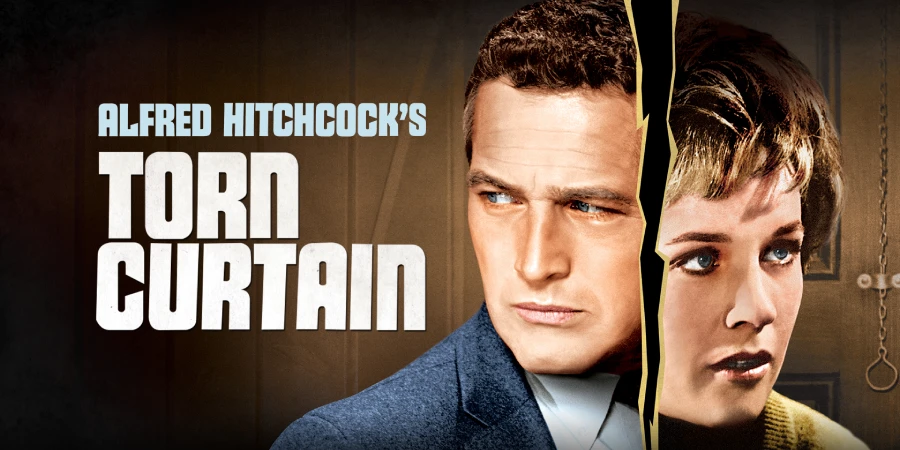

Alfred Hitchcock’s 50th film isn’t a glamorous spy caper. Instead, Torn Curtain offers a gritty, unvarnished look at the dirty work of espionage. Its most famous scene is a brutal, exhausting murder that strips away any romanticism about a spy’s life. This film proves that even a master of suspense found new ways to shock his audience.
Detailed Summary
The Calculated Defection
Professor Michael Armstrong (Paul Newman), a renowned American physicist, travels to an international physics conference in Copenhagen. His fiancée and assistant, Sarah Sherman (Julie Andrews), accompanies him. During the trip, Sarah intercepts a message meant for Michael and discovers he is secretly arranging a flight to East Berlin.
Believing he is a traitor, a heartbroken Sarah follows him onto the plane. Upon arrival, East German officials greet Michael as a high-profile defector. He coldly informs Sarah she should have stayed behind, confirming her worst fears.
Life in East Berlin
Michael is assigned a minder, Hermann Gromek (Wolfgang Kieling), a deceptively cheerful security officer. He is taken to meet Professor Gustav Lindt (Ludwig Donath), the lead scientist on an advanced anti-missile defense system. Michael’s goal, however, is not to defect permanently.
In reality, he is a double agent. Armstrong is pretending to defect to learn the secrets of Lindt’s anti-missile formula, a piece of intelligence the US government desperately needs. Sarah, unaware of this, remains a captive of her emotions and the oppressive state.
The Gromek Problem
Gromek grows suspicious of Michael’s true motives. He follows Michael to a remote farmhouse, where Michael is meeting a contact from “Pi,” an underground escape network. Consequently, Gromek discovers Michael’s deception and plans to expose him.
A brutal struggle ensues. Michael, aided by the farmer’s wife, attempts to kill Gromek. Their fight is clumsy, slow, and horrifyingly realistic. They try gassing him in an oven and stabbing him, with Michael finally succeeding in a desperate, exhausting act of violence.
The Escape Plan
Now a murderer, Michael must accelerate his escape. He reconnects with Sarah and finally reveals his true mission, convincing her to help. The “Pi” network arranges a complex escape route for them.
Meanwhile, Michael must still get the formula from Professor Lindt. He goads the arrogant professor into a technical argument, tricking Lindt into writing the entire equation on a blackboard. Michael memorizes it instantly.
A Crowded Bus and a Deceptive Ballerina
The “Pi” network uses a decoy bus to draw away Stasi agents searching for the couple. However, the plan goes wrong, and Michael and Sarah become fugitives on the run. Several loyal East Germans put their lives on the line to misdirect the authorities and help them.
They eventually seek refuge with a Polish ballerina, Countess Kuchinska (Lila Kedrova), who offers them help in exchange for her own passage to America. She guides them to the Friedrichstraße theatre, where she is performing, and arranges for them to be smuggled out of the country.

Movie Ending
Inside the crowded theatre, Michael and Sarah are spotted by the ballerina’s security escort. A frantic chase unfolds backstage during a live performance of Giselle. To create a diversion, someone in the “Pi” network shouts “Fire!” in the packed auditorium, inciting a panic.
During the chaos, Michael and Sarah are hidden inside two large wicker baskets used for shipping costumes. The baskets are loaded onto a ship bound for Sweden. On board, the suspicious ballerina almost gives them away, but the crew members of the “Pi” network manage to keep their cover intact.
As the ship crosses into international waters, Stasi agents board and search the vessel. Michael and Sarah, still hidden, barely avoid detection. They finally emerge from their baskets on the open deck, free and clear, as the ship sails toward safety, having successfully stolen the enemy’s vital intelligence.
Are There Post-Credits Scenes?
No, there are no post-credits scenes in Torn Curtain. The film concludes as Michael and Sarah embrace on the deck of the ship.
Type of Movie
Torn Curtain is a Cold War spy thriller and a political drama. Its tone is consistently tense and suspenseful, but it notably lacks the glamour often associated with the genre in the 1960s.
Instead, the film maintains a gritty, realistic feel, emphasizing the danger and moral ambiguity of espionage. There are moments of dark humor, particularly in Michael’s interactions with Professor Lindt, but the overarching mood is one of paranoia and dread.
Cast
- Paul Newman – Professor Michael Armstrong
- Julie Andrews – Dr. Sarah Sherman
- Lila Kedrova – Countess Kuchinska
- Hansjörg Felmy – Heinrich Gerhard
- Tamara Toumanova – The Ballerina
- Wolfgang Kieling – Hermann Gromek
- Ludwig Donath – Professor Gustav Lindt
- Günter Strack – Professor Karl Manfred
- David Opatoshu – Mr. Jacobi
Film Music and Composer
The score for Torn Curtain holds a controversial place in film history. Alfred Hitchcock’s long-time collaborator, Bernard Herrmann, initially composed the score. However, Hitchcock, under pressure from Universal to create a more marketable, pop-influenced soundtrack, rejected Herrmann’s dark and traditional composition.
This rejection caused a permanent rift between the two legendary artists, ending their partnership. English composer John Addison was hired to write the replacement score. Addison’s music is more upbeat and conventional for the era, a stark contrast to the moody atmosphere Herrmann had intended.


Filming Locations
Despite being set primarily in Copenhagen and East Berlin, Torn Curtain was shot almost entirely on the Universal Studios backlot in Hollywood, California. Hitchcock favored the controlled environment of a soundstage, which allowed him to manipulate every visual detail.
This decision contributes to the film’s slightly stylized, artificial look for East Germany. The bleak, colorless sets effectively communicate the oppressive atmosphere of life behind the Iron Curtain, even if they lack authentic geographic detail.
Awards and Nominations
Torn Curtain was not a major awards contender upon its release. The film received no Academy Award nominations or wins, a notable fact given Hitchcock’s esteemed reputation.
Behind the Scenes Insights
- Alfred Hitchcock and Paul Newman famously clashed during production. Newman, a proponent of Method acting, constantly questioned his character’s motivation, which frustrated Hitchcock’s preference for precise, pre-planned direction.
- The murder of Gromek was designed by Hitchcock to be the antithesis of a “clean” movie killing. He wanted to show how difficult, messy, and exhausting it is to take a human life, a process he called “the un-murder.”
- Hitchcock fired his trusted composer, Bernard Herrmann, over the score for this film. Herrmann’s grim, orchestral music did not fit the studio’s desire for a lighter, more commercial soundtrack, leading to a bitter and permanent falling out.
- Hitchcock was reportedly unhappy with the final film. He felt the star power of Newman and Andrews overshadowed the plot and that the studio’s commercial demands compromised his artistic vision.
Inspirations and References
The core plot of Torn Curtain was inspired by the real-life story of the “Cambridge Five“ spy ring. Specifically, the film draws from the 1951 defection of British diplomats Guy Burgess and Donald Maclean to the Soviet Union.
Their sudden disappearance and re-emergence in Moscow sent shockwaves through the Western intelligence community. Brian Moore’s screenplay fictionalizes this event, centering it on a scientist feigning a defection to steal Cold War secrets rather than a genuine traitor.
Alternate Endings and Deleted Scenes
There are no known alternate endings for Torn Curtain. The script, however, did undergo revisions. One notably different idea involved Michael Armstrong being exposed much earlier in the film, forcing him to spend more time on the run inside East Berlin.
Furthermore, some dialogue-heavy scenes were trimmed to improve the film’s pacing. Hitchcock ultimately favored a version that prioritized suspenseful set pieces, such as the farmhouse murder and the bus decoy, over extended political discussions.
Book Adaptations and Differences
Torn Curtain is not based on a book. It is an original story conceived by Alfred Hitchcock, with the screenplay written by Irish-Canadian novelist and screenwriter Brian Moore.

Memorable Scenes and Quotes
Key Scenes
- The Farmhouse Murder: Michael and a farmer’s wife struggle to kill the Stasi agent Gromek. The scene is long, unstylized, and brutal, showing the grim reality of violence without cinematic flair.
- The Bus Decoy: The “Pi” network uses a fake, chartered bus to lead the police on a wild goose chase while Michael and Sarah slip away. The sequence highlights the tension and precision of the underground network’s operations.
- Shouting “Fire”: To escape the theatre, an ally shouts “Fire!” in German, causing a mass panic that allows Michael and Sarah to be smuggled out in costume baskets amidst the chaos.
Iconic Quotes
- Michael Armstrong: “I had to have you here, to be my cover. No one would ever believe that I was defecting if I brought my fiancée along. They know that a man on the run, a man who is turning his back on his country, doesn’t bring a woman with him.”
- Professor Gustav Lindt: “The only thing that could possibly destroy us is ourselves.”
- Countess Kuchinska: “So you are the famous rocket scientist Armstrong… and you are going to get me my visa to the United States?”
Easter Eggs and Hidden Details
- Hitchcock’s Cameo: The director makes his signature appearance early in the film. He is seen sitting in a hotel lobby holding a baby, who then wets his lap.
- “Pi” Symbol: The Greek letter for pi (π) appears several times as a symbol for the underground escape network, including as a lapel pin and drawn on a dusty surface.
- Visual Contrast: The film uses a muted, drab color palette for scenes in East Berlin, which starkly contrasts with the more vibrant colors seen in Copenhagen at the beginning of the movie.
Trivia
- This was Alfred Hitchcock’s 50th feature film.
- Julie Andrews was cast directly after her massive successes in Mary Poppins (1964) and The Sound of Music (1965), and audiences at the time found it jarring to see her in such a serious, non-musical role.
- The working title for the film was simply Interlude.
- Actor Wolfgang Kieling, who played the villainous East German agent Gromek, was dubbed for the English release.
Why Watch?
See this film for its masterfully constructed suspense sequences. The raw, unflinching murder scene and the tense bus escape are Hitchcock at his most inventive. It is a must-watch for its place as a turning point in the director’s legendary career.
Director’s Other Movies
- The 39 Steps (1935)
- Rebecca (1940)
- Notorious (1946)
- Rear Window (1954)
- Vertigo (1958)
- North by Northwest (1959)
- Psycho (1960)
- The Birds (1963)
Recommended Films for Fans
- The Spy Who Came in from the Cold (1965)
- The Ipcress File (1965)
- Funeral in Berlin (1966)
- Three Days of the Condor (1975)
- Bridge of Spies (2015)