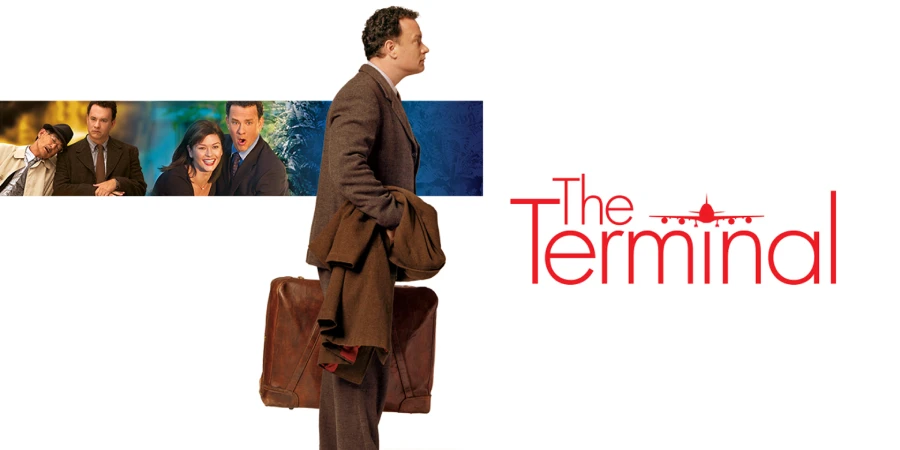

A diplomatic crisis trapping a man in an airport for nine months seems like a bureaucratic nightmare. For Viktor Navorski, however, it became a strange and beautiful home. This is the story of how a man without a country found humanity inside John F. Kennedy International Airport.
Detailed Summary
A Man Without a Country
Viktor Navorski (Tom Hanks) arrives at New York’s JFK airport from the fictional nation of Krakozhia. During his flight, a violent coup overthrows his government. Consequently, his passport and visa are now invalid.
Frank Dixon (Stanley Tucci), the Acting Field Commissioner of the airport’s Customs and Border Protection, explains the situation. Viktor cannot legally enter the United States, but he also cannot be deported to a country that no longer exists. He is, for all intents and purposes, a man without a state.
Dixon tells Viktor to stay within the international transit lounge, expecting him to become someone else’s problem. He gives Viktor meal vouchers and a pager, effectively abandoning him to this bureaucratic limbo. Viktor, with his limited English, finds an empty terminal gate, Gate 67, and makes it his new home.
Life in Gate 67
As days turn into weeks, Viktor learns to survive. He discovers how to earn quarters for food by returning luggage carts. By comparing his Krakozhian-language Fodor’s guide with the English version in a bookshop, he even teaches himself the language.
Over time, a makeshift life takes shape within the terminal’s ecosystem. His earnestness and kindness begin to charm the airport staff, allowing him to befriend cargo handler Joe (Chi McBride), food service worker Enrique (Diego Luna), and janitor Gupta (Kumar Pallana).
Finding Work and Friends
Viktor’s resourcefulness earns him respect. He impresses Enrique by gathering intel on a customs officer, Dolores, whom Enrique loves. Viktor acts as a go-between, ultimately helping them get engaged.
One day, he spots an unfinished wall in the terminal. As a former construction worker, he instinctively fixes it, which gets him hired for cash by a contractor. This newfound employment gives him purpose and a legitimate source of income.
Notably, Viktor’s defining moment of heroism comes when he helps a desperate Russian man. The man is trying to bring medicine to his sick father but lacks the correct paperwork. Viktor acts as a translator, cleverly reframing the man’s plea to fit a bureaucratic loophole, an act which enrages Dixon but makes Viktor a hero among the staff.
The Amelia Romance
Meanwhile, Viktor meets a flight attendant named Amelia Warren (Catherine Zeta-Jones). She is beautiful, complicated, and stuck in an affair with a married man. They form a connection, drawn together by their shared state of “waiting.”
Viktor builds an elaborate fountain for her as a gift. For one night, they have a romantic dinner by the terminal’s Hudson News. Amelia is touched by his sincerity, but she ultimately cannot escape her own messy life to join his.
Dixon’s Final Stand
Months later, the war in Krakozhia ends, and Viktor’s passport becomes valid again. However, Dixon, now obsessed with getting rid of Viktor, refuses to sign his one-day travel visa. He threatens to fire Viktor’s friends, starting with Enrique, if Viktor leaves the airport.
Viktor decides to return to Krakozhia to protect his friends. In a surprising twist, it is the curmudgeonly janitor Gupta who saves the day. He runs onto the tarmac with a cleaning mop, forcing all planes to be grounded and giving Viktor the window he needs.


Movie Ending
With the airport temporarily shut down by Gupta’s stunt, Viktor is free to leave. Dixon, seeing that all other officers have turned a blind eye, finally relents. He lets Viktor walk out the front doors of JFK.
Viktor takes a taxi into New York City. His entire nine-month ordeal was for one purpose: to fulfill a promise to his deceased father. He needed to get the final autograph for his father’s collection of jazz musicians, a signature from saxophonist Benny Golson.
He finds Golson at a hotel, gets the signature, and his mission is complete. Standing on a snowy New York street, Viktor looks at the autograph and then tells his taxi driver, “I’m going home.” His journey in America is over, and he can finally return to Krakozhia.
Are There Post-Credits Scenes?
No, there are no post-credits or mid-credits scenes in The Terminal. The story concludes before the credits begin to roll.
Type of Movie
The Terminal is a comedy-drama. It blends humor derived from Viktor’s fish-out-of-water situation with a sentimental and dramatic story about perseverance and human connection.
The film’s tone is overwhelmingly heartwarming and optimistic. Despite the bleak premise, Spielberg crafts a tale that emphasizes kindness, community, and the simple dignity of a promise kept.
Cast
- Tom Hanks – Viktor Navorski
- Catherine Zeta-Jones – Amelia Warren
- Stanley Tucci – Frank Dixon
- Chi McBride – Joe Mulroy
- Diego Luna – Enrique Cruz
- Kumar Pallana – Gupta Rajan
- Zoë Saldaña – Dolores Torres
- Barry Shabaka Henley – Thurman
- Michael Nouri – Max
- Benny Golson – Himself
Film Music and Composer
The score for The Terminal was composed by the legendary John Williams. Williams is a frequent collaborator with director Steven Spielberg. His music plays a crucial role in setting the film’s gentle, whimsical tone.
The main theme, “The Tale of Viktor Navorski,” features a clarinet solo that incorporates elements of jazz and Eastern European klezmer music. This sound effectively captures Viktor’s character: slightly old-world, a little lonely, but ultimately hopeful and resilient.

Filming Locations
Almost the entire film is set within a single location: JFK’s international transit lounge. However, the production did not take place in a real, functioning airport. Spielberg wanted complete control over his environment, which would be impossible in a real airport.
As a result, a massive, full-scale airport terminal set was constructed inside a hangar at the Palmdale Regional Airport in California. The set was built to code and included real retail outlets like Burger King and Borders, which lent an incredible layer of authenticity to the film.
Awards and Nominations
The Terminal was not a major contender during awards season. Its most notable accolades came from technical guilds.
For instance, the film won a BMI Film Music Award for John Williams’s score and an award for Excellence in Production Design from the Art Directors Guild.
Behind the Scenes Insights
- The Krakozhian language spoken by Viktor was invented for the film. Tom Hanks learned his lines in the fictional language, which was designed to sound like a mix of Russian and other Slavic languages.
- Director Steven Spielberg’s father, Arnold Spielberg, has a brief cameo as one of the travelers listening to the news report about the Krakozhian coup.
- Many of the stores in the terminal set, like Dean & DeLuca and Godiva Chocolatier, were real, functioning businesses that had agreed to operate within the film’s set.
- The character of Amelia Warren was written with Catherine Zeta-Jones in mind after Spielberg saw her in The Mask of Zorro.
Inspirations and References
The film’s premise is inspired by the true story of Mehran Karimi Nasseri, also known as Sir Alfred Mehran. He was an Iranian refugee who lived in the departure lounge of Terminal 1 in Paris’s Charles de Gaulle Airport from 1988 until 2006.
Nasseri’s situation arose after he was exiled from Iran and his refugee papers were stolen. Unable to prove his identity or enter any country, he remained in the airport for 18 years. He ultimately became a local celebrity and the subject of international fascination.
Alternate Endings and Deleted Scenes
There are no official alternate endings released for The Terminal. The filmmakers were committed to the bittersweet conclusion where Viktor fulfills his promise and goes home.
However, a few deleted scenes have been discussed. One notable sequence involved Viktor trying to fix a leaky roof in the terminal during a rainstorm, further showcasing his resourceful nature and construction skills.
Book Adaptations and Differences
The Terminal is not based on a book. It is an original story by Andrew Niccol and Sacha Gervasi, with a screenplay by Gervasi and Jeff Nathanson.
While inspired by the real-life ordeal of Mehran Karimi Nasseri, the film’s plot, characters, and romantic elements are entirely fictional. Nasseri’s own autobiography was published in 2004 as The Terminal Man, but it is a separate work from the film.



Memorable Scenes and Quotes
Key Scenes
- The Medicine Translation: Viktor uses his wits to help a distraught Russian traveler by creatively translating the reason for the man’s illegally imported medicine, outsmarting airport bureaucracy.
- The Fountain Date: To create a romantic dinner for Amelia, Viktor arranges for his airport friends to set up a beautiful table for two overlooking a fountain he built himself.
- Gupta on the Tarmac: Gupta, a man terrified of being sent back to India, overcomes his fear by running in front of a plane to create a diversion, allowing Viktor his chance to finally enter New York.
Iconic Quotes
- “So I wait… I wait.” – Viktor, explaining his situation to anyone who will listen.
- “I’ve been in this airport for 35 years. I’ll be here long after you’re gone.” – Gupta, to Viktor.
- “You say you are waiting for what? … I’m waiting for you.” – Amelia, flirting with Viktor.
- “This is… home.” – Viktor, describing Gate 67.
- “Keep your promises.” – Viktor, after fulfilling his father’s wish.
Easter Eggs and Hidden Details
- Tom Hanks’s Family Cameos: Early in the film, a news broadcast shows an interview with a woman about the coup in Krakozhia. That woman is played by Tom Hanks’s real-life wife, actress Rita Wilson.
- A Famous Author: When Viktor looks for English books to learn the language, he picks up a copy of The Hunger. On the film’s fictional cover, the author listed is “S. Spielberg.”
- Stanley Kubrick Reference: The design of the terminal and the wide-angle shots used by Spielberg evoke the aesthetic of Stanley Kubrick’s 2001: A Space Odyssey.
- Real Newscasters: The news reports seen on the terminal’s televisions feature real-life CNN news anchors like Aaron Brown and Soledad O’Brien.
Trivia
- Soccer star Zinedine Zidane makes a blink-and-you’ll-miss-it appearance on a TV screen in the background playing for Real Madrid.
- The jazz musician Viktor needs to find, Benny Golson, is a real-life jazz legend who plays himself in the movie.
- The name of Viktor’s homeland, Krakozhia, sounds very similar to Kraków, a major city in Poland, which is where director Steven Spielberg’s family has roots.
- Viktor’s peanut can and its contents (the jazz autographs) are a subtle tribute to Spielberg’s father, who would give him a Sucrets tin full of small items as a child.
Why Watch?
This film is a must-see for Tom Hanks’s masterful performance and its incredibly unique setting. It’s a testament to human resilience, finding community in the most unexpected places. Ultimately, it’s a warm, funny, and deeply touching story about keeping a promise.
Director’s Other Movies
- Jaws (1975)
- Raiders of the Lost Ark (1981)
- E.T. the Extra-Terrestrial (1982)
- Jurassic Park (1993)
- Schindler’s List (1993)
- Saving Private Ryan (1998)
- Minority Report (2002)
Recommended Films for Fans
- Cast Away (2000)
- Big (1988)
- Forrest Gump (1994)
- Up in the Air (2009)
- Lost in Translation (2003)
- Paddington 2 (2017)