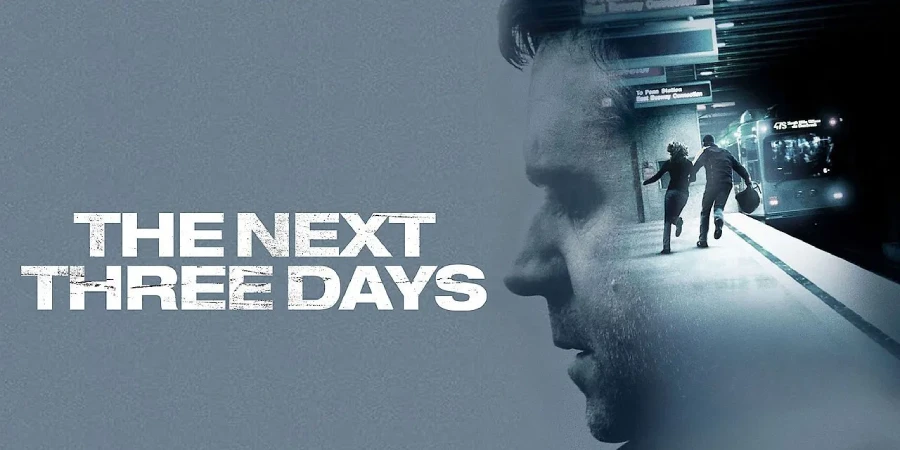

The Next Three Days is a tense, grounded thriller directed by Paul Haggis and starring Russell Crowe and Elizabeth Banks. It’s a remake of the 2008 French film Pour Elle, but with a distinctly American scale and emotional intensity.
This isn’t just a prison-break movie. It’s about how far an ordinary man will go when the system fails him.
Detailed Summary
A Normal Life Shattered
John Brennan (Russell Crowe) is a mild-mannered community college professor living a comfortable life in Pittsburgh with his wife Lara (Elizabeth Banks) and their young son. Their world collapses overnight when Lara is arrested for the murder of her boss. The evidence against her is strong: eyewitness testimony, motive, and physical evidence.
Lara insists she’s innocent. John believes her.
The film immediately establishes its emotional core: a man torn between faith in the justice system and faith in his wife.
Appeals Exhausted – Desperation Sets In
After multiple failed appeals and mounting legal bills, Lara attempts suicide in prison. This is the turning point. John realizes the legal system won’t save her.
He begins considering something unthinkable: breaking her out of prison.
Learning How to Break Someone Out of Prison
John seeks out Damon Pennington (Liam Neeson), a former prison escape artist who successfully broke out multiple times. Pennington bluntly tells him the truth: escaping is the easy part. Surviving afterward is nearly impossible.
John studies prison layouts, memorizes transit schedules, learns about forged documents, and experiments with criminal contacts. His transformation from soft-spoken academic to desperate planner is gradual and believable.
One key moment: John attempts to buy fake passports and nearly gets killed. This sequence reinforces a central theme — he is not a criminal mastermind; he’s improvising in a world he doesn’t understand.
The Escape Plan Takes Shape
John realizes the only feasible window is during Lara’s transfer between facilities. He manipulates events so she’s moved unexpectedly, forcing the timeline forward.
Everything begins to spiral. Police grow suspicious. His son’s teacher questions his behavior. Surveillance intensifies.
The tension builds relentlessly as the plan narrows into a single, high-risk window of opportunity.
The Escape
The escape itself is chaotic rather than slick. Lara initially resists — she doesn’t believe John can pull it off. But once she commits, things move fast.
Gunshots are fired. A prison doctor dies during the chaos. Police lock down the city. Traffic checkpoints are activated. Airports are monitored.
This is not a glamorous escape. It’s messy and morally complicated.



Movie Ending
After the breakout, John and Lara must reach the airport to flee to Venezuela, a country without an extradition treaty.
But everything goes wrong.
The police identify John as a suspect quickly. His car is flagged. Roadblocks close in. He’s forced to abandon parts of the plan and improvise. At one point, it appears completely hopeless — especially when their son is temporarily separated from them during the chaos.
The most nerve-wracking sequence comes when John and Lara split up to avoid capture, and it seems inevitable one of them will be caught. Surveillance footage, airport patrols, and heightened security make escape feel impossible.
Yet through sheer persistence and quick thinking, John manages to reunite with Lara and their son inside the airport. In a final moment of tension, authorities nearly intercept them — but they make it onto the plane just in time.
The film ends with them landing in Venezuela. They are safe — for now.
But here’s the emotional weight:
Lara’s innocence is never definitively proven. The case remains unresolved. A subtle late revelation suggests a piece of evidence might have cleared her if John had waited longer.
That’s the tragic irony.
Did he risk everything unnecessarily?
We don’t get a definitive answer.
The ending leaves us with uneasy relief. They escaped physically. But morally and legally? The ambiguity lingers.
Are There Post-Credits Scenes?
No. There are no mid-credits or post-credits scenes. Once the film ends, the story is complete.
Type of Movie
This is a grounded crime thriller and emotional drama. While it contains action elements, its real strength lies in psychological tension and moral conflict rather than spectacle.
Cast
- Russell Crowe as John Brennan
- Elizabeth Banks as Lara Brennan
- Liam Neeson as Damon Pennington
- Olivia Wilde as Nicole
- Brian Dennehy as George Brennan
- RZA as Mouss
Film Music and Composer
The score was composed by Danny Elfman. Unlike his more fantastical work, here he delivers a restrained, tension-driven soundtrack that supports the film’s escalating anxiety without overwhelming it.


Filming Locations and Their Importance
The movie was primarily shot in Pittsburgh, Pennsylvania. The city’s bridges, tunnels, and dense urban layout play a crucial role in the escape sequences. The geography isn’t just background — it becomes part of the suspense.
Airport scenes were filmed at Pittsburgh International Airport, adding realism to the final act. The grounded, real-world setting reinforces the film’s theme that this could happen to anyone.
Awards and Nominations
While the film did not majorly dominate award seasons, it received recognition for performances and technical aspects in smaller film circles. Russell Crowe’s performance was widely praised for its emotional restraint.
Behind the Scenes Insights
- Paul Haggis aimed to make the escape feel realistic, consulting law enforcement and legal experts.
- Russell Crowe intentionally portrayed John as physically awkward in fights to emphasize that he is not an action hero.
- The film is a remake of the French film Pour Elle, but expands character development significantly.
- Elizabeth Banks performed several emotionally intense prison scenes with minimal rehearsal to preserve authenticity.
Inspirations and References
The movie is based on the French thriller Pour Elle directed by Fred Cavayé. Unlike many Hollywood remakes, it retains the core moral dilemma and tension of the original.
It also fits into the lineage of prison-break films but shifts focus from inside the prison to the psychological toll on the one planning the escape.
Alternate Endings and Deleted Scenes
There are no widely released alternate endings. However, deleted scenes reportedly included:
- Extended legal appeal sequences
- More development of John’s interactions with the criminal underworld
- Additional father-son bonding moments
These cuts were likely made to tighten pacing and maintain suspense.
Book Adaptation and Differences
The film is not based on a novel but directly adapted from the French movie Pour Elle. Compared to the original:
- The American version expands action sequences.
- John’s planning process is more detailed.
- Emotional stakes are heightened, especially involving their son.


Memorable Scenes and Quotes
Key Scenes
- John’s tense meeting with Liam Neeson’s character, where escape logistics are coldly dissected.
- Lara’s suicide attempt — a devastating emotional pivot.
- The chaotic prison transfer ambush.
- The airport reunion sequence, which pushes tension to its peak.
Iconic Quotes
- “How can you be so sure?”
“Because I choose to be.” - “You don’t need luck. You need a plan.”
Easter Eggs and Hidden Details
- The film subtly plants a clue suggesting Lara may actually be innocent, but it’s easy to miss.
- Several background news reports hint at procedural errors in her conviction.
- John’s academic specialty in literature subtly parallels themes of tragic heroes and fate.
Trivia
- Russell Crowe gained weight for realism and avoided action-hero training.
- Paul Haggis wanted the film to feel like “a domestic tragedy disguised as a thriller.”
- The movie was shot in chronological order more than most thrillers to preserve emotional progression.
- Liam Neeson filmed his scenes in just a few days.
Why Watch?
If you enjoy smart thrillers grounded in emotional reality, this film delivers. It’s less about explosions and more about moral tension. The central question — What would you do if the system failed someone you love? — lingers long after the credits roll.
It’s intense without being flashy, dramatic without being melodramatic.
Director’s Other Works (Paul Haggis)
- Crash (2004)
- In the Valley of Elah (2007)
- Third Person (2013)
Recommended Films for Fans
- Prisoners (2013)
- Gone Baby Gone (2007)
- The Fugitive (1993)
- A Perfect World (1993)
- Law Abiding Citizen (2009)