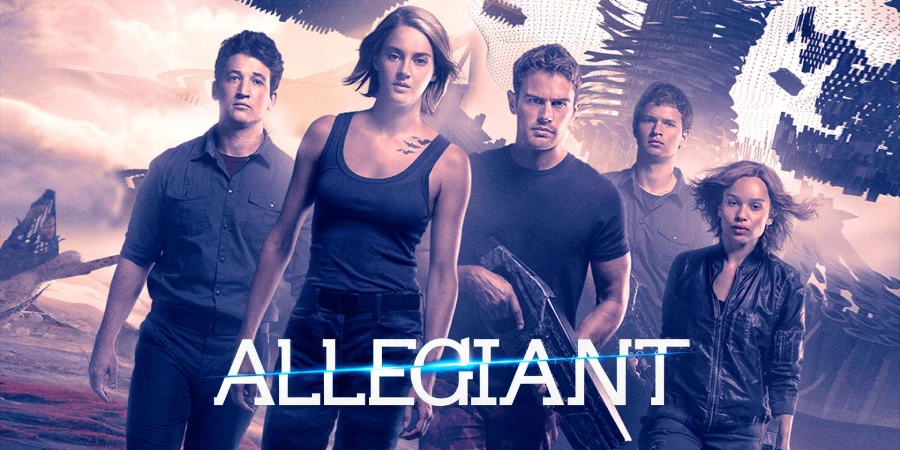

The Divergent Series: Allegiant is the third installment in the Divergent franchise and continues the dystopian story of Tris Prior and Tobias Eaton as they finally step beyond the walls of Chicago. The film shifts from confined rebellion to a broader science-fiction narrative, expanding the universe while raising big questions about identity, control, and freedom.
Detailed Summary
Life After the Fence
Following the collapse of the faction system in Insurgent, Chicago is in chaos. Evelyn Johnson (Four’s mother) now rules the city under martial law. Former Erudite members are imprisoned, and anyone connected to Jeanine is punished.
Tris and Four discover a recorded message left by Edith Prior, revealing that Chicago was an experiment, sealed off from the rest of the world. Beyond the fence lies the truth about humanity.
Against Evelyn’s orders, Tris, Four, Christina, Caleb, Peter, and Tori escape Chicago using stolen technology and cross the wall for the first time.
The World Beyond Chicago
Outside the fence, they encounter a devastated wasteland and are captured by advanced soldiers working for the Bureau of Genetic Welfare.
Here, the story takes a major turn.
The Bureau explains that humanity was genetically damaged long ago. Society was divided into:
- Genetically Pure (GP)
- Genetically Damaged (GD)
Chicago was one of several experiments designed to restore genetic purity through controlled social systems. Divergents are rare individuals whose genes healed naturally.
Tris is genetically pure.
Four is genetically damaged.
This revelation deeply affects both characters and becomes one of the film’s emotional cores.
The Bureau’s True Motives
Although the Bureau presents itself as peaceful, cracks quickly appear.
Director David and his team manipulate populations through memory serum, wiping entire cities whenever experiments fail. The Bureau now plans to reset Chicago again, erasing everyone’s memories to start over.
Tris is initially trusted and welcomed. Four is treated with suspicion.
As Tris learns more, she realizes the Bureau’s morality is no better than Jeanine’s.
Rising Conflicts
Inside the Bureau:
- Caleb works with scientists to atone for his past betrayal.
- Christina trains as a soldier.
- Peter cooperates purely for survival.
- Four grows increasingly angry at how “damaged” people are treated.
Meanwhile, Evelyn prepares for war inside Chicago, planning to attack the Bureau if necessary.
Tris uncovers the horrifying truth: the Bureau has erased entire civilizations before without remorse.
Betrayal and Revelation
David intends to release memory serum over Chicago, effectively killing everyone they were and restarting the experiment.
Tris and Four try to stop the plan, but tragedy strikes.
During a mission to secure the memory serum, Tori is shot and killed, reminding the group that survival is never guaranteed.
As tensions peak, Tris discovers the serum can only be accessed safely by someone genetically pure.
That person is her.

Movie Ending
The final act focuses on sacrifice, forgiveness, and choice.
Tris decides to enter the Bureau’s vault alone to release the antidote instead of the memory serum. If she fails, the serum will deploy and erase Chicago’s population.
Inside the vault, she records a farewell message to Four, acknowledging that bravery isn’t fearlessness, but choosing others over yourself.
David betrays her, locking her inside the chamber.
Tris releases the antidote manually, knowing it will kill her.
She succeeds.
The antidote spreads, neutralizing the memory serum before deployment. Tris dies from radiation exposure moments later.
Four arrives too late and watches her die.
After her death:
- The Bureau’s authority collapses.
- The truth about genetic discrimination is broadcast publicly.
- Evelyn ends her authoritarian rule.
- The faction system is permanently dismantled.
- Chicago opens its gates to the outside world.
In the final scene, Four scatters Tris’s ashes over the city skyline. Her recorded message plays one last time, emphasizing that humanity must be defined by choices, not genes.
The film ends quietly, focusing on healing rather than revolution.
Are There Post-Credits Scenes?
No. The Divergent Series: Allegiant does not include a post-credits or mid-credits scene. The story concludes entirely within the main runtime.
Type of Movie
The film blends dystopian science fiction with action and romance, leaning more heavily into futuristic sci-fi themes than the previous entries while maintaining its emotional character-driven focus.
Cast
- Shailene Woodley – Tris Prior
- Theo James – Tobias “Four” Eaton
- Zoë Kravitz – Christina
- Miles Teller – Peter Hayes
- Ansel Elgort – Caleb Prior
- Naomi Watts – Evelyn Johnson
- Jeff Daniels – David
- Maggie Q – Tori Wu
- Octavia Spencer – Johanna Reyes
Film Music and Composer
The score was composed by Joseph Trapanese, who previously worked on Insurgent. The music combines electronic elements with orchestral tones, reinforcing the cold, clinical nature of the Bureau while maintaining emotional weight during Tris’s final moments.


Filming Locations
The movie was primarily shot in:
- Atlanta, Georgia (USA) – served as futuristic Bureau headquarters
- Chicago, Illinois (USA) – skyline and exterior shots
- Studio-based CGI environments – used heavily for the Bureau interiors and wasteland landscapes
Atlanta’s modern architecture helped sell the sterile, advanced feel of the world beyond the fence.
Awards and Nominations
The film received limited awards recognition but was nominated for:
- Teen Choice Awards – Choice Sci-Fi Movie
- MTV Movie Awards – Best Action Performance
It was more commercially than critically driven, with reception focusing heavily on franchise fatigue.
Behind the Scenes Insights
- The original plan was to split Allegiant into two films, similar to Harry Potter and The Hunger Games.
- Poor box-office performance canceled the planned fourth movie.
- Shailene Woodley strongly opposed the franchise being concluded as a TV movie.
- Much of the Bureau’s design was inspired by Apple and Google campuses.
- Several action scenes were rewritten to reduce budget during production.
Inspirations and References
- Based on Allegiant, the third novel by Veronica Roth
- Influenced by classic dystopian literature such as Brave New World and Gattaca
- Themes echo real-world debates about genetic engineering and eugenics
Alternate Endings and Deleted Scenes
- An extended ending showed more of Four’s life after Tris’s death.
- A deleted scene included Christina confronting Evelyn directly.
- Early scripts explored Tris surviving but losing her memories, closer to the book’s emotional ambiguity.
Book Adaptations and Differences
Major differences from the novel include:
- The movie removes the dual Tris–Four narration structure.
- The Bureau is portrayed as more villainous in the film.
- Several political subplots are simplified.
- The ending remains faithful in outcome but less philosophical than the book.

Memorable Scenes and Quotes
Key Scenes
- The escape beyond the fence
- Tris discovering she is genetically pure
- Tori’s sudden death
- Tris entering the vault alone
- Four scattering Tris’s ashes over Chicago
Iconic Quotes
- “I suppose a fire that burns that bright is not meant to last.”
- “It’s not about what we have. It’s about what we choose.”
- “Human nature is the true enemy.”
Easter Eggs and Hidden Details
- Tris’s test simulation symbols appear subtly inside the Bureau’s architecture.
- The memory serum color matches earlier Dauntless fear simulations.
- Edith Prior’s name references religious and philosophical themes of sacrifice.
- Genetic codes seen on screens are modified human DNA sequences.
Trivia
- The film was shot back-to-back with Insurgent concept development.
- Jeff Daniels replaced an earlier-cast actor late in production.
- The Bureau logo appears exactly 16 times, symbolizing the original factions.
- This is the only Divergent film not directed by Neil Burger.
Why Watch?
You should watch Allegiant if you want:
- Closure to Tris Prior’s journey
- A darker, more emotional franchise entry
- Exploration of identity versus biology
- A tragic but meaningful ending rarely seen in YA adaptations
It’s imperfect, ambitious, and emotionally heavy, especially for longtime fans.
Director’s Other Works
Robert Schwentke’s notable films include:
- Flightplan (2005)
- Red (2010)
- R.I.P.D. (2013)
- The Captain (2017)