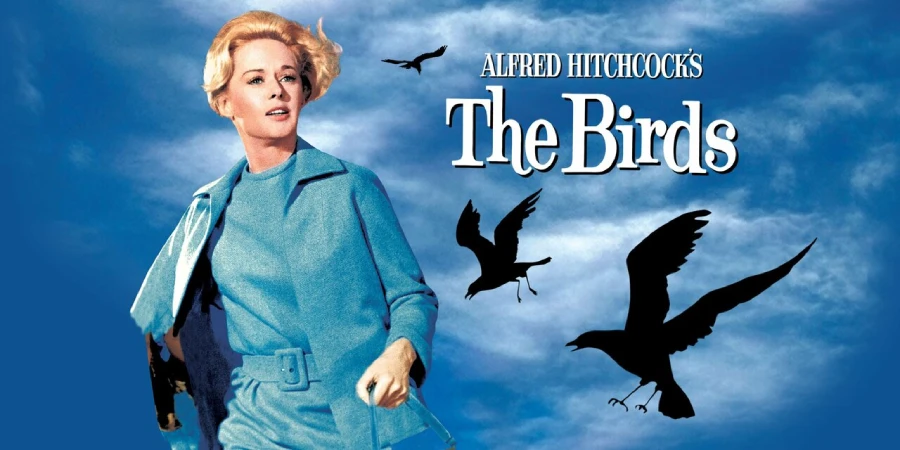
The true terror of Alfred Hitchcock’s magnum opus is not the violence, but the utter lack of reason behind it. Suddenly, nature’s most unassuming creatures become instruments of chaos. Indeed, the film masterfully suggests that humanity is merely a guest on this planet, and its lease has just been revoked without warning.
Detailed Summary
The Meet-Cute in the Pet Shop
The film opens in a bustling San Francisco pet shop. Here, the sophisticated socialite Melanie Daniels first encounters the charmingly arrogant lawyer, Mitch Brenner. Mitch, looking for lovebirds for his sister’s birthday, pretends to mistake Melanie for an employee. Consequently, a playful battle of wits ensues. Intrigued and a bit miffed, Melanie decides to turn the tables on him. She purchases the lovebirds herself and resolves to deliver them personally.
Journey to Bodega Bay
Melanie’s impulsive quest takes her up the coast to the sleepy fishing town of Bodega Bay, where Mitch spends his weekends. Upon arrival, she learns Mitch has gone out on the water. Therefore, she rents a small boat to cross the bay and secretly leave the birds inside the Brenner family home. Her plan succeeds, but not without catching Mitch’s attention. He spots her on her return journey across the water, a smirk playing on his lips.
The First Attack
As Melanie motors back across the serene bay, a single gull swoops down from the clear sky. It strikes her forcefully on the head, drawing blood. The attack is swift, shocking, and seemingly random. Mitch helps her ashore, and everyone, including Melanie, dismisses the event as a bizarre fluke. In retrospect, however, this was the first, ominous tremor before the earthquake.
Trouble at the Party
The following day, Melanie attends the birthday party for Mitch’s younger sister, Cathy. At first, all is idyllic, with children laughing and playing games. The mood abruptly shatters when a flock of gulls descends upon the party. They dive-bomb the terrified children with unnerving precision. This attack is far more organized than the first incident. Consequently, it marks the moment when unease officially curdles into genuine fear.
The Chimney Invasion
That evening, the Brenner household experiences a direct assault. A massive flock of sparrows swarms down the chimney, flooding the living room in a chaotic whirlwind of flapping wings and panicked chirps. The family desperately fights them off, ultimately containing the feathered intruders. However, the message is now terrifyingly clear. These are not isolated incidents; this is a coordinated siege. The sense of safety within their own home is irrevocably broken.
Chaos at the Schoolhouse
Worried for Cathy, Melanie goes to the local schoolhouse. Outside, she witnesses a truly chilling sight: a murder of crows silently gathering on the children’s jungle gym. One by one, they arrive until the structure is black with them. Melanie warns the teacher, Annie Hayworth, and they organize a frighteningly tense evacuation. As soon as the children begin running, the crows attack with savage ferocity. During the chaos, Annie is tragically killed while heroically shielding Cathy from the onslaught.
The Town Descends into Madness
The horror spills into the town center. A gull attack on a gas station attendant causes him to drop the fuel pump, leading to a massive, fiery explosion. Melanie, watching from a nearby phone booth, is trapped as the town erupts into flame and panic. Afterwards, she seeks refuge in The Tides restaurant, where the townsfolk descend into hysteria and blame-casting. Some accuse Melanie of bringing this curse upon them, highlighting how quickly civilization collapses under pressure.
The Final Siege
The surviving Brenners and Melanie board up their isolated home, preparing for the night. Soon, the birds launch an all-out war. They smash through windows and peck through the wooden barricades in a relentless auditory and physical assault. Later in the night, hearing a noise upstairs, Melanie foolishly investigates the attic alone. There, she is cornered and mauled by a horde of birds that had broken through the roof. Mitch barely rescues her in time, but she is left catatonic from the physical and psychological trauma.
Movie Ending
The ending of The Birds is famously ambiguous and unsettling. After the attic attack leaves Melanie in a state of shock, Mitch decides they must escape to San Francisco for medical help. In the grey, pre-dawn light, Mitch cautiously opens the door. The entire landscape is blanketed with thousands of birds, sitting silently, watching. The family slowly makes their way to the car, navigating a sea of their avian tormentors. They drive away down a road lined with countless birds, with no explanation for the attacks ever given. The film simply concludes without a traditional “THE END” title card, leaving the audience with the terrifying implication that this is not over; it is merely a lull in the storm.
Are There Post-Credits Scenes?
No, there are no post-credits scenes in The Birds. The film ends abruptly to maximize the feeling of unresolved tension.
Type of Movie
The Birds is a masterpiece of natural horror and psychological thriller. It defies easy categorization, as its primary goal is not jump scares but the slow, creeping accumulation of dread. The tone is one of mounting suspense, focusing on the psychological breakdown of individuals and a community under an inexplicable and relentless siege. Hitchcock masterfully turns a common sight into a source of profound existential terror.
Cast
- Tippi Hedren – Melanie Daniels
- Rod Taylor – Mitch Brenner
- Jessica Tandy – Lydia Brenner
- Suzanne Pleshette – Annie Hayworth
- Veronica Cartwright – Cathy Brenner
Film Music and Composer
Notably, The Birds features no traditional musical score. Alfred Hitchcock made the bold decision to forgo music entirely. Instead, he enlisted Bernard Herrmann, his frequent collaborator, as a “sound consultant.” The film’s entire chilling soundscape was created by German electronic music pioneers Oskar Sala and Remi Gassmann on an instrument called the Mixtur-Trautonium. The soundtrack consists solely of electronically manipulated bird calls and silences, which ultimately makes the auditory experience far more terrifying than any conventional score could be.

Filming Locations
The film was primarily shot on location in Bodega Bay and the nearby inland town of Bodega, California. These locations were crucial for establishing the story’s isolated, coastal setting. For instance, the panoramic shots of the bay and the sleepy town create a false sense of security that is later shattered. The remote feel of the Brenner house, perched on the edge of the bay, enhances the feeling of being trapped. Many interior scenes, as well as complex special effects shots, were filmed on soundstages at Universal Studios in Hollywood.
Awards and Nominations
While the film terrified audiences, its awards recognition was limited. It received an Academy Award nomination for Best Special Effects (awarded to Ub Iwerks). However, for her debut performance, Tippi Hedren won the Golden Globe Award for Most Promising Newcomer – Female.
Behind the Scenes Insights
- The week-long shoot for the attic attack scene was famously harrowing for Tippi Hedren. Real birds were, at times, thrown at her by handlers, and one was even tied loosely to her costume, resulting in genuine physical and emotional trauma for the actress.
- Hitchcock’s professional relationship with Hedren became notoriously obsessive and controlling throughout the production, a subject that has since been documented extensively.
- While many real birds were used, the production team also employed a number of mechanical birds for close-ups and more controllable actions, costing around $200,000.
- The iconic final shot, showing a landscape covered in birds, was a complex matte painting by Albert Whitlock, which involved combining 32 separate exposures.
Inspirations and References
The film is loosely based on Daphne du Maurier’s 1952 short story of the same name. In addition, Hitchcock was also inspired by a real-life event from August 1961. In Capitola, California, thousands of disoriented sooty shearwaters crashed into homes and littered the streets, apparently after ingesting toxic algae. Hitchcock requested news clippings of the incident to use as research material for his developing story.
Alternate Endings and Deleted Scenes
The originally scripted ending was far more ambitious and apocalyptic. After escaping Bodega Bay, the characters were supposed to see the Golden Gate Bridge in the distance, completely covered in birds. This would have confirmed the catastrophe was not confined to their small town but was a widespread, possibly global, event. Ultimately, this ending was scrapped due to budgetary constraints and technical difficulty, with Hitchcock opting for the more personal and ambiguous conclusion.
Book Adaptations and Differences
The film is an adaptation of Daphne du Maurier’s short story, but the differences are vast. The original story is set in Cornwall, England, and follows Nat Hocken, a farmhand, and his family. There is no romantic subplot, no Melanie Daniels, and no trip to Bodega Bay. Du Maurier’s tale is a much bleaker, more focused survival story. Its ending is even more pessimistic, with the family boarded up in their cottage, listening to the birds tear at the walls, their fate all but sealed.
Memorable Scenes and Quotes
Key Scenes
- The Jungle Gym: Melanie sits for a smoke outside the school, oblivious as crows slowly and silently mass on the jungle gym behind her. The gradual reveal is a masterclass in building suspense.
- The Attic Attack: The claustrophobic, brutal, and personal assault on Melanie in the attic is the film’s most visceral and frightening sequence.
- The Final Shot: The family’s car driving away through a landscape covered in tens of thousands of silent, watchful birds is one of cinema’s most iconic and chilling final images.
Iconic Quotes
- “They’re coming! They’re coming!” – A child screaming during the attack on the schoolhouse.
- “It’s the end of the world!” – A drunken patron in the Tides restaurant, voicing the town’s underlying fear.
- “I don’t know…” – Lydia Brenner’s hollow response when asked why the birds are attacking, encapsulating the film’s core mystery.
Easter Eggs and Hidden Details
- Hitchcock’s Cameo: The director makes his signature appearance early in the film, seen walking his two real-life Sealyham Terriers, Geoffrey and Stanley, out of the pet shop as Melanie enters.
- No “The End”: Hitchcock deliberately omitted the “THE END” title card from the film’s conclusion to leave the audience feeling that the horror was ongoing and unresolved.
- The Innocent Lovebirds: The two lovebirds that Melanie buys for Cathy remain in their cage and never participate in any of the attacks, serving as a constant, quiet symbol of nature controlled and tamed by humanity.
Trivia
- This was actress Tippi Hedren’s feature film debut. Hitchcock saw her in a television commercial for a diet drink called Sego and decided to cast her.
- Rod Taylor reportedly got the role of Mitch Brenner after Hitchcock saw him in the H.G. Wells adaptation The Time Machine (1960).
- The bird cries on the soundtrack were created using a Mixtur-Trautonium, an early electronic synthesizer, which allowed for unnatural and unsettling sounds.
- During the premiere in London, speakers were hidden in the trees outside the Odeon Cinema to broadcast screeching and flapping sounds at patrons as they exited.
Why Watch?
This film is a foundational text of the horror genre. Moreover, it proves that true terror lies not in monsters, but in the familiar made threatening. It’s a masterclass in building suspense through sound, silence, and the chilling absence of explanation.