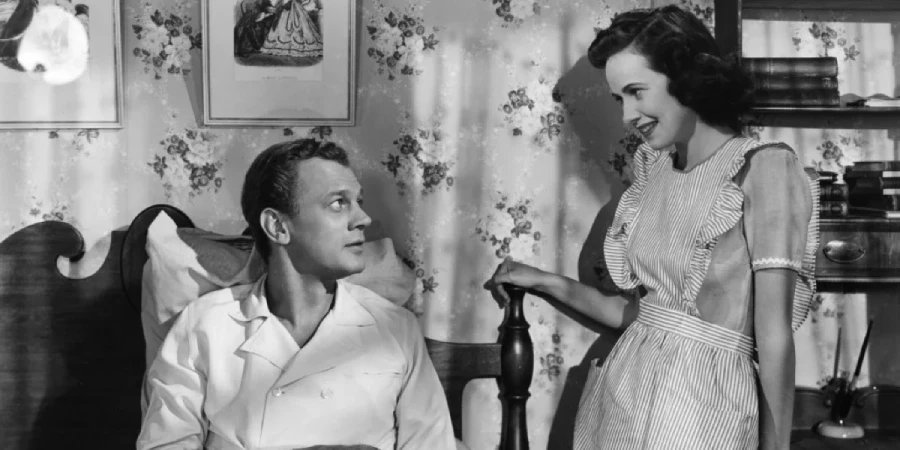

Shadow of a Doubt is often considered one of the most personal and unsettling films by master of suspense Alfred Hitchcock. Released in 1943, the film blends psychological tension with a seemingly ordinary American small-town setting. What begins as a warm family reunion slowly evolves into a chilling exploration of deception, evil, and moral awakening.
The movie stars Teresa Wright and Joseph Cotten, whose performances anchor a story that Hitchcock himself once said was his favorite among his own films.
Detailed Summary
Charlie Newton and the Quiet Town of Santa Rosa
The film opens in a boarding house room in Newark, where the mysterious Charlie Oakley (Joseph Cotten) lies on his bed surrounded by money. Two men are watching him from the street, suggesting he is being followed.
Meanwhile, in the quiet town of Santa Rosa, young Charlotte “Charlie” Newton (Teresa Wright) feels trapped in the monotony of small-town life. She longs for excitement and believes her beloved Uncle Charlie could bring something new into her dull routine.
In one of Hitchcock’s most clever narrative parallels, both Charlies simultaneously decide to contact each other. Uncle Charlie soon arrives in Santa Rosa, greeted warmly by his sister and her family.
At first, everything feels wholesome and joyful. Uncle Charlie appears charming, generous, and sophisticated — everything the small town seems to admire.
But Hitchcock slowly plants seeds of suspicion.
The “Merry Widow Murderer” Investigation
Two men posing as reporters arrive in Santa Rosa, claiming they want to photograph the average American family. In reality, they are detectives investigating a serial killer known as the “Merry Widow Murderer,” who targets wealthy widows.
Young Charlie begins to notice strange behavior from her uncle:
- He becomes angry when widows are mentioned.
- He refuses to be photographed.
- He gives her a ring that still has another woman’s initials engraved inside.
Her curiosity turns into dread as she slowly realizes something horrifying: her beloved uncle might actually be a serial killer.
Growing Suspicion and Psychological Tension
Charlie investigates further and discovers that the initials inside the ring belong to one of the murdered widows.
She begins piecing together clues:
- Uncle Charlie’s nervousness when detectives appear.
- His hatred toward wealthy widows, whom he describes as useless parasites.
- His attempts to keep Charlie from discovering the truth.
At this point the film shifts from mystery to psychological thriller. Young Charlie is now trapped in a terrifying position: she knows the truth, but exposing her uncle would destroy her family.
When she confronts him, Uncle Charlie admits the truth in chilling fashion. He reveals his cynical worldview, claiming the world is rotten and that widows he killed were worthless.
This moment becomes the emotional core of the film — the shattering of Charlie’s innocence.
Uncle Charlie Realizes She Knows
Once Uncle Charlie understands that his niece knows the truth, the relationship turns dangerous.
The tension escalates with several incidents that strongly suggest he tries to eliminate her:
- A staircase breaks while she is walking down it.
- A garage filled with toxic fumes nearly suffocates her.
Whether these are deliberate murder attempts or disguised accidents is left just ambiguous enough to heighten the suspense.
What becomes clear is that Charlie is no longer safe.
Movie Ending
Eventually the detectives confirm that Uncle Charlie is indeed the Merry Widow Murderer and plan to arrest him.
Before they can do so, Uncle Charlie decides to flee Santa Rosa. He plans to leave town by train.
However, he insists that his niece accompany him to the station for a private goodbye. The atmosphere during this sequence becomes intensely suspenseful because Charlie understands that she may be in real danger.
On the train platform, Uncle Charlie attempts to kill her by pushing her off the moving train. In a violent struggle aboard the train steps, Charlie manages to resist him. During the fight, Uncle Charlie loses his balance and falls under the train, dying instantly.
His death resolves the immediate danger, but it leaves Charlie emotionally shaken.
In the aftermath, the town never learns the truth. The family is told that Uncle Charlie died heroically while escaping police suspicion in another city. To preserve her mother’s happiness, Charlie keeps the truth secret.
The film ends with a funeral ceremony honoring Uncle Charlie as a respected man.
Young Charlie and detective Jack stand together, silently sharing the knowledge of who he really was. The ending leaves the audience with a haunting realization: evil can exist behind the most charming faces, even within family.
Are There Post-Credits Scenes?
No. Shadow of a Doubt was produced during the classical Hollywood era, and the film ends directly after its final scene without any post-credits material.
Type of Movie
Shadow of a Doubt is a psychological thriller and film noir–influenced suspense drama. Hitchcock blends small-town Americana with a dark exploration of hidden evil, creating a story that feels both intimate and disturbing.
Cast
- Teresa Wright — Charlotte “Charlie” Newton
- Joseph Cotten — Uncle Charlie Oakley
- Macdonald Carey — Detective Jack Graham
- Henry Travers — Joseph Newton
- Patricia Collinge — Emma Newton
- Hume Cronyn — Herbie Hawkins
Film Music and Composer
The film’s score was composed by Dimitri Tiomkin.
One of the film’s most important musical elements is the recurring use of the classical piece The Merry Widow Waltz, which serves as a haunting motif associated with the murders.
Hitchcock uses the melody almost like a psychological signal whenever Uncle Charlie’s dark side surfaces.
Filming Locations and Their Importance
The movie was filmed largely on location in Santa Rosa, something relatively rare for Hollywood films of that era.
Important locations include:
- The Newton family house, representing the warmth and innocence of American domestic life.
- Downtown Santa Rosa streets, reinforcing the town’s calm and friendly atmosphere.
- The train station, which becomes the setting for the climactic confrontation.
The contrast between this peaceful town and the dark secret within it is central to Hitchcock’s theme that evil can hide in ordinary places.
Awards and Nominations
While the film was highly respected, its main recognition came through writing:
- Academy Award nomination for Best Original Story (1944)
- Nominees: Gordon McDonell, Thornton Wilder, Sally Benson
Over time, the film has gained immense critical recognition and is frequently listed among Hitchcock’s greatest works.
Behind the Scenes Insights
- Alfred Hitchcock considered this his personal favorite film among those he directed.
- Pulitzer Prize–winning playwright Thornton Wilder helped write the screenplay.
- Hitchcock wanted the town to feel authentically American, which is why he insisted on shooting extensively in Santa Rosa.
- Residents of Santa Rosa appeared as extras in several scenes.
- Joseph Cotten’s performance as Uncle Charlie became one of the most chilling villains of early Hitchcock cinema.
Inspirations and References
The story was inspired by real-life serial killer Earle Leonard Nelson, known as the “Gorilla Killer,” who murdered multiple widows during the 1920s.
The screenplay also reflects Hitchcock’s fascination with the “double” motif, where two characters mirror each other — here represented by the two Charlies.
Alternate Endings and Deleted Scenes
No fully developed alternate ending has been documented.
However, early script drafts reportedly contained:
- A longer investigation sequence involving the detectives.
- Additional dialogue exploring Uncle Charlie’s past crimes.
These scenes were removed to tighten the film’s pacing and maintain suspense.
Book Adaptations and Differences
Shadow of a Doubt was not adapted from a novel. The screenplay was an original story developed for the film, though it later inspired novelizations and academic analyses of Hitchcock’s work.

Memorable Scenes and Quotes
Key Scenes
- Uncle Charlie’s arrival in Santa Rosa and the family’s joyful reunion
- The dinner conversation where he angrily criticizes wealthy widows
- Charlie discovering the ring with another woman’s initials
- The terrifying garage suffocation scene
- The climactic struggle on the moving train
Iconic Quotes
- “The world is a foul sty.” — Uncle Charlie
- “We’re not just an uncle and a niece. It’s something else.” — Uncle Charlie
- “I know you.” — Charlie Newton
Easter Eggs and Hidden Details
- Hitchcock appears in a cameo playing cards on the train.
- The two Charlies share the same name to symbolize their psychological connection.
- The Newton home address is deliberately emphasized several times to anchor the story in normality.
- The Merry Widow waltz plays subtly whenever suspicion about Uncle Charlie grows.
Trivia
- Teresa Wright became the only actor ever nominated for an Oscar for her first three films.
- Hitchcock deliberately avoided flashy camera tricks to make the story feel more realistic.
- The Newton family dynamic was inspired by Hitchcock’s observations of American households.
- The film helped establish the trope of the charming psychopath hiding in plain sight.
Why Watch?
Because it is one of Hitchcock’s most psychologically disturbing films.
Instead of spies or elaborate conspiracies, the terror here is deeply personal: the possibility that someone you love might be a monster. The film’s quiet tension, brilliant performances, and haunting moral ambiguity make it one of the most enduring thrillers of classic Hollywood.
Director’s Other Works (Alfred Hitchcock)
- Psycho (1960)
- Rear Window (1954)
- Vertigo (1958)
- North by Northwest (1959)
- Rebecca (1940)
- Notorious (1946)
- The Birds (1963)
Recommended Films for Fans
If you enjoyed Shadow of a Doubt, these films explore similar themes of psychological suspense and hidden evil:
- Rear Window (1954)
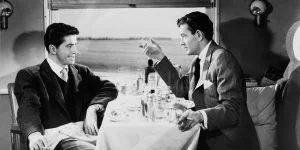
- Strangers on a Train (1951)
- Cape Fear (1962)
- Night of the Hunter (1955)
- Blue Velvet (1986)
- Prisoners (2013)