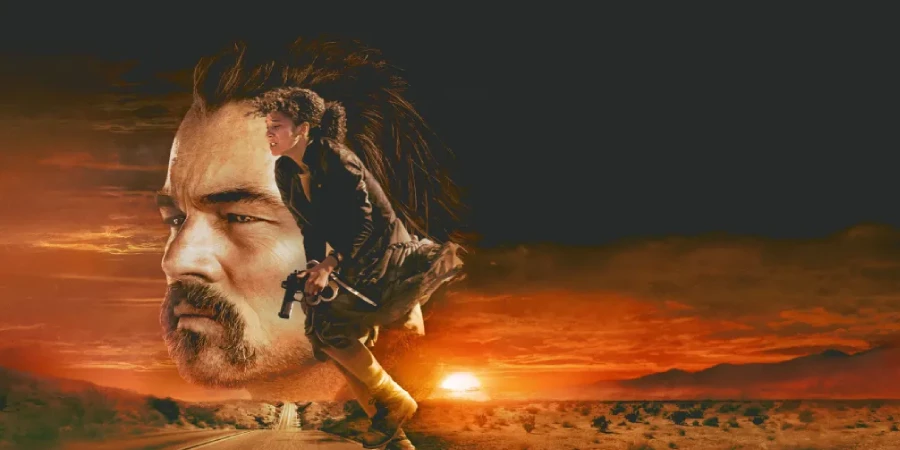
One Battle After Another is a bold, action-thriller with strong satirical and political overtones. Written and directed by Paul Thomas Anderson,it follows an ex-revolutionary forced back into his former life when his daughter goes missing and old enemies resurface.
Detailed Summary
The Revolutionary Origin & the French 75
The film opens with an audacious raid: French 75, a radical leftist revolutionary group, storms a U.S.–Mexico border immigration detention center. Led by Perfidia Beverly Hills (Teyana Taylor) and Bob “Ghetto Pat” Ferguson (Leonardo DiCaprio), they free detainees — and humiliate Col. Steven J. Lockjaw (Sean Penn) in a sexually charged power play. This mission establishes both the group’s ideology and the twisted personal dynamics between revolutionary and authority.
Fallout, Betrayal, and Disappearance
Perfidia becomes pregnant, giving birth to a daughter, Willa, but her revolutionary life collides with the personal. Lockjaw strikes a covert deal to avoid prison in exchange for intel, betraying key French 75 members. Many of the revolutionaries are forced underground, hunted by Lockjaw’s forces. Bob and Perfidia’s romantic and ideological partnership fractures; she enters witness protection, their daughter grows up away from the frontlines, and past wounds fester.
Sixteen Years Later: A Father–Daughter in Exile
Cut to 16 years after the revolution. Bob now lives off-grid in paranoia, coasting on weed and regret, raising teenage Willa (Chase Infiniti). Perfidia is absent; her whereabouts are murky. Lockjaw resurfaces, more obsessed than ever with avenging or controlling his past. His return threatens to dismantle Bob’s fragile peace.
The Rescue Mission & Escalation
When Willa disappears (or is taken), Bob is forced to resurrect his old ties. He reconnects with Sensei Sergio (Benicio del Toro), an old comrade and martial arts mentor, to navigate the radical networks. Meanwhile, other former French 75 members (like Deandra, played by Regina Hall) mobilize to help. Their journey involves covert safe houses, coded communications, and high-stakes ops, all set against an America deeply fractured by surveillance culture, ideological paranoia, and secret power structures.
Ideological Clashes & Paranoia
As they move, several factions emerge. The Christmas Adventurers, a white nationalist club with sinister power, loom as a major threat. Lockjaw’s ideology is not just retribution, but a drive to erase revolutionary narratives. The film uses these conflicts to interrogate how memory, ideology, and power intertwine — and how the cost of radicalism echoes across generations.
Movie Ending
By the film’s climax, Bob and his allies launch an assault on Lockjaw’s compound, risking everything to free Willa.
In the fray, Avanti sacrifices himself: he frees Willa but dies fighting off mercenaries.
Willa takes his car and a weapon, fleeing in a tense chase. She faces down Tim Smith, a relentless pursuer, by exploiting a hidden “counter-sign” to lure him into a fatal crash.
Back at Lockjaw’s stronghold, a DNA test confirms that Lockjaw is Willa’s father, destabilizing his position within the Christmas Adventurers.
Lockjaw meets a brutal end: after his power is threatened, he’s gassed by his own club and his body is cremated, symbolizing the collapse of his ideological and moral authority.
In the final moments, Bob gives Willa a letter from Perfidia (her mother), bearing the name “Charlene” — the name Perfidia once used for her daughter.
They walk together toward a protest in Oakland: Willa is no longer a passive beneficiary of her parents’ legacy but is empowered to make her own stand. Bob watches her leave, hopeful but wary — their future remains uncertain, but possible.
Are There Post-Credits Scenes?
No — there are no post-credits scenes in One Battle After Another. The story is resolved in its final act, and the credit roll comes without mid- or post-credits surprises.
Type of Movie
The film is an epic biographical historical drama that blends personal tragedy with sweeping political change, delivered through Bertolucci’s intimate yet grand visual storytelling.
Cast
- Leonardo DiCaprio as Bob Ferguson / Pat “Ghetto Pat” Calhoun
- Sean Penn as Col. Steven J. Lockjaw
- Teyana Taylor as Perfidia Beverly Hills
- Chase Infiniti as Willa Ferguson
- Benicio del Toro as Sensei Sergio / Sergio St. Carlos
- Regina Hall as Deandra
- Alana Haim as Mae West
Film Music and Composer
The score is by Jonny Greenwood, whose intense, atmospheric compositions underscore both the film’s political urgency and its emotional weight.


Filming Locations
- The movie was shot in California, including areas like Humboldt County (Eureka, Arcata) and Sacramento.
- Anderson used VistaVision format for principal photography, a throwback to classic film formats that gives the movie a wide, almost panoramic visual feel.
- These locations and formats contribute to the film’s “road-epic” quality — the physical spaces reflect both isolation (off-grid life) and the larger landscapes of conflict and revolution.
Awards and Nominations
- The film received a record six nominations at the 2025 Gotham Awards, including Best Feature, Best Director, Best Adapted Screenplay, Supporting Performance (Benicio del Toro, Teyana Taylor), and Breakthrough Performer (Chase Infiniti).
- (As of now) it’s not yet publicly confirmed whether it has won those — the nominations alone signal strong critical and industry recognition.
Behind the Scenes Insights
- Paul Thomas Anderson had long wanted to adapt Thomas Pynchon’s novel Vineland, and this film is his “loose” update of it.
- The production is one of Anderson’s most expensive, with a budget between $130 million and $175 million.
- Shooting in VistaVision is rare in modern cinema — Anderson chose it deliberately to evoke both vintage and epic visual scale.
- There’s a strong thematic interplay between action set-pieces and satirical politics; Anderson blends militant rebellion with dark humor and personal stakes, making the production feel like both a blockbuster and an auteur film.
Inspirations and References
- Thomas Pynchon’s novel Vineland (1990) is the primary inspiration.
- The film references Gil Scott-Heron’s poem/song “The Revolution Will Not Be Televised”, thematically connecting to the revolutionaries in the story.
- Cinematically, the film evokes political thrillers and revolutionary cinema, as well as classic road-movie and satirical films.
Alternate Endings and Deleted Scenes
There’s no widely reported alternate ending. Public sources emphasize that Anderson streamlined his adaptation: while the film is “inspired by” Vineland, he omitted many subplots and characters from the book to sharpen the central narrative.
Similarly, specific deleted scenes haven’t been extensively disclosed in press materials — most commentary focuses on what was cut out of Pynchon’s novel, rather than wholly separate cinematic scenes.
Book Adaptations and Differences
- The film is a loose adaptation of Pynchon’s Vineland rather than a faithful retelling.
- Anderson weaves in original characters and arcs, such as his own version of Bob’s paranoia and Willa’s modern upbringing, which don’t match the novel exactly.
- Some political and emotional beats are condensed or altered: the tone of the film leans more into action-satire than the novel’s dense, reflective style.

Memorable Scenes and Quotes
Key Scenes
- The initial raid on the detention center: powerful, chaotic, and ideologically charged.
- Perfidia’s motel negotiation with Lockjaw after she is caught: deeply personal and politically symbolic.
- The climactic rescue, involving a betrayal, high stakes, and a brutal showdown.
- The final reunion between Bob and Willa, closing the loop on their emotional journey.
Iconic Quotes
- While there’s no widely reported single “tagline quote” yet, many lines reflect the film’s ideological urgency. For example, Bob’s cynicism about revolution and his love for his daughter, and Lockjaw’s cold authoritarian rhetoric, are repeated motifs in reviews. (Since official scripts or quotes are not fully available publicly, most come via thematic summary.)
Easter Eggs and Hidden Details
- Use of VistaVision is itself a kind of Easter egg — a nod to classic filmmaking formats.
- The “Christmas Adventurers Club” led by Lockjaw allegorically evokes real-world extremist or reactionary movements, but with a satirical exaggeration.
- The fact that Willa’s DNA reveals Lockjaw’s parenthood is loaded with symbolic weight — bloodlines, legacy, and the personal cost of political actions.
Trivia
- This is Paul Thomas Anderson’s most expensive film to date, an auteur making a big-budget action movie.
- It’s one of the few recent films shot in VistaVision, reviving a format rarely used since the mid-20th century.
- The film opened to very strong critical reviews: on Metacritic it scored around 96, making it one of the most praised films of 2025.
Why Watch?
- If you enjoy political thrillers that don’t shy away from ideology, this is emotionally and intellectually engaging.
- For fans of Paul Thomas Anderson, it’s a bold departure — yet still unmistakably his voice.
- The combination of action, satire, and personal drama makes it a rare studio film with auteur sensibility.
- The performances (especially DiCaprio and Penn) are widely praised, and the cinematography + score elevate the film to cinematic spectacle.
Director’s Other Movies
- There Will Be Blood (2007)
- Magnolia (1999)
- Inherent Vice (2014) — also based on a Thomas Pynchon novel
- Phantom Thread (2017)