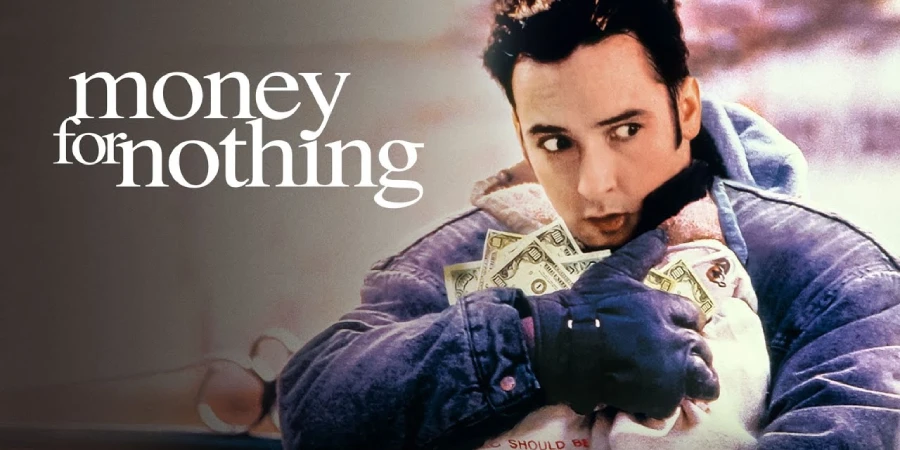

Money for Nothing (1993) is a darkly comic crime thriller that quietly asks a dangerous question: What would you do if the universe accidentally handed you a fortune… that wasn’t yours? Directed by Ramón Menéndez, the film blends irony, fate, and moral ambiguity into a grounded early-90s urban story.
Detailed Summary
A Boring Life in Queens
The film centers on Tommy Callahan, an ordinary, financially struggling guy living in Queens, New York. His life is unremarkable: a dead-end job, no major ambitions, and a general sense of being stuck. From the very beginning, the movie emphasizes how unexceptional Tommy is, which becomes crucial once luck intervenes.
The Accident That Changes Everything
One night, while walking home, Tommy witnesses a violent altercation involving a suspicious man. Moments later, the man is dead, and a large sum of cash is left behind. No witnesses. No clear owner. Just a bag full of money sitting in the street.
This moment is the film’s true inciting incident: chance over intention. Tommy doesn’t plan a crime—he stumbles into one.
Temptation, Rationalization, and Fear
Tommy takes the money, initially convincing himself it’s temporary. He plans to return it… maybe. As time passes, his anxiety grows. He begins imagining who might be looking for the cash and whether the police are already onto him.
The film excels here by showing how guilt slowly replaces excitement. Every benefit the money brings—better clothes, improved confidence, romantic possibilities—is paired with paranoia.
Enter the Mob
It becomes clear that the money belonged to organized crime, and people are actively searching for it. A mob enforcer begins closing in, escalating the tension. Tommy is now trapped between law enforcement suspicion and criminal retaliation.
The tone darkens significantly as the movie transitions from ironic comedy to genuine thriller.
Moral Crossroads
Tommy is forced to confront what the money is truly costing him: his peace of mind, his safety, and potentially his life. The story becomes less about wealth and more about the price of unearned fortune.


Movie Ending
In the final act, Tommy’s luck completely runs out. The mob finally catches up with him, and the illusion of control he’s been clinging to collapses. The money, which once felt like a miracle, is now a liability he cannot escape.
Tommy attempts to negotiate and justify his actions, insisting that he never meant harm and that he simply found the money by accident. But in the criminal world, intent doesn’t matter—possession does.
The film ends with Tommy paying the ultimate price for his moment of weakness. He does not ride off into a better life, nor does he cleverly outsmart the system. The money brings no redemption, no lasting benefit, and no escape. The final moments reinforce the film’s central message: random fortune without responsibility leads to inevitable consequences.
It’s a bleak, ironic ending that refuses to romanticize crime or luck, leaving the audience unsettled rather than satisfied.
Are There Post-Credits Scenes?
No. Money for Nothing does not include any post-credits or mid-credits scenes. The story ends definitively with the final scene.
Type of Movie
Money for Nothing is a crime thriller with dark comedy elements, leaning heavily into irony and moral tension rather than action-driven spectacle.
Cast
- John Cusack as Tommy Callahan
- Minnie Driver as Lucy
- Michael Madsen as Eddie
- Philip Baker Hall as Sal
- Benicio del Toro as Paulie
Film Music and Composer
The score was composed by Mark Isham, whose subtle, atmospheric music enhances the film’s sense of unease. The soundtrack avoids grand themes, instead reinforcing the mundane realism that makes Tommy’s situation feel frighteningly plausible.



Filming Locations
The movie was shot primarily in Queens and Manhattan, New York City.
These real, lived-in locations are crucial to the film’s impact. The familiar streets and apartments emphasize that this story could happen to anyone, grounding the crime narrative in everyday reality rather than stylized fantasy.
Awards and Nominations
Money for Nothing did not receive major awards or high-profile nominations. Over time, however, it has gained modest recognition as a cult favorite among 90s crime films, particularly for John Cusack’s restrained performance.
Behind the Scenes Insights
- The film was shot on a relatively modest budget, contributing to its realistic tone.
- John Cusack intentionally underplayed his role to avoid glamorizing crime.
- Ramón Menéndez wanted the film to feel more like a bad week gone wrong than a traditional crime epic.
- Several scenes were rewritten during production to sharpen the moral ambiguity.
Inspirations and References
The film draws inspiration from:
- Classic noir themes (chance, fate, moral compromise)
- Urban crime dramas of the late 80s and early 90s
- The idea of “found money” stories, where luck becomes a curse rather than a gift
Alternate Endings and Deleted Scenes
An alternate ending was discussed where Tommy survives but loses everything else. This version was ultimately scrapped in favor of a harsher, more cautionary conclusion, which the director felt better reflected the story’s themes. Some character-development scenes were cut to keep the pacing tight.
Book Adaptations and Differences
Money for Nothing is not based on a book or novel. It is an original screenplay.


Memorable Scenes and Quotes
Key Scenes
- Tommy discovering the bag of money on the street
- His first panic attack after realizing the money is mob-related
- The tense confrontations with Eddie
- The final reckoning where luck fully turns against him
Iconic Quotes
- “I didn’t steal it. I found it.”
- “Money doesn’t change who you are. It shows who you already were.”
Easter Eggs and Hidden Details
- Street signs in early scenes subtly foreshadow later locations.
- Eddie’s calm demeanor contrasts deliberately with traditional mob stereotypes.
- The cash bag reappears visually framed as a burden rather than a prize in later scenes.
Trivia
- Benicio del Toro was still early in his career at the time.
- The film was released shortly before Cusack’s rise in more mainstream roles.
- The title reflects the central irony: the money costs far more than it gives.
Why Watch?
If you enjoy crime stories rooted in realism, where bad decisions snowball quietly instead of exploding spectacularly, Money for Nothing is worth your time. It’s a reminder that luck is not the same thing as opportunity.
Director’s Other Works
- Stand and Deliver (1988)
- Like Water for Chocolate (1992)