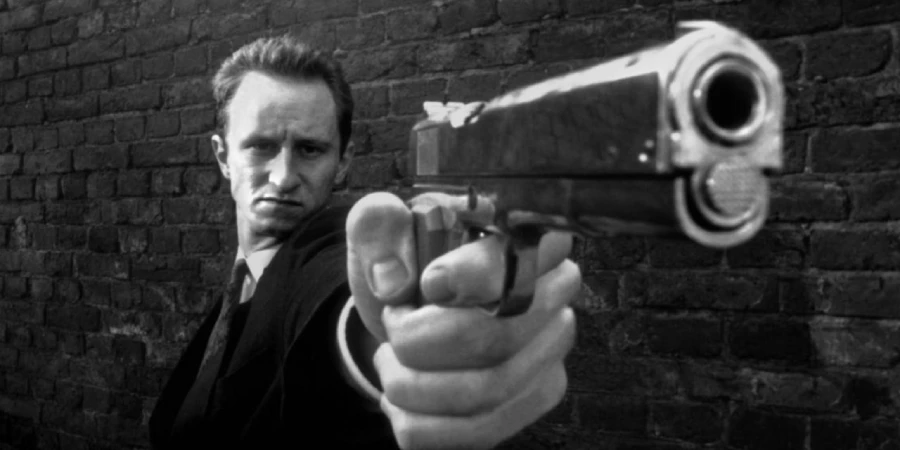
A serial killer who recites poetry, lectures on architecture, and cheerfully helps the documentary crew dispose of bodies he just created: that is the central conceit of Man Bites Dog, and it commits to that conceit with a ferocity that still feels genuinely dangerous. Rémy Belvaux, André Bonzel, and Benoît Poelvoorde shot this Belgian mockumentary on a shoestring budget and produced something that implicates the viewer far more than most horror films dare to try. Watch long enough and you realize the camera itself is the real weapon.
Table of Contents
Detailed Summary
Introducing Benoît and the Documentary Crew
A film crew led by director Rémy follows a charming, articulate man named Benoît as he goes about his daily routine. That routine involves murdering people. Benoît strangles a woman on a train in the opening minutes, and the crew films without flinching.
Benoît is not a lurking, shadowy monster. He talks constantly, cracking jokes, offering unsolicited opinions on music, architecture, and the proper weight of a body for sinking it in a river. He calculates that weight with genuine enthusiasm, and the scene plays almost like a cooking tutorial.
Expanding the Circle
As the film progresses, the crew grows closer to Benoît. He takes them to meet his parents, his grandparents, and his girlfriend. These scenes are shot with a warmth that makes the surrounding violence feel even more disorienting.
Benoît funds the documentary by robbing his victims after killing them. When the crew runs low on money, he covers production costs himself, effectively becoming the film’s financier. That financial dependency tightens the moral noose around the documentary crew’s necks.
Violence Escalates
Benoît murders a postman, a young couple, an elderly woman. Each killing is filmed in unflinching close detail. The camera never looks away, and the crew never intervenes.
A rival gang confronts Benoît at one point, and he retaliates with brutal efficiency. Two of the documentary’s own sound operators are killed during this confrontation. Rather than stepping back, the remaining crew simply continues filming.
The Gang Rape Scene
In the film’s most disturbing sequence, Benoît and the crew break into a couple’s home at night. Benoît murders the man. Then both Benoît and members of the film crew assault and rape the woman before killing her.
This scene is the pivot point where passive observation collapses entirely. Rémy and the crew have crossed from witnesses into active participants. No ambiguity remains about their culpability.
Decline and Isolation
Benoît grows increasingly paranoid and erratic. His social relationships fray. He kills more desperately and with less of his earlier performative confidence. The jaunty intellectual posturing fades, and what replaces it is uglier and sadder.
A second documentary crew appears, apparently following a rival killer. Benoît attacks and kills members of that crew. Territorial violence over the very act of being filmed is a sharp, bitter joke from the filmmakers.

Movie Ending
Benoît’s paranoia reaches a breaking point. He is increasingly reckless, and the protective mythology he has built around himself disintegrates. In the film’s final act, a group of unknown gunmen ambush him and the remaining documentary crew.
Rémy, the director, and the surviving crew members are shot dead. Benoît is killed in the same burst of violence. Nobody survives. The camera continues rolling for a moment after the bodies fall, and that final, unmanned shot is the film’s last formal statement.
What makes this ending land so hard is its refusal of dramatic closure. There is no investigation, no consequence shown, no grieving family. A camera sits next to corpses and keeps recording. Audiences expecting a reckoning for Benoît get one, but the crew earns the same fate, and the film insists that feels correct.
Are There Post-Credits Scenes?
No. Man Bites Dog has no post-credits scene of any kind. Once the film ends, it ends completely, which is entirely consistent with its stripped-down, confrontational approach to filmmaking.
Type of Movie
Man Bites Dog is a mockumentary, operating somewhere between black comedy, horror, and satirical crime film. Its tone shifts constantly, sometimes within a single scene, lurching from dry wit to genuine brutality.
Calling it a horror film undersells the comedy. Calling it a comedy undersells the horror. It is a satire of media complicity that uses shock as a rhetorical tool rather than a genre indulgence.
Cast
- Benoît Poelvoorde – Benoît
- Rémy Belvaux – Rémy (the director)
- André Bonzel – André (the cameraman)
- Jacqueline Poelvoorde-Pappaert – Benoît’s Mother
- Nelly Pappaert – Benoît’s Grandmother
- Hector Pappaert – Benoît’s Grandfather
- Jenny Drye – Jenny
- Malou Madou – Malou
- Willy Vandenbroeck – Boby
Film Music and Composer
Jean-Marc Chenut and Laurence Dufrêne contributed to the film’s sparse musical selections. Music appears infrequently and deliberately, which amplifies the documentary illusion.
When music does surface, it tends to accompany Benoît’s more domestic or tender moments, creating a jarring contrast with what immediately precedes or follows. That tonal whiplash is not accidental; it reflects the film’s central argument about the seductive packaging of violence.


Filming Locations
The film was shot almost entirely in and around Belgium, primarily in Namur and Brussels. These are not glamorous cinematic backdrops; they are ordinary apartment buildings, nondescript streets, and unremarkable countryside.
That ordinariness is the point. Benoît is not a creature of gothic castles or shadowy urban underbellies. He exists in the same mundane geography as his audience, and the familiar Belgian landscapes make that proximity genuinely unsettling.
Awards and Nominations
Man Bites Dog received a nomination for the Camera d’Or at the Cannes Film Festival in 1992, recognizing it as a notable debut feature. Its reception in critical circles was significant, though major awards largely eluded it at the time of release.
Behind the Scenes Insights
- Rémy Belvaux, André Bonzel, and Benoît Poelvoorde co-directed the film together, and all three also appear in it as fictionalized versions of themselves.
- Production began as a student film project, which explains the extremely low budget and the grainy black-and-white photography.
- Poelvoorde recruited his own family members to play Benoît’s family on screen, which is why those scenes carry an authentic warmth that professional casting might not have achieved.
- The crew shot over an extended period, returning to scenes and characters repeatedly, which allowed the relationships between the fictional documentarians and Benoît to develop organically.
- Several of the murder scenes were choreographed with minimal rehearsal to preserve the spontaneous, documentary-style energy the filmmakers wanted.
- The filmmakers deliberately kept the crew small to maintain the visual grammar of a genuine low-budget documentary.
Inspirations and References
The film draws on a long tradition of documentary filmmaking and turns that tradition against itself. Frederick Wiseman’s observational cinema is an obvious reference point, though Man Bites Dog corrupts the ethics of that form completely.
Network television news coverage and the growing tabloidization of crime reporting in the late 1980s and early 1990s clearly informed the film’s satirical targets. Belvaux and his collaborators were watching how cameras were reshaping public relationships with violence.
Zelig by Woody Allen and This Is Spinal Tap by Rob Reiner demonstrated that mockumentary could be a serious formal tool, not just a gimmick. Man Bites Dog takes that formal seriousness to a much darker destination.
Alternate Endings and Deleted Scenes
No widely documented alternate endings or significant deleted scenes for Man Bites Dog have entered the public record. Given the film’s origins as a student production with a lean shooting style, the available cut appears to represent the directors’ complete intended vision.
Book Adaptations and Differences
Man Bites Dog is not based on a book. It is an original screenplay written by Rémy Belvaux, André Bonzel, Benoît Poelvoorde, and Vincent Tavier.

Memorable Scenes and Quotes
Key Scenes
- Benoît strangling a woman on a train while the crew films from a few feet away, the scene cutting to him matter-of-factly adjusting his coat afterward.
- Benoît’s lecture on calculating the correct weight of concrete needed to sink a body, delivered with the cadence of a patient professor explaining something to slow students.
- Benoît performing a song for the crew at a piano, showcasing Poelvoorde’s genuine charisma and making you almost like him before the next murder arrives.
- The home invasion sequence, where the crew’s active participation in rape and murder removes any remaining pretense of journalistic neutrality.
- The arrival of the rival documentary crew, which Benoît treats as a professional insult more than a safety concern.
- The final ambush, shot with the same detached, handheld grammar as every preceding scene, so the deaths of the filmmakers register as almost routine.
Iconic Quotes
- “A little old lady on a pension generates about fifteen hundred francs a month. On the other hand, a postman generates about two thousand. But a postman is more dangerous.”
- “I started with animals, but it lacked the grand gesture.”
- “In autumn, you have the leaves. In spring, little birds. Winter offers nothing.”
Easter Eggs and Hidden Details
- Benoît Poelvoorde’s real family members appear as Benoît’s on-screen family, so the warmth in those scenes is not entirely performed.
- The names of the documentary crew match the real first names of the directors, collapsing the boundary between filmmaker and character in a way that mirrors the film’s broader argument.
- A brief moment where Benoît looks directly into the camera lens and pauses serves as an acknowledgment of the audience watching, a quiet breaking of the fourth wall that most viewers miss on first viewing.
- The rival film crew’s equipment appears slightly more professional than Rémy’s crew, a small visual detail suggesting the industry is always ready to replace one exploitative documentary with another.
Trivia
- The film’s French title is C’est arrivé près de chez vous, which translates roughly as “It Happened in Your Neighborhood,” a title that directly addresses the audience’s proximity to the violence.
- Benoît Poelvoorde became a significant star in Belgian and French cinema following this film’s release, going on to appear in major French productions.
- Roger Ebert wrote about the film and found it genuinely disturbing while acknowledging its satirical intelligence, a combination that captures how critics generally received it.
- The film runs at approximately 95 minutes, a compact length that prevents the concept from wearing out its welcome.
- Its black-and-white photography was a budget necessity that became a creative asset, lending the footage an authenticity that color would have undermined.
- Rémy Belvaux, one of the three directors, died in 2006 at the age of 34.
Why Watch?
Poelvoorde’s performance is the reason to show up: he plays Benoît with such unguarded, gregarious energy that you catch yourself laughing at a man who just killed a pensioner for pocket change. That cognitive dissonance, held for ninety-five minutes, is what separates this film from simple provocation. No other film from this era puts the camera’s own moral position so squarely on trial.
Director’s Other Movies
- Man Bites Dog (1992) was the sole feature film directed by the three collaborators as a team. Rémy Belvaux directed short films prior to this work but did not complete another feature before his death in 2006.
Recommended Films for Fans
- Henry: Portrait of a Serial Killer (1986)
- Funny Games (1997)
- Natural Born Killers (1994)
- Behind the Mask: The Rise of Leslie Vernon (2006)
- Chronicle (2012)
- Peeping Tom (1960)
- Network (1976)