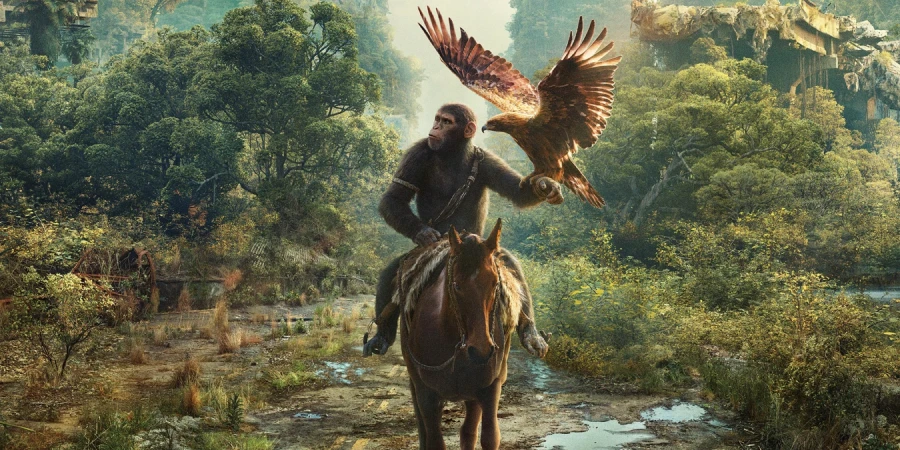

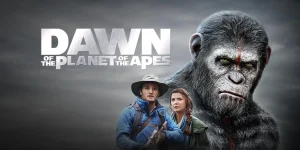
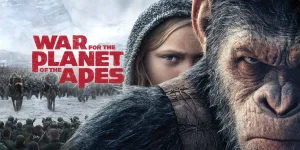
Kingdom of the Planet of the Apes (2024) marks a bold new era for one of science fiction’s most iconic franchises. Set generations after the events of War for the Planet of the Apes (2017), the film expands the mythology into a world where apes have inherited the Earth and humanity has faded into legend.
Detailed Summary
A World Long After Caesar
The story takes place hundreds of years after Caesar’s death. His legacy has become mythological, misunderstood, and in some cases deliberately manipulated.
Apes now dominate the planet, living in tribal civilizations with varying ideologies:
- Some worship Caesar as a symbol of peace
- Others twist his teachings to justify tyranny
- Humans are scattered, mute, and hunted
The world has returned to a primitive state, with remnants of human technology slowly decaying beneath forests and ruins.
Noa and the Eagle Clan
The protagonist is Noa, a young chimpanzee from the Eagle Clan. His people live peacefully atop cliffs, raising eagles and avoiding conflict.
When a neighboring ape empire attacks his village, Noa’s entire world collapses. His clan is enslaved, his family taken, and his home destroyed.
This event pushes Noa into a journey not of revenge, but of awakening.
The Rise of Proximus Caesar
The antagonist is Proximus Caesar, a powerful bonobo warlord who rules through fear. Unlike Caesar, he believes apes must dominate absolutely.
Proximus:
- Enslaves other ape clans
- Hunts remaining humans
- Seeks lost human technology
- Claims divine authority through Caesar’s name
He interprets Caesar’s teachings selectively, using them as propaganda rather than philosophy.
This creates one of the film’s strongest themes:
What happens when history becomes religion?
The Human Survivor: Mae
Noa encounters Mae, a human woman who can still speak, read, and think strategically.
She represents something new in the franchise:
- Humans are not extinct
- Some have preserved intelligence
- A secret human network may still exist
Mae’s goals are unclear. She aids Noa but hides critical information, creating tension between cooperation and mistrust.
The Lost Human Vault
Proximus is obsessed with unlocking an ancient underground human vault rumored to contain:
- Weapons
- Satellites
- Knowledge capable of restoring global dominance
The vault symbolizes humanity’s final ghost and the temptation of absolute power.
Noa begins to realize that the future of the world depends on whether that knowledge is rediscovered or buried forever.

Movie Ending
The final act takes place at the massive human bunker near the coast.
The Final Confrontation
Proximus forces enslaved apes to open the vault. Inside lies advanced technology that apes cannot fully understand but recognize as power.
During the chaos:
- Noa leads a rebellion among the enslaved apes
- Mae reveals her true mission: preventing the technology from falling into ape hands
- Proximus becomes obsessed, seeing himself as Caesar’s rightful successor
A massive battle erupts between:
- Proximus’ authoritarian followers
- Rebel apes inspired by Noa
- Human survivors attempting sabotage
Proximus’ Downfall
Proximus enters the vault and attempts to activate ancient systems. He is ultimately killed during the collapse of the structure, crushed beneath the very human world he tried to inherit.
His death is symbolic:
Power without understanding leads only to ruin.
Noa’s Choice
Noa has the opportunity to seize control of the technology.
Instead, he allows it to be destroyed.
He chooses memory over domination.
The surviving apes return to the surface, rejecting empire-building and slavery.
The Final Revelation
In the closing moments:
- Mae transmits a signal using surviving human tech
- A satellite responds
- Somewhere beyond the ruins, organized human civilization still exists
The film ends on a chilling note:
Apes rule the Earth, but humans are not gone.
The balance is fragile. War is inevitable.
Are There Post-Credits Scenes?
No. There are no mid-credits or post-credits scenes.
However, the final shot itself functions as a sequel hook, clearly setting up the next chapter in the franchise.
Type of Movie
Kingdom of the Planet of the Apes is a science fiction epic that blends dystopian adventure, post-apocalyptic survival, and philosophical drama. It focuses less on spectacle and more on ideology, power, and inherited belief systems.
Cast
- Owen Teague – Noa
- Freya Allan – Mae
- Kevin Durand – Proximus Caesar
- Peter Macon – Raka
- Eka Darville – Sylva
Most ape performances were created using advanced motion capture technology.
Film Music and Composer
The score is composed by John Paesano, who previously worked on War for the Planet of the Apes.
The music emphasizes:
- Tribal percussion
- Low, ominous brass
- Emotional silence rather than constant scoring
It reinforces the film’s somber, mythic tone rather than heroic bombast.

Filming Locations
The movie was filmed primarily in:
- Australia (Sydney and surrounding forests)
- Practical jungle environments combined with digital extensions
These locations were essential in grounding the film visually. The overgrown ruins emphasize that nature has fully reclaimed civilization.
Awards and Nominations
As of now, the film has received:
- Visual Effects Society Award nominations
- Early consideration for Best Visual Effects at major award shows
Its motion-capture realism has been widely praised.
Behind the Scenes Insights
- The film uses over 90 percent performance capture for ape characters
- Each ape tribe was given unique movement styles and posture
- Director Wes Ball insisted on real outdoor environments instead of green screens
- The script was designed as the first chapter of a new trilogy
- The actors studied chimpanzee and bonobo social behavior extensively
Inspirations and References
- Original Planet of the Apes novel by Pierre Boulle
- The Caesar trilogy (2011–2017)
- Biblical and mythological storytelling structures
- Themes inspired by Dune and Lawrence of Arabia
Alternate Endings and Deleted Scenes
Reported deleted material includes:
- A longer prologue showing the collapse of early ape civilizations
- Extended scenes of human underground communities
- A darker ending where the vault partially activates
These were removed to keep the ending morally ambiguous rather than catastrophic.
Book Adaptations and Differences
The film is not a direct adaptation of any single book.
Differences from earlier lore include:
- Caesar is long dead and mythologized
- Apes are no longer unified
- Humans are evolving differently rather than devolving entirely
This marks a thematic shift from evolution to historical distortion.


Memorable Scenes and Quotes
Key Scenes
- The destruction of the Eagle Clan village
- Noa witnessing humans speak for the first time
- The mass ape rebellion inside the vault
- The satellite activation in the final scene
Iconic Quotes
- “Caesar’s word was not law. It was hope.”
- “If we become like them, we inherit their mistakes.”
- “Power does not make us strong. Choice does.”
Easter Eggs and Hidden Details
- Caesar’s original symbol appears carved incorrectly, showing history’s distortion
- A rusted reference to the Golden Gate Bridge appears in background ruins
- Human books seen briefly include titles from earlier films
- The word “Ape Shall Not Kill Ape” appears altered in Proximus’ temple
Trivia
- The film takes place approximately 300 years after War for the Planet of the Apes
- Over 1,500 VFX shots were used
- Noa is the first main protagonist not genetically linked to Caesar
- The movie intentionally avoids naming real-world countries
Why Watch?
You should watch this film if you enjoy:
- Intelligent science fiction with moral weight
- Deep world-building rather than nonstop action
- Philosophical questions about leadership and legacy
- One of the best motion-capture performances in modern cinema
This is not just another sequel.
It is a civilization story disguised as a blockbuster.