
Ang Lee’s Hulk is not the comic book movie audiences expected; it is a brooding Greek tragedy in green spandex. Instead of high-octane action, the film offers a deep, psychological dive into generational trauma. Consequently, it became one of the most divisive superhero adaptations ever made, a fascinating and flawed cinematic experiment.
Detailed Summary
David Banner’s Forbidden Experiments
The story begins in the 1960s with scientist David Banner. He works on a government project to create super soldiers through genetic manipulation. General Thaddeus “Thunderbolt” Ross forbids human trials, but David, obsessed with improving humanity, experiments on himself.
Soon after, his wife gives birth to their son, Bruce. David notices that his own altered DNA has passed to the child. Believing Bruce is a monster, he tries to find a cure but ultimately snaps, attempting to kill his son in a fit of rage. He accidentally kills his wife instead, just as Ross’s military police arrive. The government takes David away, placing young Bruce into foster care with his memories of the event suppressed.
Bruce’s Lab Accident
Years later, an adult Bruce Krenz (his adoptive name) is a brilliant but emotionally reserved geneticist. He works at a Berkeley lab alongside his ex-girlfriend, Betty Ross, who happens to be General Ross’s daughter. Their research involves using gamma radiation and nanomeds to accelerate cellular regeneration.
A new janitor, really a disguised David Banner, has been watching Bruce’s work. During a critical experiment, a malfunction threatens to blast a colleague with a lethal dose of gamma rays. Bruce heroically throws himself in front of his coworker, absorbing the full blast. Miraculously, he survives with no apparent injuries, puzzling his doctors and Betty.
First Transformation
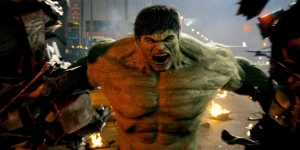
The gamma radiation, however, has activated the altered DNA David passed down to him. Later, under immense stress from his father’s reappearance and pressure from the slimy defense contractor Glenn Talbot, Bruce’s anger boils over. He transforms for the first time into the massive, green-skinned Hulk.
The Hulk trashes the lab before escaping into the night. When Bruce awakens the next morning at home, he has no memory of the event. Betty finds him, and General Ross, now aware of Bruce’s dangerous potential, arrives to place him under house arrest.
Hulk on the Run
David Banner reveals his identity to Bruce, explaining the origin of his powers. In addition, David confesses his plan to replicate the Hulk’s abilities. To test his son further, David sends three mutated “Hulk-dogs” to attack Betty at her isolated cabin.
Bruce transforms again to protect her. A brutal fight ensues, with the Hulk ultimately vanquishing the monstrous canines. This confirms Ross’s worst fears, leading him to capture the creature using tranquilizer darts. They transport the sedated Hulk to a secret desert base called Desert Rock.
Showdown in the Desert
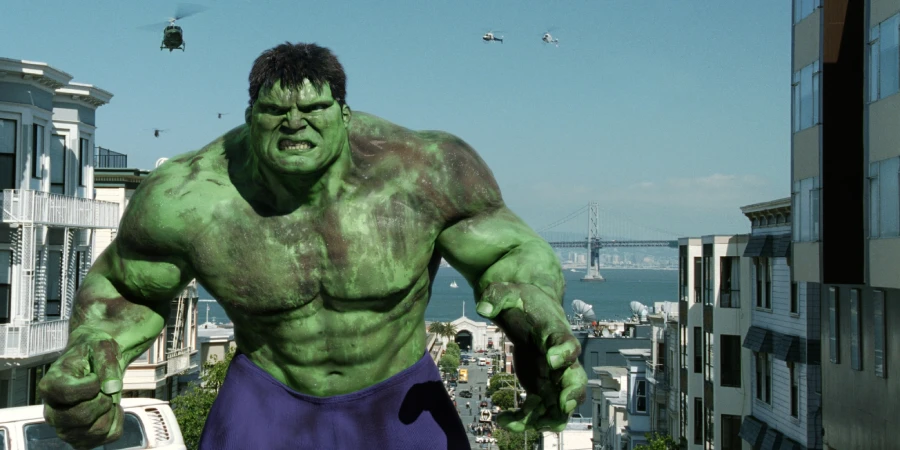
At the base, Talbot attempts to exploit the Hulk’s biology for financial gain. His aggressive methods provoke another transformation. This Hulk breaks free from his restraints and tears through the heavily armed facility. He smashes tanks, deflects missiles, and leaps across the desert landscape toward San Francisco to find Betty.
Talbot is killed in the chaos. Ross’s military forces pursue the Hulk relentlessly across the American Southwest. Nonetheless, the Hulk proves to be an unstoppable force of nature, easily defeating every plane, helicopter, and tank sent after him.
Father vs. Son
The Hulk finally reaches San Francisco, where Betty manages to calm him, causing him to revert to Bruce. The military captures him. Meanwhile, David Banner subjects himself to the same gamma experiment that created the Hulk, gaining the ability to absorb the properties of anything he touches.
David allows himself to be captured and taken to the same base as Bruce. Ross forces them into a confrontation, hoping they will destroy each other. A powerful electrical charge transforms David into a formless, absorbing entity, and he attacks Bruce. To fight back, Bruce unleashes the Hulk one last time. Hulk allows his father to absorb his limitless energy. The power is too much for David, who expands into a massive energy bubble before Ross orders a Gamma Charge bomb to be dropped on him, ending his threat for good.
Movie Ending
The finale sees Bruce Banner willingly transform into the Hulk to fight his father. David Banner, having become a being of pure energy, attempts to absorb all of the Hulk’s power, taunting him to “Take it all!” Bruce gives him what he wants, releasing an infinite well of gamma energy.
The raw power overwhelms and destroys David. The military, witnessing this, presumes Bruce/Hulk is also dead in the blast. A year later, General Ross mentions to Betty that there have been alleged sightings of the creature, but he considers the case closed.
In the final scene, we find Bruce living in a remote South American village. He provides medical aid to locals. When armed mercenaries try to steal supplies, they accost him. His eyes glow green, and he warns them in Spanish, “You’re making me angry. You wouldn’t like me when I’m angry.” A roar echoes through the jungle, confirming that the Hulk is still very much alive and perhaps more under Bruce’s control.
Are There Post-Credits Scenes?
There are no post-credits scenes in Hulk. Once the credits begin to roll, the movie is officially over.
Type of Movie
Hulk is a superhero film filtered through the lens of a psychological drama and sci-fi monster movie. Director Ang Lee sidesteps traditional action tropes, focusing instead on the internal conflict of Bruce Banner. As a result, its tone is somber, introspective, and heavily rooted in character tragedy, drawing comparisons to classic stories like Dr. Jekyll and Mr. Hyde and Frankenstein.
Cast
- Eric Bana – Bruce Banner / Hulk
- Jennifer Connelly – Betty Ross
- Sam Elliott – General Thaddeus “Thunderbolt” Ross
- Josh Lucas – Glenn Talbot
- Nick Nolte – David Banner / Father
Film Music and Composer
Danny Elfman composed the score for Hulk. His music blends traditional orchestral bombast with experimental electronic and world music elements. The main theme, “Main Titles,” establishes a brooding, percussive tone that captures the film’s psychological tension.
Interestingly, the score features contributions from several other artists. The ethnic woodwind solos, for instance, were performed by the renowned musician Jivan Gasparyan, adding a unique and mournful quality to key emotional scenes.
Filming Locations
Filming for Hulk took place across several key locations in the United States. The bleak, expansive landscapes of the Utah and Arizona deserts provided the perfect backdrop for the Hulk’s rampage against the military. These locations emphasized his isolation and raw power against nature and machinery.
In contrast, the urban scenes were primarily shot in San Francisco and the Bay Area, California. The Lawrence Berkeley National Laboratory served as the setting for Bruce’s workplace. This contrast between the sterile lab, the bustling city, and the stark desert highlights the different facets of Bruce’s life and the Hulk’s journey.
Awards and Nominations
While not a major awards contender, Hulk received several nominations from the Academy of Science Fiction, Fantasy & Horror Films. Notably, it was nominated for four Saturn Awards, including Best Science Fiction Film, Best Actress (Jennifer Connelly), Best Music (Danny Elfman), and Best Special Effects.
Behind the Scenes Insights
- Director Ang Lee approached the film as a “Greek tragedy,” focusing on the dysfunctional father-son dynamic as the story’s core.
- The film is famous for its unique editing style, which uses split screens and comic book-style panels to transition between scenes, mimicking the experience of reading a comic.
- The CGI for the Hulk was groundbreaking for its time, but many viewers criticized the creature’s bright green color and seemingly weightless, “gummy” appearance.
- Eric Bana filmed his scenes separately from the CGI Hulk. He worked extensively with Ang Lee, who would act out the Hulk’s movements himself to give Bana a reference for his reactions.
Inspirations and References
The film is primarily based on the Marvel Comics character created by Stan Lee and Jack Kirby. Its story, however, draws heavily from classic literary horror. The central themes of a man battling a monster within himself are a clear homage to Robert Louis Stevenson’s Strange Case of Dr. Jekyll and Mr. Hyde.
Furthermore, the Hulk’s status as a misunderstood creation, hunted by the military and feared by society, mirrors the plight of the creature in Mary Shelley’s Frankenstein. Ang Lee blended these classic gothic elements with the comic book origin to create a more psychologically complex narrative.
Alternate Endings and Deleted Scenes
Several scripted and filmed scenes were cut from the final version of Hulk. One notable deletion involved a more direct physical transformation for Bruce, where his skin would have been shown visibly ripping and reforming. Ang Lee felt this was too graphic and opted for a more stylized, cell-division-inspired sequence.
A few extended character moments were also trimmed for pacing, including more dialogue between Bruce and Betty discussing their past relationship. There was no drastically different alternate ending filmed; the South American conclusion was always the intended finale for this chapter of Bruce’s story.
Book Adaptations and Differences
Hulk is not based on a specific book or novel but on decades of Marvel Comics history. The film takes significant liberties with the source material. For instance, in the comics, Bruce’s father is named Brian Banner, an abusive alcoholic, but not a super-powered villain like Nick Nolte’s David Banner.
David Banner’s character in the film is actually a composite of Brian Banner and comic book villains like the Absorbing Man and Zzzax. Bruce’s origin story is also altered; the comic version involved him saving a teenager during a gamma bomb test, whereas the film’s origin is tied directly to his father’s genetic experiments.
Memorable Scenes and Quotes
Key Scenes
- Hulk vs. The Hulk-Dogs: The first major action sequence, where the Hulk defends Betty from three genetically mutated dogs, showcases his protective instincts and brutal strength.
- The Desert Battle: A thrilling set piece where the Hulk faces off against General Ross’s entire arsenal of tanks and helicopters, leaping miles at a time and catching missiles.
- The Final Confrontation: Bruce faces his father, David, who has become an energy-absorbing monster. Bruce finally embraces the Hulk’s rage to overload and destroy his creator.
Iconic Quotes
- David Banner: “We’re going to have to watch that temper of yours.”
- Bruce Banner: “You’re making me angry. You wouldn’t like me when I’m angry.”
- David Banner: “Stop fighting it, son. Take it all!”
Easter Eggs and Hidden Details
- The film features cameos from two Hulk legends: Stan Lee (co-creator of the Hulk) and Lou Ferrigno (who played the Hulk in the 1970s TV series). They appear together as security guards.
- Early in the film, Bruce’s lab experiments involve frogs that puff up when exposed to gamma rays. This foreshadows the Hulk’s own transformations.
- When Bruce is a child, his father gives him a purple dinosaur toy. Bruce smashes it—a nod to the Hulk’s iconic purple pants from the comics.
- The name on Bruce’s motorcycle helmet is “Krenzler,” a nod to Bruce’s original comic book artist, Herb Trimpe, who sometimes used the pseudonym “John Krenzler.”
Trivia
- Before Eric Bana was cast, actors like Johnny Depp and Edward Norton were considered for the role of Bruce Banner. Norton would eventually play the character in 2008’s The Incredible Hulk.
- The visual effects team at Industrial Light & Magic (ILM) spent over a year and a half developing the technology to create a fully digital, realistically muscled Hulk.
- General Ross’s daughter is named Betty in the film, as in the comics. However, the 1970s TV show avoided the name, fearing it sounded too much like “Betty Rubble” from The Flintstones.
Why Watch?
This film is a must-see for its bold, artistic take on a superhero. It dares to be a slow-burn character study, not just an action flick. Ang Lee’s unique visual style and the deeply emotional performances make it a fascinating piece of cinema.
Director’s Other Movies
- The Wedding Banquet (1993)
- Sense and Sensibility (1995)
- Crouching Tiger, Hidden Dragon (2000)
- Brokeback Mountain (2005)
- Life of Pi (2012)
Recommended Films for Fans
- The Incredible Hulk (2008)
- Frankenstein (1931)
- Unbreakable (2000)
- The Fly (1986)