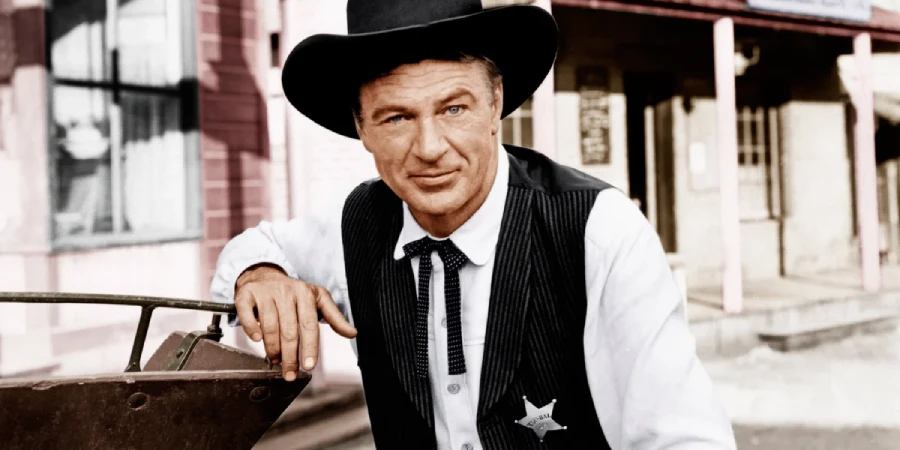

Fred Zinnemann’s High Noon isn’t just a Western; it’s a compact, real-time moral thriller about courage, duty, and the uncomfortable silence of a town that refuses to stand with its marshal.
Detailed Summary
The Imminent Threat Returns
Marshal Will Kane (Gary Cooper) has just married Amy (Grace Kelly), a Quaker pacifist, and is preparing to retire when he learns that Frank Miller—a criminal Kane once put away—is returning on the noon train. Miller’s gang is already waiting for him.
This moment sets the real-time ticking clock of the film into motion. From here, everything that happens builds toward that fateful noon arrival.
Kane Seeks Support from the Town
Kane tries to round up deputies to help him stand against Miller and his gang. Most townspeople refuse, using excuses ranging from fear to politics to personal grudges. Kane’s desperate attempts reveal the town’s moral decay and cowardice.
Amy and Helen: Two Women, Two Moral Codes
Amy wants Will to flee with her; her religious beliefs forbid violence. Meanwhile, Helen Ramirez (Katy Jurado), Kane’s former lover, understands the danger better than anyone. Helen warns Amy that running doesn’t solve anything. Helen eventually leaves town, knowing where this conflict is headed.
The Clock Strikes Noon
The tension peaks as Kane realizes he’s alone. The camera stays tight on the clock throughout, pushing the sense of dread. Noon arrives. The train whistle blows. Miller steps off.
Movie Ending
The final act is a gritty and psychologically intense showdown. Kane faces the Miller gang completely alone—no deputies, no friends, not even his new wife at first. The town watches from behind closed curtains, silent and cowardly.
Kane takes on Miller’s henchmen in the deserted streets. One of the most memorable and significant moments occurs when Amy, who had planned to leave on the departing train, hears the gunfire. In a moment of moral conviction overriding her pacifism, she returns and shoots one of Miller’s men in the back to save Will. It’s her transformation—her recognition that sometimes standing against evil requires action.
Kane and Miller confront each other. After an intense standoff, Kane kills Miller.
The townspeople finally emerge, suddenly brave now that the danger is gone. Kane looks at them with contempt.
In one final symbolic act, he throws his marshal badge in the dirt—a powerful statement about loyalty and the thankless burden of duty—before riding off with Amy. It’s not a triumphant Western ending but a harsh critique of communal cowardice.
Are There Post-Credits Scenes?
No. High Noon does not have any post-credits scenes. Once Kane leaves town, the story ends firmly and definitively.
Type of Movie
High Noon is a real-time psychological Western with strong political and moral allegory, notably reflecting themes of McCarthyism, responsibility, and integrity.
Cast
- Gary Cooper as Marshal Will Kane
- Grace Kelly as Amy Fowler Kane
- Katy Jurado as Helen Ramirez
- Thomas Mitchell as Jonas Henderson
- Lloyd Bridges as Deputy Harvey Pell
- Lee Van Cleef as Jack Colby
- Ian MacDonald as Frank Miller
Film Music and Composer
The score was composed by Dimitri Tiomkin, whose work became iconic. The song “Do Not Forsake Me, Oh My Darlin’”, sung by Tex Ritter, serves as both a theme and narrative chorus throughout the film, guiding emotional tone and reinforcing the tension.
Filming Locations
The film was primarily shot in:
- Columbia Studios, Hollywood
- Western street backlots in California
- Palmdale and Mojave Desert areas
These locations were chosen to evoke a stark, isolated frontier town. Their barren appearance enhances the film’s themes of loneliness and abandonment—especially important during Kane’s solitary walk through empty streets.
Awards and Nominations
- Won: 4 Academy Awards
- Best Actor (Gary Cooper)
- Best Film Editing
- Best Original Song
- Best Score
- Nominated: Best Picture, Best Director, Best Screenplay, and others
The film remains one of the most celebrated Westerns ever made, often appearing in “greatest films of all time” lists.
Behind the Scenes Insights
- Gary Cooper struggled with back issues during filming but insisted on doing much of the physical acting himself.
- The film’s real-time structure was unusual and risky; Zinnemann fought hard to keep the pacing intact.
- John Wayne disliked the film strongly, calling it “un-American,” believing it criticized Hollywood’s conformity during the McCarthy era.
- Cinematographer Floyd Crosby used high-contrast lighting to intensify tension and highlight isolation.
- Grace Kelly was only 21 years old and relatively inexperienced; Zinnemann intentionally directed her in a restrained manner to emphasize Amy’s emotional repression.
Inspirations and References
- Inspired by the article “The Tin Star” by John W. Cunningham.
- Often interpreted as an allegory for McCarthyism, representing those who stood alone against political persecution while others stayed silent.
- Draws influence from classical tragic hero archetypes, especially lone warriors facing impossible odds.
Alternate Endings and Deleted Scenes
Most deleted content involved minor dialogue trims and pacing adjustments. There is no known alternate ending; Zinnemann was adamant about preserving the bleak, uncompromising finale. Early drafts reportedly included more backstory for Kane and Miller, but these were removed to maintain the real-time tension.
Book Adaptations and Differences
The film was loosely adapted from The Tin Star short story:
- The story is more cynical, with a stronger focus on the town’s corruption.
- Amy is not central in the original; the film expands her role significantly.
- The real-time structure is unique to the film.
- The moral ambiguity is sharper in the story; the film chooses symbolic imagery to enhance emotional impact.


Memorable Scenes and Quotes
Key Scenes
- The slow zooms on the ticking clock as noon approaches.
- Kane walking alone through the empty streets while the soundtrack mournfully pleads “Do Not Forsake Me.”
- Amy’s return and her decisive choice to shoot one of the outlaws.
- Kane dropping his badge in the dust before leaving town.
Iconic Quotes
- “I’ve got to, that’s the whole thing.” – Kane
- “People gotta talk themselves into law and order before they do anything about it.” – Jonas Henderson
- “I’m not trying to be a hero. If you think I like this, you’re crazy.” – Kane
Easter Eggs and Hidden Details
- The clock features in at least two dozen shots to emphasize the film’s near real-time pacing.
- Miller’s gang appears silently multiple times in the background, symbolizing approaching inevitability.
- Helen’s departure by train parallels Amy’s intended escape, highlighting different paths toward survival.
Trivia
- The film unfolds in almost exactly 85 minutes of real time.
- President Eisenhower reportedly listed it among his favorite films.
- Gary Cooper won the Oscar partly because his performance resonated with Cold War anxieties about duty and integrity.
- Despite their on-screen chemistry, off-screen Cooper and Kelly maintained a formal, distant relationship.
Why Watch?
High Noon is essential viewing if you care about character-driven tension, moral courage, or films that challenge traditional heroism. Its tightly wound pacing, superb acting, and pointed social commentary make it one of the most influential Westerns ever made. Even today, its message about standing alone for what’s right feels timely and uncomfortably relevant.
Director’s Other Movies
- From Here to Eternity (1953)
- A Man for All Seasons (1966)
- The Nun’s Story (1959)
- The Day of the Jackal (1973)
Recommended Films for Fans
- Shane (1953)
- The Man Who Shot Liberty Valance (1962)
- 3:10 to Yuma (1957)
- Rio Bravo (1959)
- The Ox-Bow Incident (1943)